Enhancing Critical Thinking through Collaborative Learning: The Mediating Roles of Peer Interaction and Self-Efficacy
DOI:
https://doi.org/10.70148/rise.v3i2.3Keywords:
Critical thinking, Collaborative learning, Peer interaction, Self-efficacy, Higher education.Abstract
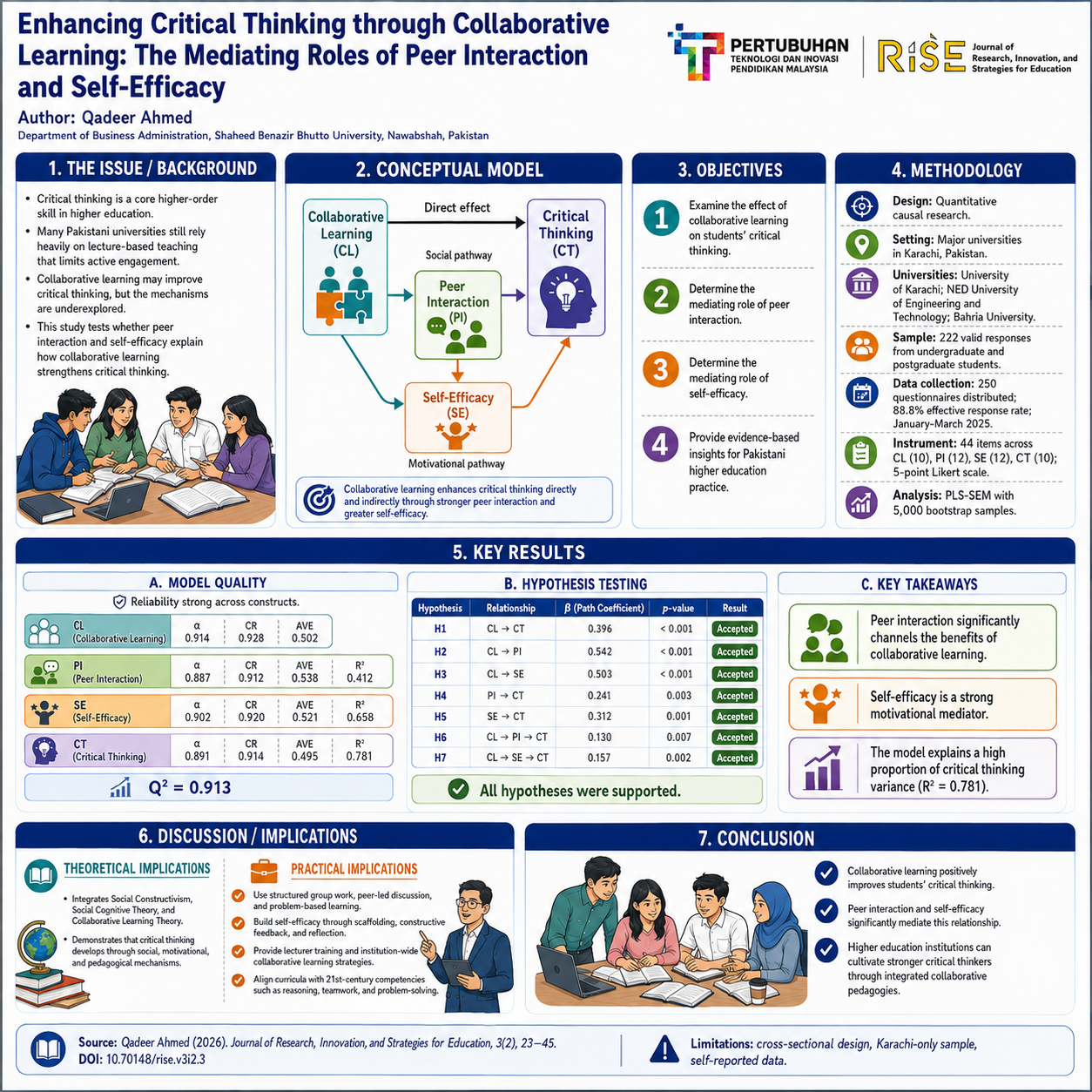
The effect of collaborative learning (CL) on critical thinking among students within a higher education institute in Karachi and Pakistan with mediating variables of peer interaction (PI) and self-efficacy (SE) is studied in this study. Critical thinking (CT) is the key to academic success yet its development usually requires interaction and the confidence in their skills of students. The causal quantitative research design was adopted and 222 surveys were given to the undergraduate and post graduate students of various universities in Karachi. The survey instruments were modified based on prior researches that are valid in order to be reliable and consistent. Structural Equation Modelling (SEM) with Partial Least Squares (PLS) was used to analyse the data. Findings demonstrate that CL positively impacts massively on the CT of students. Furthermore, PI and SE were identified to have significant mediation effect of this correlation which emphasised the need to establish supportive peer networks and instil confidence in students regarding their academic abilities. These results imply that institutions of higher learning in Karachi have the potential to improve CT through either a structured CL activity or by facilitating the creation of a culture where students actively engage. The present research is relevant to the body of research on educational psychology and pedagogical practises, as it offers practical implications to teachers who would like to foster students in developing higher-order thinking skills and self-directed learning capabilities.
References
An, X., Hong, J. C., Li, Y., & Zhou, Y. (2022). The impact of attitude toward peer interaction on middle school students' problem-solving self-efficacy during the COVID-19 pandemic. Frontiers in Psychology, 13, 978144.
Awad, A. (2025). The role of digital marketing tools in promoting tourism: An applied study on online marketing strategies. Innovative Marketing.
Al-Fahim, N. H., Ateeq, A. A., Abro, Z., Milhem, M., Alzoraiki, M., Alkadash, T. M., & Nagi, M. (2024). Factors influencing the mobile banking usage: mediating role of perceived usefulness. In Digital technology and changing roles in managerial and financial accounting: theoretical knowledge and practical application (Vol. 36, pp. 115-128). Emerald Publishing Limited.
Awad, A., & Mahmoud, M. (2024). Impact of electronic customer relationship management on competitive advantage: Mediating role of customer satisfaction in EgyptAir. Problems and Perspectives in Management, 22(3), 276.
Alkadash, T. M., Nagi, M., Ateeq, A. A., Alzoraiki, M., Alkadash, R. M., Nadam, C., ... & Dawwas, M. (2023). The effects of leadership style on employee sustainable behaviour: a theoretical perspective. In Artificial Intelligence and Transforming Digital Marketing (pp. 205-213). Cham: Springer Nature Switzerland.
Aldabousi, A. M. (2023). The legal problems facing the conclusion of cloud computing contracts. University and Society , 15 (3), 602-611.
Al-Maamari, Q. A., Alkadash, T., Al-Absy, M. S., Nagi, M., & Abdullah, M. A. (2021). THE MEDIATION IMPACT OF ORGANIZATIONAL COMMITMENT ON THE TOTAL QUALITY MANAGEMENT PRACTICES AND INDIVIDUAL READINESS FOR TQM IMPLEMENTATION WITHIN YEMENI OIL UNITS. International Journal for Quality Research, 15(2).
Awad, A. (2025). The role of universities' social responsibility in enhancing business sustainability: Mediating role of entrepreneurial culture. Problems and Perspectives in Management, 23(1), 181.
Awad, A., Aziz, A. F., & Shma, T. R. (2025). Investment behavior in the Egyptian stock market: The impact of social media on investor decision-making. Investment Management & Financial Innovations, 22(1), 203.
Awad, A., Aldabousi, A. M., & Albatal, S. (2025). The influence of social media marketing on customer knowledge management: The role of confidentiality in UAE public banks. Banks and Bank Systems, 20(1), 1.
Aldabousi, A. M. (2022). Legal problems of conclusion of intelligent software agent for smart commercial contracts in the era of Blockchain UAE as model. Universidad y Sociedad, 14(S3), 713-728.
Awad, A., Aldabousi, A. M., & Albatal, S. (2025). The influence of social media marketing on customer knowledge management: The role of confidentiality in UAE public banks. Banks and Bank Systems, 20(1), 1.
Aldabousi, AM (2023). Legal problems facing the conclusion of cloud computing contracts. Journal of University and Society , 15 (3), 602-611.
Awad, A. (2025). Augmented Reality as a Tool for Customer Engagement: Impact on Brand Perception in Retail. TEM Journal, 14(3), 2111-2123.
Aldabousi, A. M. (2022). Legal Problems of Electronic Pollution According to UAE and Egyptian Law. The Arab World Geographer, 25(2-3), 154-168.
Aldabousi, A. M., Awad, A., Hassan, H. E. M., Abdullah, S. S., & Ghonim, A. (2025). Arbitration in Islamic banking: Exploring legal and practical implications for dispute resolution. Banks and Bank Systems, 20(2), 15.
Awad, A., Al‐fil, N. Z., Dganni, K. M., Aldabousi, A. M., & Obeidat, M. A. (2024). Optimizing dormant account management in UAE banking: Legal gaps and proposed reforms. Banks and Bank Systems, 19 (4), 124.
Aldabousi, A. M. (2025). Managing commercial space activities: Legal and regulatory challenges in the UAE's space sector. Problems and Perspectives in Management, 23(2), 423.
Awad, A., Akola, O., Amer, M., & Mousa, E. K. A. (2025). Artificial intelligence in financial statement preparation: Enhancing accuracy, compliance, and corporate performance. Int. J. Innov. Res. Sci. Stud, 8, 361-374.
Al-Ramahi, N., Kreishan, F. M., Hussain, Z., Khan, A., Alghizzawi, M., & AlWadi, B. M. (2024). Unlocking sustainable growth: The role of artificial intelligence adoption in jordan retail sector, moderated by entrepreneurial orientation. International Review of Management and Marketing, 14(6), 143.
Awad, A., & Aldabousi, A. M. (2024). Analyzing the impact of viral marketing on brand equity dimensions in Egypt’s home appliances sector: A customer and legal perspective. Innovative Marketing, 20(4), 100.
Alghizzawi, M., Hussain, Z., Abualfalayeh, G., Abu-AlSondos, I. A., Alqsass, M., & Chehaimi, E. M. (2025). The impact of AI-driven strategy on salespeople training and performance. International Review of Management and Marketing, 15(2), 1.
Awad, A. (2024). Artificial intelligence and marketing innovation: The mediating role of organizational culture. Innovative Marketing, 20(3), 170.
Abdulrahim, H. M., Ateeq, A., Al-Khalifa, F. A., Al-Aghbas, N., Jo, S., Nagi, M., & Alastal, A. (2024). Qualitative investigation of green building rating system development in Bahrain’s affordable housing industry. In The AI Revolution: Driving Business Innovation and Research: Volume 1 (pp. 543-549). Cham: Springer Nature Switzerland.
Aldabousi, A. M. (2024). The Joint Responsibility of the Air Carrier Established in accordance with International Conventions on the Status of Air Terrorism. Pakistan Journal of Criminology, 16(2), 135.
Awad, A., Kordy, A., Hassan, A., & Aal, H. A. (2025). The role of blockchain technology in advancing supply chain innovation: A descriptive-analytical study.
Armutcu, B., Majeed, M. U., Hussain, Z., & Aslam, S. (2025). The impact of digital voice of customer and product lifecycle management on Quality 4.0: moderating role of AI in SMEs. Journal of Manufacturing Technology Management.
Alfiras, M., Nagi, M., Bojiah, J., & Sherwani, M. (2021). Students’ perceptions of hybrid classes in the context of Gulf University: An analytical study. Journal of Hunan University Natural Sciences, 48(5).
Awad, A., & Ghonim, A. (2025). Data-Driven Marketing in Banks: The Role of Artificial Intelligence in Enhancing Marketing Efficiency and Business Performance. International Review of Management and Marketing, 15(5), 422.
Al-Sherman, N., & Aldabousi, A. M. (2024). The Complementary Penalties Enforced to Combat Corporate Crimes in UAE Law. Pakistan Journal of Criminology, 16(3).
Almeer, S., Almaamari, Q., Ateeq, A., & Nagi, M. (2024). The impact of psychological empowerment on job creativity a study applied to employees of the ministry of works, municipalities affairs and Urban Planning in the Kingdom of Bahrain. In Business Sustainability with Artificial Intelligence (AI): Challenges and Opportunities: Volume 2 (pp. 517-529). Cham: Springer Nature Switzerland.
Awad, A., Shemais, M., & Al-Embabi, M. (2024). Driving HR performance through digital transformation in educational directorates: A strategic imperative. Problems and Perspectives in Management, 22(4), 163.
Brahmi, M., Hussain, Z., & Khan, A. (1988, May). Driving Success: Examining the Influence of Innovation Culture on Artificial Intelligence Adoption and Firm Performance in Asian SMEs. In Annual International Conference on the Theory and Applications of Cryptographic Techniques (pp. 89-105). Cham: Springer Nature Switzerland.
Bandura, A. (1997). Self-efficacy: The exercise of control . Macmillan.
El Gareh, F., Elmenssouri, A., Oulamine, A., & Hussain, Z. (2025). A PRISMA-Based Systematic Review on Organizational Commitment and Logistic Performance. Knowledge Sharing and Fostering Collaborative Business Culture, 213-240.
Fathallah, A. I., & Nagi, M. (2024). Retaining Talented Employees to Enhance Business and Management—A Case Study. In Business Sustainability with Artificial Intelligence (AI): Challenges and Opportunities: Volume 2 (pp. 601-608). Cham: Springer Nature Switzerland.
Ghonim, A., & Awad, A. (2024). Leveraging E-Marketing for enhancing customer knowledge management: A systematic review of tourism strategies in the Saudi Arabian context. Journal of Ecohumanism, 3(8), 11693-11709.
Ghonim, A., Awad, A., Shemais, M., Shma, T., & Aziz, A. (2025). Exploring the impact of flexible work arrangements on employee engagement in telecommunications: case of Egypt. Problems and Perspectives in Management, 23(2), 198.
Gupta, A. D., & Nagi, M. (2022). Globalization and Trade in the Post-Covid World. In Transitioning From Globalized to Localized and Self-Reliant Economies (pp. 28-36). IGI Global Scientific Publishing.
Ghonim, A., & Awad, A. (2025). Shaping customer insights through e-marketing: An applied study in the banking sector. Journal name not provided.
Hussain, Z. (2023). The Use of Web 3.0 in University E-learning, Quality Assurance, and Knowledge Management. In Advances in Distance Learning in Times of Pandemic (pp. 155-176). Chapman and Hall/CRC.
Hussain, Z., Khan, A., & Ali, A. (2023). The impact of user-generated content, social interactions and virtual economies on metaverse environments. Journal of Sustainable Economics, 1(2), 34-44.
Khan, A., Hamid, A. B. A., & Hussain, Z. (2024). Unveiling the Impact of AI in Customer Touchpoints: A Review and Research Agenda. Minds Unveiled, 70-83.
Kozulin, A. (1986). The concept of activity in Soviet psychology: Vygotsky, his disciples and critics. American psychologist, 41(3), 264.
Khan, A., Hamid, A. B. A., Saad, N. M., Hussain, Z., & Arif, A. R. (2023). Effectiveness of artificial intelligence in building customer loyalty: investigating the mediating role of chatbot in the tourism sector of Pakistan. International Journal of Academic Research in Business and Social Sciences, 13(9), 657-671.
Khalifa, H., Al-Absy, M., Badran, S., Alkadash, T. M., Almaamari, Q. A., & Nagi, M. (2020). COVID-19 pandemic and diffusion of fake news through social media in the Arab world. Arab Media & Society, 30(Summer/Fall 2020).
Murthy, Y. S., Bhatnagar, P., & Hussain, Z. (2025). Navigating Emotions Mapping Emotional Touchpoints to Enhance Customer Experience in the Digital Era. In Demystifying Emotion AI, Robotics AI, and Sentiment Analysis in Customer Relationship Management (pp. 129-160). IGI Global Scientific Publishing
Nazil, A. R. (2025). AI-Powered Visualization is Transforming Modern Healthcare. International Journal of Research Publication and Reviews, 6(8), 1474-1478.
Mari, I. H., & Hussain, Z. (2021). Climate Change in Pakistan: Govt Efforts to Reduce the Climat Change Threats. European journal of innovation in nonformal education, 1(1), 1.
Nazil, A. R. (2025). AI at War: The next revolution for military and defense.
Nagi, M., & Nigam, S. (2023). Impact and Analyzing Employees Performance On Modern Working Approach and Work from home. Journal of Survey in Fisheries Sciences, 10(2S), 113-120.
Nagi, M., Nigam, S., Pothu, H., & Sonika, S. (2025). Exploring Social Media Usage and Compulsive Scrolling Behaviour. In Integrating Artificial Intelligence, Security for Environmental and Business Sustainability: Volume 1 (pp. 539-550). Cham: Springer Nature Switzerland.
Nagi, M. (2024). Strategic Human Resource Management Impacting on the Sustainable Competitive Advantage: Mediating Role of Employee Involvement and Human Capital Development. In Business Sustainability with Artificial Intelligence (AI): Challenges and Opportunities: Volume 2 (pp. 249-256). Cham: Springer Nature Switzerland.
Nagi, M., Bojiah, J., & Al Firas, M. (2024). Students' Perceptions of Written Examinations and Typed Examinations-A Comparative Study in Gulf University. Journal of Engineering Education Transformations, 155-167.
Maher Alhalawany, R., & Mohamed Elhomosy, S. (2021). Peer Learning Model for Critical Thinking and Self-Efficacy in Clinical Practice Education among Nursing Students. Egyptian Journal of Health Care, 12(1), 1240-1252.
Muskan Nagi, J. B. (2022). Effect of psychological support from employers to employees during COVID-19 pandemic in Bahrain. Journal of Hunan University Natural Sciences, 49(1).
Nagi, D. M., & Mohammed Ali, Y. (2020). The effect of talent management practices on employee performance. International Journal of Management, 11(9).
Nagi, M., & Singh, S. (2025). The Future of Retail: A Technology Acceptance Model Analysis of Self-checkout. In Integrating Artificial Intelligence, Security for Environmental and Business Sustainability: Volume 1 (pp. 31-40). Cham: Springer Nature Switzerland.
Nagi, M., Nigam, S., Ateeq, A., Al-Maamari, Q., & Almeer, M. S. (2023). Analyzing relation among performance, career planning, and impact of retaining workers in industrial companies in the Kingdom of Bahrain. Bol. Lit. Oral Lit. J, 10(1), 3685-3700.
Mahmoud, M., Shma, T., Aziz, A., & Awad, A. (2025). Integrating knowledge management with smart technologies in public pharmaceutical organizations. Knowledge and Performance Management, 9(1), 31.
Nagi, M., & Bojiah, J. (2020). Real classes vs Online classes: A comparative study on the chosen course of HRM students of Gulf University, Kingdom of Bahrain. International Journal of Emerging Technologies in Learning (iJET), 15(18), 31-39.
Nagi, M., Nigam, S., Almaamari, Q., Khalifa, H., & Bojiah, J. (2021). Impact of social media on consumers brand preference for laptops. Turkish Journal of Computer and Mathematics Education, 12(11), 866-873.
Obeidat, M. A., AlFil, N. Z., Aldabousi, A. M., & DGANNI, K. M. (2024). Criminal Protection for the Merchants from the Crimes of Electronic Publishing about Invasion of Privacy in UAE Legislation. Pakistan Journal of Criminology, 16(3).
Pan, F., Zhu, G., Sui, W., & Fu, M. (2024). The effects of peer interaction on learning outcome of college students in digital environment—The chain-mediated role of attitude and self-efficacy. Studies in Educational Evaluation, 83, 101404.
Qadeer, A., & Awad, A. (2025). AI-Powered ChatGPT in Branding: Benefits, Challenges, and Future Directions. In Impacts of AI-Generated Content on Brand Reputation (pp. 1-26). IGI Global Scientific Publishing.
Qadeer, A., & Awad, A. (2025). Generative AI in Advertisements: A Conceptual Framework Based on the Technology Acceptance Model. In Impacts of AI-Generated Content on Brand Reputation (pp. 109-128). IGI Global Scientific Publishing.
Qadeer, A., Awad, A., & Ali, A. (2025). Understanding Generative AI Implementation in Digital Advertising Among Retail SMEs in Pakistan. In Impacts of AI-Generated Content on Brand Reputation (pp. 177-202). IGI Global Scientific Publishing.
Sari, S. (2025). Exploring the Impact of Peer Interaction and Self-Efficacy on Students' Engagement in Online Learning. IDEAS: Journal on English Language Teaching and Learning, Linguistics and Literature, 13(1), 1123-1140.
Saad, M., Awad, A., Aziz, A. F., & Shma, T. R. (2025). Influencer marketing’s impact on credibility and purchase intention: A study on University of Bisha students in Saudi Arabia. Innovative Marketing, 21(1), 326.
Sharma, M. K., & Nagi, M. (2018). Factors affecting prevalence of reverse mentoring in India. International Journal of Business Marketing and Management, 3(8), 2456-4559.
Saeed Almanbahi, F., Awad, A., Ghonim, A., Mohammed Alabsy, N., & Shemais, M. (2025). Ethical leadership and organizational excellence: the mediating role of citizenship behavior in healthcare. Humanities and Social Sciences Communications, 12(1), 1-14.
Wahid, A., & Awad, A. (2025). Role of AI Chatbots in Enhancing Customer Satisfaction and Customer Loyalty. In Impacts of AI-Generated Content on Brand Reputation (pp. 129-148). IGI Global Scientific Publishing.
Wang, C. H., & Shan, S. (2018). The effects of self-efficacy on learners’ perceptions of cognitive presence in online collaborative learning activities. PEOPLE: International Journal of Social Sciences, 3(3), 1144-1172.
Yahia Shams Eldin, A., Elnour, A., Omer Ahmed Hassan, R., & Awad, A. (2025). The role of technological and environmental factors in creating business value from social media dynamic capabilities for SMEs in Saudi Arabia. Humanities and Social Sciences Communications, 12(1), 1-11.
Yusuf, A., Ayus, A. K. M., Shiddieqy, D. F., & Awad, A. (2025). The Role of Sukuk Financing in Economic Growth and Poverty Reduction: Empirical Evidence from Selected ASEAN Countries. Public and Municipal Finance, 14, 42-50.
Yadav, A., Mayfield, C., Moudgalya, S. K., Kussmaul, C., & Hu, H. H. (2021, March). Collaborative learning, self-efficacy, and student performance in cs1 pogil. In Proceedings of the 52nd ACM Technical Symposium on Computer Science Education (pp. 775-781).
Downloads
Published
Issue
Section
License
Copyright (c) 2025 Abdul Qadeer (Author)

This work is licensed under a Creative Commons Attribution 4.0 International License.