Residents’ Perceptions of the Woodcraft Knowledge Transfer Program for the Development of a Reading Station at the People’s Housing Project (PPR) Kempas Permai, Johor
DOI:
https://doi.org/10.70148/rise.v3i2.2Keywords:
TVET, knowledge transfer, woodcraft, community development, literacy, experiential learningAbstract
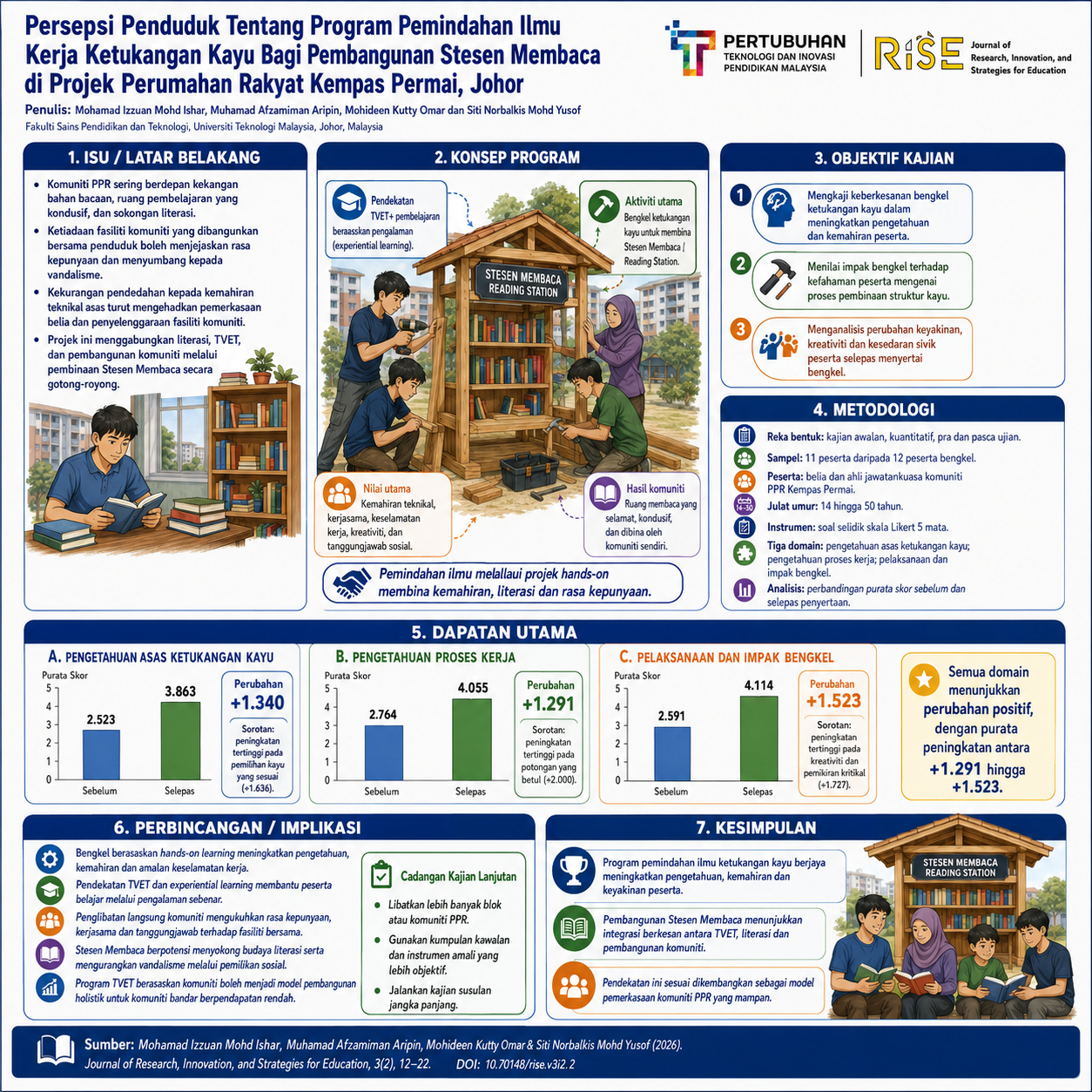
This study evaluates the effectiveness of a community-based woodcraft knowledge transfer program grounded in the Technical and Vocational Education and Training (TVET) approach to empower low-income urban communities at PPR Kempas Permai, Johor Bahru. The main objective was to assess participants’ improvements in knowledge, skills, and attitudes towards woodcraft and social responsibility through the collaborative construction of a Reading Station. A quantitative pre-test and post-test design was employed involving 11 participants comprising youth and community committee members. Data were collected using a five-point Likert scale questionnaire encompassing three key domains: basic woodcraft knowledge, understanding of work processes, and the overall impact of the workshop. Findings revealed significant improvements across all domains, with mean score increases ranging from +1.291 to +1.523, particularly in creativity, confidence, and awareness of safety practices. The results demonstrate that experiential learning aligned with TVET principles effectively enhanced participants’ technical competencies, social values, and sense of community ownership. Overall, the study underscores the potential of community-based TVET initiatives as a holistic development model that integrates skill empowerment, literacy enhancement, and social responsibility among low-income urban populations.
References
Akhbar, N., Jamal, R., & Hassan, M. (2021). Community ownership and vandalism prevention in urban low-cost housing projects. Journal of Social Development, 12(3), 55–70.
Ahmad, R., & Lee, Y. S. (2023). Community-based literacy hubs: Lessons from Southeast Asia. International Journal of Education and Development, 8(2), 45–60.
Che Hassan, N., Mohd Noor, M. S., & Fadzil, A. (2020). Socioeconomic barriers to reading habits among low-income families in Malaysia. Malaysian Journal of Literacy Studies, 5(1), 22–34.
Hassan, N., & Othman, S. (2022). Integrating TVET and community development: A Malaysian perspective. Journal of Technical Education, 10(2), 11–26.
Ismail, H., & Ramli, N. (2019). Knowledge transfer through technical skills in community empowerment programs. Journal of Vocational Studies, 7(1), 14–25.
Kolb, D. A. (1984). Experiential learning: Experience as the source of learning and development. Prentice Hall.
Lim, S. Y., & Ahmad, Z. (2024). Designing inclusive reading spaces for low-income urban communities. Asian Journal of Built Environment, 9(1), 77–93.
MYReaders. (2022). Annual Impact Report 2022. Kuala Lumpur: MYReaders Malaysia.
Nor Azizah, M., Rahim, A., & Tan, C. (2021). Reading patterns among children in People’s Housing Project areas. Journal of Educational Research Malaysia, 9(4), 12–27.
Noraini, M., & Zakaria, N. (2022). Learning by doing: Vocational pedagogy and motivation among youth learners. Asian TVET Review, 3(1), 40–53.
OECD. (2023). Building future-ready TVET systems: Trends and policies. OECD Publishing.
Perpustakaan Negara Malaysia (PNM). (2022). Profil tabiat membaca rakyat Malaysia 2022. Putrajaya: PNM.
UNESCO. (2022). Global report on learning poverty and literacy recovery post-pandemic. UNESCO Publishing.
World Bank. (2021). Learning poverty in the aftermath of COVID-19. Washington DC: World Bank.
Yusoff, A., & Karim, H. (2023). Community participation and facility maintenance in low-cost housing areas. Journal of Urban Development Studies, 11(1), 65–81.
Downloads
Published
Issue
Section
License
Copyright (c) 2025 Mohamad Izzuan Mohd Ishar, Muhamad Afzamiman Aripin, Mohideen Kutty Omar, Siti Norbalkis Mohd Yusof (Author)

This work is licensed under a Creative Commons Attribution 4.0 International License.