Analysis of Multicultural Values in Primary ELT Textbook of Bangladesh
DOI:
https://doi.org/10.70148/rise.v3i3.2Keywords:
Primary Education, Multicultural Education, ELT, Content analysisAbstract
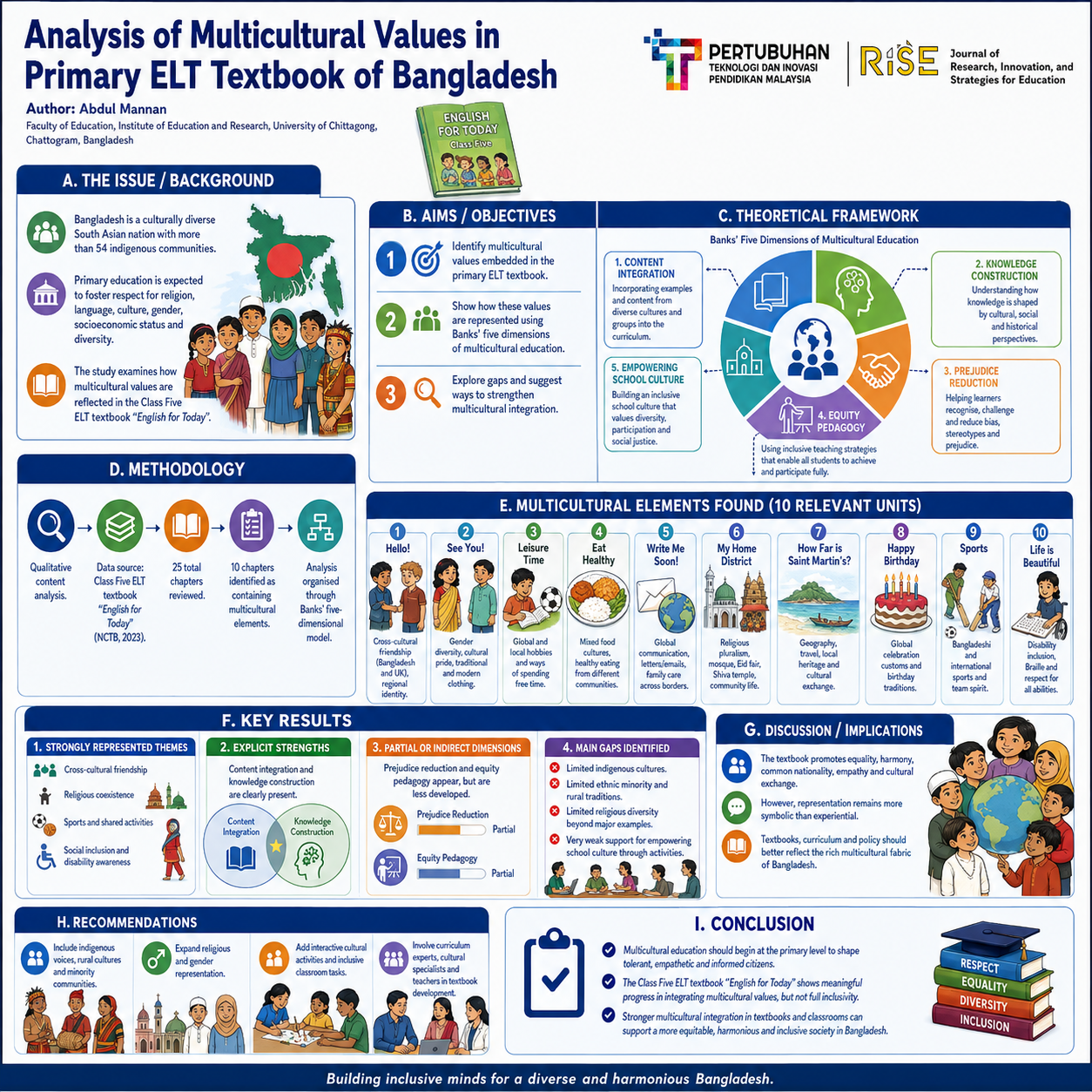
Bangladesh is a South Asian nation holding more than 54 indigenous communities. The significance of multicultural education has become evident in its education system. The study aims to analyze the reflection of multicultural values in the primary class five English language teaching (ELT) textbook of Bangladesh. The textbook named ‘English for Today’ has been analyzed as a document using the content analysis approach guided by Banks' (2000) five-dimensional model of multicultural education. This study explored and analyzed ten chapters of the ELT textbook that contained elements of multicultural education. The results revealed that the chapters emphasize cross-cultural friendship, multiple religions, sports, and social inclusion through the use of written text and pictures on various topics. The textbook has successfully integrated elements of equality, harmony, and common nationality. Still, it lacks proper representation of indigenous cultures, religious diversity, ethnic minorities, rural cultures and traditions. Furthermore, this study also finds that content integration and knowledge construction are explicitly articulated. However, the equity pedagogy and prejudice reduction are indirectly developed, and the textbook lacks guidance on empowering school culture through various cultural activities. This study offers implications for policymakers, curriculum developers, and textbook writers to develop policies, curricula, and textbooks with a multicultural fabric, as well as for English subject teachers to incorporate cultural variation through practice activities, revealing the scope for incorporating cultural variation to better align with multicultural education.
References
Aboud, F. E. (2009). Modifying children's racial attitudes. In The Routledge international companion to multicultural education (pp. 199-209). Routledge.
Aslan, A., & Shiong, P. K. (2023). Learning in the digital age full of hedonistic cultural values among elementary school students. Bulletin of Pedagogical Research, 3(2), 94-102. https://doi.org/10.51278/bpr.v3i2.515
Azam, M. G. (2023). Cultural Diversity and Social Change In Bangladesh: The Emerging Demand of Social Work Practice.
Banks, J. A. (2000). Multicultural education: Issues and perspectives. Wiley.
Banks, J. A., & Banks, C. A. M. (Eds.). (2016). Multicultural education: Issues and perspectives (9th ed.). John Wiley & Sons.
Bravo, M. C. M., Chalezquer, C. S., & Serrano-Puche, J. (2021). Meta-framework of digital literacy: A comparative analysis of 21st-century skills frameworks. Revista Latina de Comunicacion Social, (79), 76-109. https://doi.org/10.4185/RLCS-2021-1508
Brown, J. C., & Livstrom, I. C. (2020). Secondary science teachers’ pedagogical design capacities for multicultural curriculum design. Journal of Science Teacher Education, 31(8), 821-840. https://doi.org/10.1080/1046560X.2020.1756588
Chakma, E. (2024). Challenges of indigenous children’s primary education in the Chittagong Hill Tracts of Bangladesh: Insights from individuals working in education. International Journal of Educational Management and Development Studies, 5(1), 148-171. doi: https://doi.org/10.53378/353050
El Zoghbi, M. B. (2008). Inclusive Pedagogies: the development and delivery of Australian Indigenous curricula in higher education. Learning and Teaching in Higher Education, (3), 33-48. URI: http://eprints.glos.ac.uk/id/eprint/3849
Elo, S., & Kyngäs, H. (2008). The qualitative content analysis process. Journal of Advanced Nursing, 62(1), 107-115.
Fatmawati, L., Dewi, K. P., & Wuryandani, W. (2023). Multicultural competence of elementary teacher education students. International Journal of Elementary Education, 7(4), 721-730. https://doi.org/10.23887/ijee.v7i4.62880
Gay, G. (2010). Culturally responsive teaching: Theory, research, and practice (2nd ed.). Teachers College Press.
Gharbavi, A., & Mousavi, S. A. (2012). A content analysis of textbooks: Investigating gender bias as a social prominence in Iranian high school English textbooks. English Linguistics Research, 1(1), 42-49.
Hayah, U. K. (2023, July). Multiculturalism Values: Content Analysis of History Textbook. In UNCLLE (Undergraduate Conference on Language, Literature, and Culture) (Vol. 3, No. 1, pp. 220-228).
Islam, K. M. M., & Asadullah, M. N. (2018). Gender stereotypes and education: A comparative content analysis of Malaysian, Indonesian, Pakistani and Bangladeshi school textbooks. PloS one, 13(1), e0190807. https://doi. org/10.1371/journal.pone.0190807
Islam, M. T., Hussain, M., & Orthy, S. K. (2020). Cultural diversity and peaceful coexistence: A reflection on some selective school textbooks. Social Science Review [The Dhaka University Studies, Part-D], 37(2), 59–86. doi:10.3329/ssr.v37i2.56506
Krippendorff, K. (2018). Content analysis: An introduction to its methodology. Sage.
Levy, S. R., & Killen, M. (Eds.). (2008). Intergroup attitudes and relations in childhood through adulthood. Oxford University Press.
Liu, X. (2022). Comparing multicultural education in China and Finland: From policy to practice. Asian Ethnicity, 23(1), 165– 185. https://doi.org/10.1080/14631369.2020.1760078
Maulidiah, R. H., Nisa, K., Rahayu, S., Irma, C. N., & Fitrianti, E. (2023). Multicultural education values in the indonesian textbooks: A critical discourse analysis. Theory and Practice in Language Studies, 13(3), 624-635. doi: https://doi.org/10.17507/tpls.1303.11
Mawa, J. (2024). Harmonizing educational diversity: Integrating indigenous and ethnic minority perspectives in Bangladesh, inspired by Australian models. International Journal of Advanced Research, 12(11), 1330-1344. doi URL: https://dx.doi.org/10.21474/IJAR01/19948
Mehrin, I., Ahmed, T., Sultana, R., & Sultana, S. (2025). Indigenous Ethnic Students in the Mainstream Education of Bangladesh: Cultural Misrecognition, Linguistic Inequality and Social Injustice. Journal of Language, Identity & Education, 1-15. https://doi.org/10.1080/15348458.2025.2520429
Ministry of Education. (2010). The National Education Policy. Dhaka: Ministry of Education. https://shed.gov.bd/site/page/cfe2b6d9-5aa4-45e0-b6a1-f5c0c11c5095/-National-Education-Policy-2010
Mollah, M. M. (2015). Teachers-guardians' perceptions about quality primary education and school social work in Bangladesh. Bangladesh Journal of Social Work, 1(1), 103-112.
Morrison, A., Morrison, A., Rigney, L. I., Hattam, R., & Diplock, A. (2019). Toward an Australian culturally responsive pedagogy: A narrative review of the literature. Adelaide: University of South Australia.
MOSTAFA, M., & JAHAN, R. (2024). Cultural disparate English textbooks: An analysis of Bangladesh ELT. International Journal of Language Studies, 18(3). doi: 10.5281/zenodo.12604371
National Curriculum and Textbook Board (NCTB). (2012). Jatio Shikkhacrom [National Curriculum]. Dhaka: National Curriculum and Textbook Board.
National Curriculum and Textbook Board (NCTB). (2023), English for Today Class 5. NCTB.
Parekh, B. (2001). Rethinking multiculturalism: Cultural diversity and political theory. Ethnicities, 1(1), 109-115.
Patru, M., & Khvilon, E. (2002). Open and distance learning: Trends, policy and strategy considerations (Document Code ED.2003/WS/50). UNESCO.
Roy, S., Huq, S., & Rob, A. B. A. (2020). Faith and education in Bangladesh: A review of the contemporary landscape and challenges. International Journal of Educational Development, 79, 102290. https://doi.org/10.1016/j.ijedudev.2020.102290
Sayem, A. H. M. (2023). Enhancing ethics in the primary and secondary education system in Bangladesh. NDC E-JOURNAL, 3(1), 85-104.
Scherff, L., & Spector, K. (2011). Clashes and confrontations with culturally relevant pedagogy. Culturally relevant pedagogy: Clashes and confrontations, 1-8.
Schmidt, J. J. (2004). Diversity and invitational theory and practice. Journal of invitational theory and practice, 10, 27-46.
Schreier, M. (2012). Qualitative content analysis in practice. Sage.
Suchana, A. A. (2024). Representation of gender in English language textbooks at the primary level of education in Bangladesh (Doctoral dissertation, © University of Dhaka).
Yıldırım, A. & Şimşek. H. (2008). Sosyal bilimlerde nitel araştırma yöntemleri [Qualitative research methodologies in social sciences]. Ankara: Seçkin Publications.
Yılmaz, F. (2016). Multiculturalism and multicultural education: A case study of teacher candidates’ perceptions. Cogent Education, 3(1), 1172394.
Yunkaporta, T. (2019). Sand talk: How Indigenous thinking can save the world. Text Publishing.
Zulkarnain. (2022). Transformation towards multicultural awareness through history learning to realize social harmony. In A. T. Hidayat & M. D. E. Putri (Eds.), International Conference on Sustainable Global Goals (ICSGG 2021) (pp. 274–282). Atlantis Press. https://doi.org/10.2991/978-2-494069-17-6_30
Downloads
Published
Issue
Section
License
Copyright (c) 2025 Abdul Mannan (Author)

This work is licensed under a Creative Commons Attribution 4.0 International License.