SWOT Analysis of Secondary School Education of Bangladesh: Intern Teachers’ Insights from the Government High Schools in Chattogram
DOI:
https://doi.org/10.70148/rise.v3i3.8Keywords:
Secondary Education, SWOT Analysis, Government Schools, Intern Teachers, BangladeshAbstract
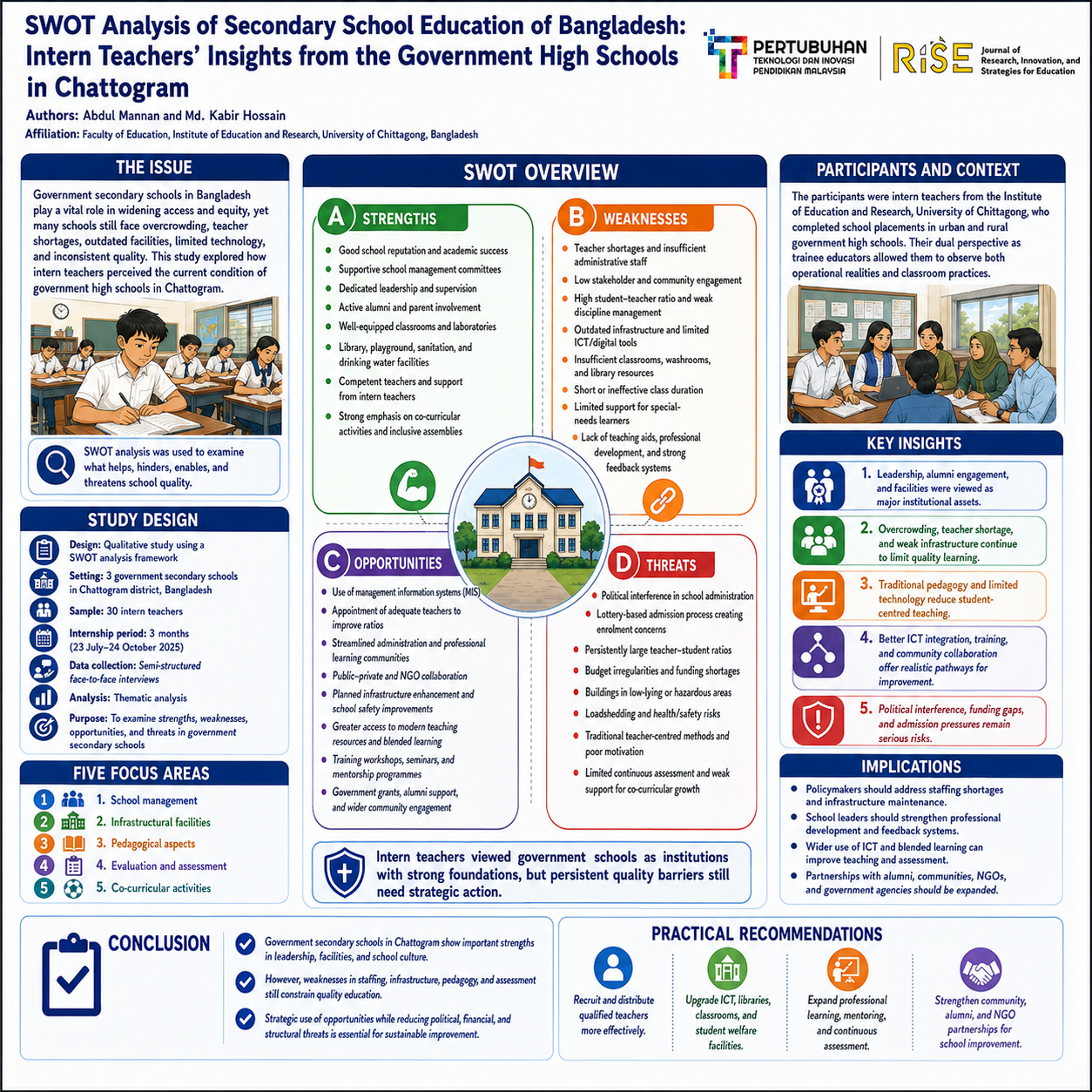
The study explored intern teachers' perceptions of the existing scenario of government secondary schools. A qualitative SWOT analysis was conducted in five key areas of the school environment. The sample consisted of 30 intern teachers selected from rural and urban areas of Chattogram district, Bangladesh. The data were collected through a semi-structured interview schedule with participants who recently completed a three-month internship and were analyzed following the themes. The findings indicate that some strengths of government secondary schools, as opined by the intern teachers, include supportive SMCs, dedicated leadership, active alumni participation, and well-equipped facilities. On the other hand, regarding the weaknesses of government schools, the study uncovered several aspects: a shortage of teachers, inadequate administrative staff, low community participation, outdated infrastructure, a lack of modern technology, and overcrowded classrooms. Additionally, the study identified opportunities in both the management system and the teaching-learning environment. The threats to the schools included the lottery-based admission process, political interference, and funding shortage. It is expected that the findings of the study will provide implications for policymakers, educators, educational administrators, and secondary school teachers in addressing the current situation to ensure quality education.
References
References
Akanda, M. R. A., & Haque, M. T. (2025). Teaching challenges in a large classroom in the secondary schools of Bangladesh.. SPC Journal of Education, 6(1) (2025) 5-11. https://doi.org/10.14419/9wpd0g40
Bangladesh Bureau of Educational Information and Statistics (BANBEIS). (2023). Bangladesh Education Statistics 2023. https://banbeis.gov.bd/sites/default/files/files/banbeis.portal.gov.bd/files/e9d388d8_3ac7_4444_a3ce_c0e61c66b525/Bangladesh%20Education%20Statistics%202023_compressed.pdf
Chakraborty, S. C., Akanda, M. R. A., & Haque, M. T. (2025). Transforming secondary education in Bangladesh: A reflective essay on student-centered pedagogy. SPC Journal of Education, 6(2), 9–13. https://doi.org/10.14419/4pw6rp30
Dewey, J. (1899). The school and society. University of Chicago Press.
Holsinger, D. B., & Cowell, R. N. (2000). Positioning secondary school education in developing countries. International Institute for Educational Planning/UNESCO, 7-9.
Islam, S., & Bushra-E-Jannat. (2025). English language learning challenges in Bangladeshi secondary schools. International Journal of Advanced Multidisciplinary Research and Studies, 5(4), 450–454. https://doi.org/10.62225/2583049X.2025.5.4.4613
Liyanage, I. K. (2014). Education system of Sri Lanka: strengths and weaknesses. Educ Syst Sri Lanka, 116-40.
Mamun-ur-Rashid, M. (2023). Quality of government secondary school services in regional Bangladesh. Heliyon, 9(1).
Mandina, S. (2012). Quality rural secondary school education in Zimbabwe: Challenges and remedies. Journal of Emerging Trends in Educational Research and Policy Studies (JETERAPS), 3(5), 768–774. Scholarlink Research Institute Journals.
Ministry of Education. (2010). The National Education Policy. Dhaka: Ministry of Education. https://shed.gov.bd/site/page/cfe2b6d9-5aa4-45e0-b6a1-f5c0c11c5095/- National-Education-Policy-2010
Ministry of Education. (2022). Annual report on secondary education in Bangladesh. Government of the People’s Republic of Bangladesh.
MoE, (2024, October 07). Circular on admission policy for government secondary schools (Circular No. 37.00.0000.071.22.146.24-96). https://shed.portal.gov.bd/sites/default/files/files/shed.portal.gov.bd/moedu_policy/bf1255e4_35bc_454c_8fee_464c144ae3c5/-2024.pdf
Nadira, S. A., Shixiang, L., & Chen, X. (2020). SWOT analysis of the management and operation of secondary education system in Dhaka city of Bangladesh. International Journal of Science, Technology and Society, 8(4), 80. doi:10.11648/j.ijsts.20200804.11
Parveen, S., & Mirza, N. (2012). Internship program in education: effectiveness, problems and prospects. International Journal of Learning & Development, 2(1), 487-498.
Polat, S., Çelik, Ç., & Okçu, Y. (2019). School administrators’ perspectives on teachers from different generations: SWOT analysis. Sage Open, 9(3), 2158244019861499.
Rahman, M. A., Khan, B., & Howlader, M. H. (2018). Secondary education in Bangladesh: issues and challenges. International Journal of Business and Social Science Research, 6(2), 19-25.
Rahman, M., Hamzah, M. I. M., Meerah, T., & Rahman, M. (2010). Historical Development of Secondary Education in Bangladesh: Colonial Period to 21st Century. International education studies, 3(1), 114-125.
Shvardak, M. (2021). SWOT-analysis as a Strategic Management Tool of Training Future Educational Institution Heads.
UNESCO. (2025). Education sector management report 2024 (ED/EO/2025/01). UNESCO. https://unesdoc.unesco.org
United Nations Development Programme. (2015). Sustainable development goals booklet. United Nations.
Downloads
Published
Issue
Section
License
Copyright (c) 2025 Abdul Mannan, Md. Kabir Hossain (Author)

This work is licensed under a Creative Commons Attribution 4.0 International License.