Teacher Readiness For Co-Teaching In Malaysian Primary School
DOI:
https://doi.org/10.70148/rise.v3i3.9Keywords:
teacher readiness, inclusive education, Malaysian primary schools, collaborative teachingAbstract
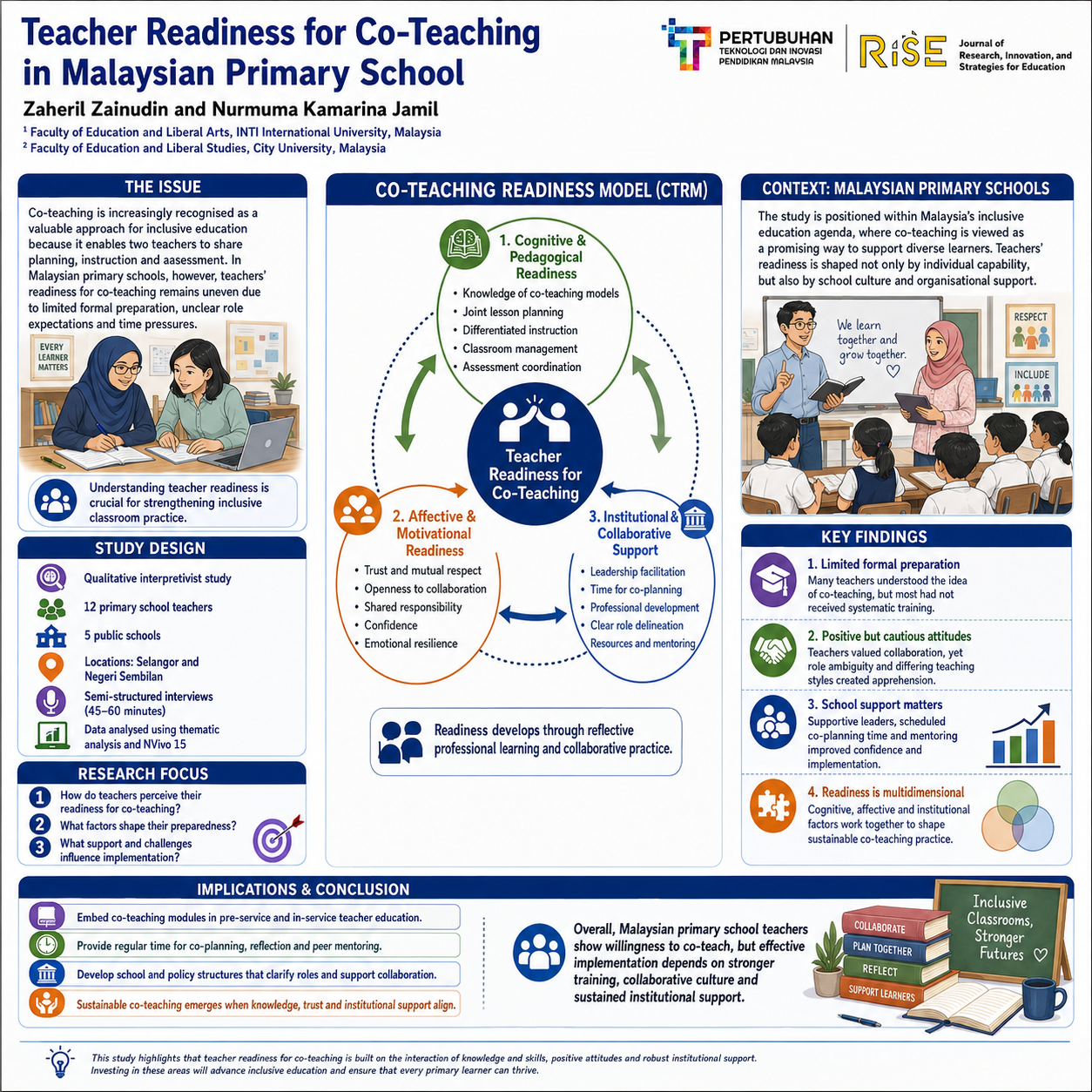
Co-teaching is widely recognized as an effective instructional approach for promoting inclusive education through collaborative practice. However, empirical evidence on teachers’ readiness for co-teaching in Malaysian primary schools remains limited. This study investigates teachers’ readiness for co-teaching and the individual and institutional factors shaping its implementation. Adopting a qualitative interpretivist approach, semi-structured interviews were conducted with twelve purposively selected primary school teachers from five public schools in Selangor and Negeri Sembilan. Data were analyzed using thematic analysis supported by NVivo software. The findings reveal that teachers’ readiness for co-teaching is multidimensional and constructed through three interrelated domains: (1) cognitive and pedagogical readiness, referring to teachers’ knowledge of co-teaching models, lesson planning, and differentiated instruction; (2) affective and motivational readiness, encompassing trust, openness to collaboration, shared responsibility, and emotional confidence; and (3) institutional and collaborative support, including leadership facilitation, time allocation for co-planning, and access to professional development. Although teachers generally demonstrated positive dispositions toward co-teaching, readiness was constrained by limited formal training, unclear role delineation, and structural time pressures. Drawing on these findings, the study proposes the Co-Teaching Readiness Model (CTRM), conceptualizing readiness as a dynamic interaction among cognitive, affective, and institutional domains strengthened through reflective professional learning. This study contributes empirically and conceptually to the literature on collaborative teaching and inclusive education in Malaysia. The findings hold significant implications for teacher education, school leadership, and policy development aimed at strengthening sustainable co-teaching practices in primary education.
References
Abdul Malik, M. A., Madzuki, N. I., Shahnirul Hizam, N. S., Shamsul Kamal, N. H., Che Yusof, N. S. H., Suhaimin, M. F. & Zulkifli, S. N. (2021). Teachers’ readiness and practices in school-based assessment implementation: Primary education in Malaysia. International Journal of Advanced Research in Future Ready Learning and Education, 2(1), 1-9. https://doi.org/10.37934/frle.23.1.19
Adnan, E. F., Mohd Darus, N., Faizal, S. N. F. & Mohamad, M. & Kamarudin, R. (2024). Benefits and challenges of differentiated learning in Malaysian Classrooms: Literature review. International Journal of Academic Research in Business and Social Sciences, 4(8), 617-622. http://dx.doi.org/10.6007/IJARBSS/v14-i8/22428
Al-Amrat, M. (2024). The role of preparing teachers’ understanding of the co-teaching and collaborative teaching models in developing their teaching experiences. International Journal of Religion, 5(2), 466-480. DOI: 10.61707/rq5mbm10
Alsudairy, N. A. (2024). Effects of a training program to improve co-teaching and collaboration skills for in-service teachers of special and general education. Sage Open, 14(4), 1-16. https://doi.org/10.1177/21582440241288076
Bauwens, J., Hourcade, J. J. & Friend, M. (1989). Cooperative teaching: A model for general and special education integration. RASE: Remedial & Special Education, 10(2), 17–22. https://doi.org/10.1177/074193258901000205
Bazeley, P. (2007). Qualitative data analysis with NVivo. London: SAGE Publications.
Braun, V., Clarke, V. (2021). Thematic analysis: A practical guide. London: SAGE Publications.
Cohen, L., Manion, L., Morrison, K. R. B. (2011). Research methods in education. London: Routledge.
Cook, L., & Friend, M. (1995). Co-teaching: Guidelines for creating effective practices. Focus on Exceptional Children, 28(3), 1-16. https://doi.org/10.17161/foec.v28i3.6852
Creswell, J. W. (2002). Research design: Qualitative, quantitative and mixed method approaches (2nd ed). California: SAGE Publications.
Creswell, J. W., & Poth, C. N. (2018). Qualitative inquiry and research design: Choosing among five approaches (4th ed). California: SAGE Publications.
Dean, S. E., Witherspoon, C. F. (1962). Team teaching in elementary school. Washington: Office of Education, Division of State and Local School Systems, Instruction, Organization and Services Branch.
Dey, I. (2003). Qualitative Data Analysis: A user-friendly guide for social scientists. London: Taylor & Francis.
Edwards, R., Holland, J. (2013). What is qualitative interviewing? New Delhi: Bloomsbury Publishing.
Eryilmaz, N., Kennedy, A. I., Strietholt, R. & Johansson, S. (2025). Teacher job satisfaction: International evidence on the role of school working conditions and teacher characteristics. Studies in Educational Evaluation, 86, 1-17. https://doi.org/10.1016/j.stueduc.2025.101474
Fitria, H. & Dewi, D. (2025). Challenges in collaborative practices: A focus on team teaching in English TPD. Journal of English Teaching and Linguistics Studies, 7(1), 7-14. DOI: 10.55215/jetli.v7i1.8
Forsman, L. (2024). Co-teaching literacy strategies for the inclusion of second-language learners: possibilities for professional development. Language and Education, 39(3), 638-655. https://doi.org/10.1080/09500782.2024.2348596
Frelin, A., Grannas, J. & Morck Riekki, W. (2025). Unpacking team teaching in innovative learning environments - teachers’ experience in practice. Education Inquiry, 9. 1–15. https://doi.org/10.1080/20004508.2025.2564508
Friend, M., Cook, L. & Murawski, W. W. (2021). Interactions: Collaboration skills for school professionals (9th ed.). London: Pearson Education.
Govindarajoo, V., Shorouk, A. & Yee, C. (2023). A case study on the implementation of collaborative learning in the Malaysian lower secondary classroom Mallika. International Journal of Academic Research in Progressive Education and Development, 12(2), 438–455. DOI: 10.6007/IJARPED/v12-i2/16826.
Guise, M., Ambroso, E., Paulding, K., Moore, C. Hegg, S. (2023). Preservice teacher reflection on coteaching implementation: Are we meeting the benchmarks? Journal of Teacher Education, 74(1), 23-39. https://doi.org/10.1177/00224871221105807
Guo, C., Chen, X. & Chen, J. (2025). Enhancing prospective teachers' professional development through shared collaborative lesson planning. Behavioral Sciences, 15(6), 1-26. https://doi.org/10.3390/bs15060753
Hamzah, N. H., Samsudin, S. & Hidayat, R. (2025). Teacher competence and readiness for classroom-based assessment in physical and health education: A systematic literature review. International Journal of Research and Innovation in Social Science, 9(9), 3206-3226. DOI: 10.47772/IJRISS.2025.909000272
Horne, S. (2025). Current challenges and practices in co-teaching in K-12 school. Journal of the American Academy of Special Education Professionals, 20(3), 57-78. https://doi.org/10.64546/jaasep.589
Hornyak, Agnes. (2025). Teacher motivation and its impact on the quality of education especially in disadvantaged areas: Challenges and opportunities for education policy. Edelweiss Applied Science and Technology, 9(6), 1931-1941. DOI: 10.55214/25768484.v9i6.8279.
Hussin, M. K. A. & Hamdan, A. R. (2016). Challenges of co-teaching in Malaysian inclusive classroom: Administrators’, teachers’ and parents’ overview. Procedia - Social and Behavioral Sciences, 217, 477-486. DOI: 10.1016/j.sbspro.2016.02.019
Idris, M., Masrom, U. & Jusoh, Z. (2021). Teaching challenges and strategies of Malaysian educators in online teaching during COVID-19 pandemic. Global Business and Management Research: An International Journal, 13(4), 318-328. https://www.researchgate.net/publication/358982928_Teaching_Challenges_and_Strategies_of_Malaysian_Educators_in_Online_Teaching_during_COVID-19_Pandemic/citations
Ioannidi, V. (2023). Research on special and inclusive education in the context of higher education - Teachers’ views about labeling. International Journal of Learning and Development, 13(3), 65-76. DOI: 10.5296/ijld.v13i3.21211
Isa, A. M., Mydin, A. & Abdullah, A. G. K. (2020). School-based management (SBM) practices in Malaysia: A systematic literature review. International Journal of Academic Research in Business & Social Sciences, 10(9), 822–838. https://doi.org/10.6007/ijarbss/v10-i9/7870
Krathwohl, D. R. (2009). Methods of educational and social science research: The logic of methods (3rd ed). Illinois: Waveland Press.
Lim, K. W., Ng, C. H., & Liew, S. Y. (2021). School culture and co-teaching: Examining the role of leadership and teacher collaboration. Asia Pacific Journal of Education, 41(3), 403–417. https://doi.org/10.1080/02188791.2021.1904290
Lincoln, Y. S., Guba, E. G. (1985). Naturalistic inquiry. London: SAGE Publications.
Ling, A. L. & San, P. H. (2025). Behavioural management challenges and support needs in inclusive classrooms in Malaysia. Asia Pacific Journal of Educators and Education, 40(1), 277-297. https://doi.org/10.21315/apjee2025.40.1.14
Maldonado-Diaz, C., Guerra, P., Faundez, M. P., Cuadros, O., Lizama, C., & Moreno, D. (2025). Pedagogical interactions between co-teachers and primary school students during co-teaching in Chilean classrooms. International Journal of Inclusive Education, 11, 1-18. https://doi.org/10.1080/13603116.2025.2584604
Maniam, V., Gerard, T., Harrington, I., Tranchard, H. & Bennett, S. (2025). Enhancing professional development through international collaborative dialogue: A study of Malaysian and Australian pre-service teachers. Malaysian Journal of Learning and Instruction, 22(1), 23-39. https://doi.org/10.32890/mjli2025.22.1.2
Manogharan, M. W., Karuppannan, G. & Chiong, K. L. (2018). Exploring teachers’ readiness, knowledge and attitudes towards inclusive education in the district of Sibu, Sarawak, Malaysia. Contemporary Educational Research Journal, 8(4), 148-157. DOI: 10.18844/cerj.v8i3.3630
Mbabazi, A., Muhammad, T., Bagiwa, Z. L. & Aja, L. (2025). Enhancing teacher performance and motivation through effective appraisal policies: Evidence-based recommendations for improving educational outcomes in secondary schools in Uganda. F1000Research, 14, 1-7. https://doi.org/10.12688/f1000research.168834.1
McTigue, E. M., Gourvennec, A. F., Solheim, O. J. & Jensen, M. T. (2023). Co-teaching implementation: How do school leaders support teachers? Education Sciences, 13(12), 1-21. https://doi.org/10.3390/educsci13121197
Metsapelto, R. L., Poikkeus, A. M., Heikkila, M., Husu, J., Laine, A., Lappalainen, K., Lahteenmaki, M., Mikkila-Erdmann, M., Warinowski, A. Iiskala, T., Hangelin, S., Harmoinen, S., Holmstrom, A., Kyro-Ammala, O., Lehesvuori, S. Mankki, V. & Suvilehto, P. (2021). A multidimensional adapted process model of teaching. Educational Assessment, Evaluation and Accountability, 34, 143-172. https://doi.org/10.1007/s11092-021-09373-9
Ministry of Education Malaysia (MOE). (2013). Malaysia Education Blueprint 2013-2025: Preschool to Post-secondary Education. Putrajaya: Ministry of Education Malaysia.
Mohd Tahir, L., Samah, N. A., Mohd Anis, S. N. & Ali, M. F. (2021). Implementing teacher leadership in Malaysian schools: Exploring secondary principals’ perspectives. Management in Education, 38(1), 5-21. https://doi.org/10.1177/08920206211053099
Morris, A. (2015). A practical introduction to in-depth interviews. London: SAGE Publications.
Murawski, W. W. (2022). Co-teaching do’s, don’ts, and do better (2nd ed.). California: Corwin Press.
Ni, L. B. (2025). Co-teaching for character and competence: An analysis of the 2027dual-teacher classroom policy in Malaysian education. Social Sciences Research, 11, 1-7. DOI: 10.5281/zenodo.17547296
Paramita, P. P., Andriani, F., Handayani, M. M., & Rusli, R. (2023). Teacher participation in professional learning programs in classroom behaviour management. Jurnal Prima Edukasia, 11(1), 96–105. https://doi.org/10.21831/jpe.v11i1.53637
Patton, M. Q. (2014). Qualitative research & evaluation methods: Integrating theory and practice. California: SAGE Publications.
Plaku, A. K. & Leka, K. (2025). The role of leaders in shaping school culture. Frontiers in Education, 3, 1-12. DOI: 10.3389/feduc.2025.1541525
Punch, D. K. F. (2009). Introduction to research methods in education. London: SAGE Publications.
Rahman, S., Ismail, R., & Ali, F. (2023). Challenges in implementing co-teaching strategies: Insights from Malaysian educators. Journal of Educational Research and Innovation, 15(2), 77–91. https://doi.org/10.1177/jeri.2023.15.2.77
Raja Al-Amrat, M. G. (2024). The role of preparing teachers’ understanding of the co-teaching and collaborative teaching models in developing their teaching experiences. International Journal of Religion, 5(2), 466-480. DOI: 10.61707/rq5mbm10
Rodriguez, M. & Castillo-Valdez, P. (2023). Promoting collaborative learning in students soon to graduate through a teaching–learning model. Education Sciences, 13(10), 1-14. DOI: 10.3390/educsci13100995
Ronn-Liljenfeldt, M., Sundqvist, C., Carpelan, R. & Rytivaara, A. (2025). Role of teacher culture in the implementation of co-teaching between special and class teachers in Finnish schools – A multiple case study. Scandinavian Journal of Educational Research, 9, 1-15. DOI: 10.1080/00313831.2025.2550268
Rytivaara, A., Pulkkinen, A. & de Bruin, C. L. (2019). Committing, engaging and negotiating: Teachers’ stories about creating shared spaces for co-teaching. Teaching and Teacher Education, 83, 225-235. https://doi.org/10.1016/j.tate.2019.04.013
Salleh, R. & Woollard, J. (2021). Inclusive education in Malaysia’s primary schools: The teachers view. Proceedings of the International Conference on Special Education, 4, 67-82. DOI : https://zenodo.org/record/6906745
Sharma, B. U. (2025). The role of co-teaching in enhancing instructional strategies in inclusive classrooms. International Journal of Research and Scientific Innovation, 12(5), 1248-1253. https://nerie.nic.in/umesh/18_2025.pdf
Sirkko, R., Kotilainen, N. & Takala, M. (2024). Towards inclusive special education? On the future of secondary school special educators’ work in Finland. European Journal of Special Needs Education, 39(6), 962–976. https://doi.org/10.1080/08856257.2024.2425518
Soeharto, S., Singh, S. S., Afriyanti, F. (2024). Associations between attitudes toward inclusive education and teaching for creativity for Indonesian pre-service teachers. Thinking Skills and Creativity, 51, 1-11. https://doi.org/10.1016/j.tsc.2024.101469
Xin, K. & Nasri, N. (2024). The readiness level of primary school teachers towards the implementation of classroom-based assessment (PBD). International Journal of Academic Research in Progressive Education and Development, 13(4), 1788-1799. http://dx.doi.org/10.6007/IJARPED/v13-i4/23224
Xu, C. & Shi, B. (2025) Spatial inequality and policy implications of school physical education resource allocation: evidence from Shaanxi Province, China. Frontiers in Education, 10, 1-23. https://doi.org/10.3389/feduc.2025.1693461
Zuo, L., Krish, P. & Jain, J. (2025). Teacher Collaboration Through Digital Tools in the 21st Century-Issues and Challenges: A Comprehensive Literature Review. Pertanika Journal of Social Science & Humanities, 33(1), 99-118. DOI: https://doi.org/10.47836/pjssh.33.1.05
Zuzana, S., Kriz, J. & Veteska, J. (2024). Transformation of teaching through co-teaching and innovative methods. Acta Educationis Generalis, 14(3), 41-55. DOI: 10.2478/atd-2024-0017
Downloads
Published
Issue
Section
License
Copyright (c) 2025 Zaheril Zainudin, Nurmuma Kamarina Jamil (Author)

This work is licensed under a Creative Commons Attribution 4.0 International License.