Teaching Practices and Learning Contexts as Determinants of EFL Students’ Perceptions Teacher Effectiveness in Bangladeshi Universities
DOI:
https://doi.org/10.70148/rise.v3i4.5Keywords:
Qualitative Study , Social Cognitive Theory, Teacher Effectiveness, Learning Context, EFL in Bangladesh, Teaching PracticesAbstract
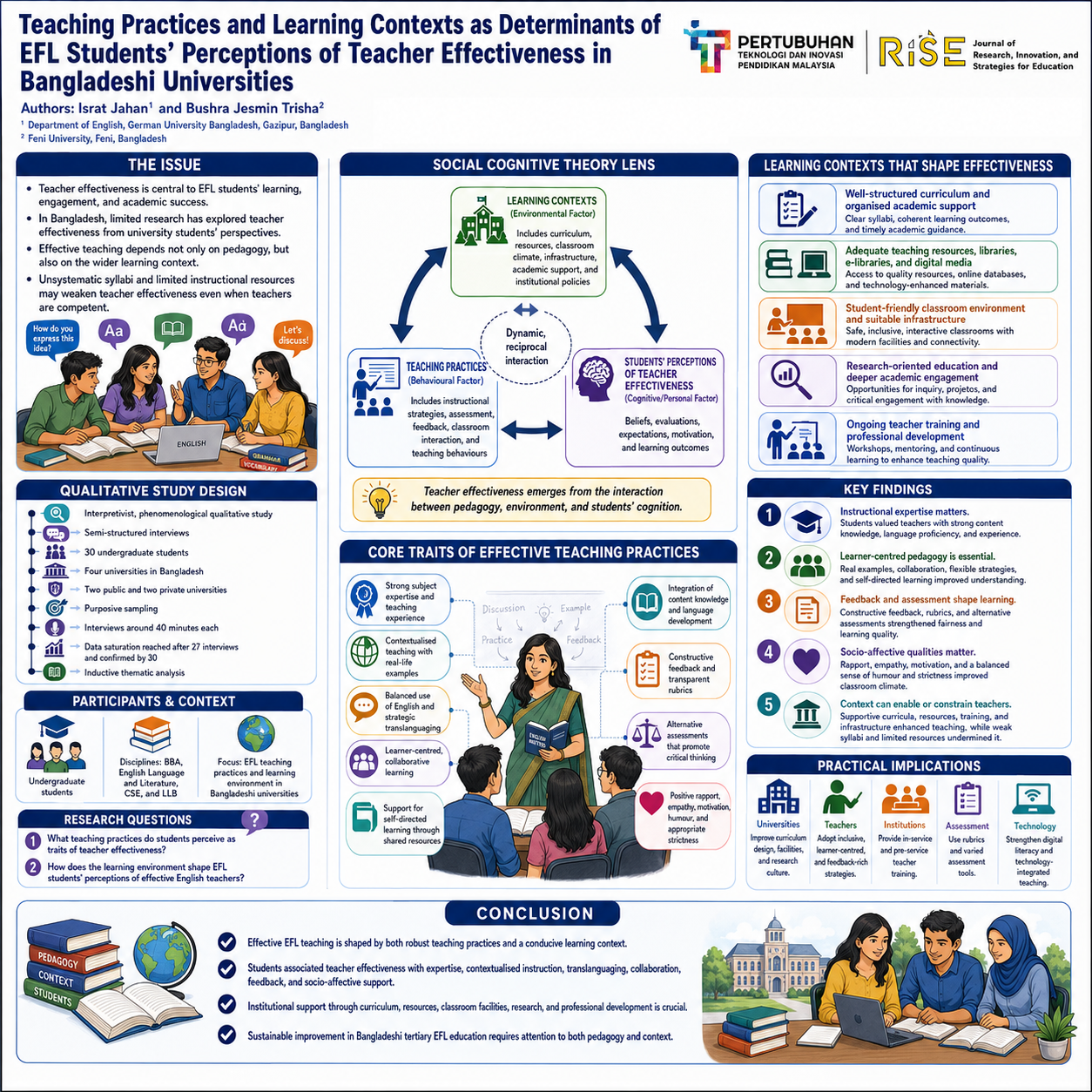
Robust teaching practices and conducive learning contexts promote teacher effectiveness in the EFL field. The purpose of this study is to explore the traits of teaching practices and examine the influence of the learning atmosphere on teacher effectiveness among university students in Bangladesh. Employing a qualitative approach, data were gathered through semi-structured interviews with 30 students, ranging from undergraduate level, recruited using purposive sampling technique and examined thematically. Participants highlighted the instructional expertise, contextualized teaching, subject matter knowledge, language proficiency, translanguaging, collaborative learning, diverse instructional methods, feedback mechanism, assessment strategies, teachers’ rapport, emotional intelligence, balanced sense of humor with strictness and motivation skills are core traits of teaching practices. Findings also indicate that a well-designed academic curriculum, teaching resources, pedagogical training, and promotion of research-based education contribute to a conducive learning atmosphere. However, despite a teachers’ instructional competence, a non-systematic syllabus and insufficient instructional resources may undermine the teacher's effectiveness. This study underscored the importance of aligning teaching practices with a learning context to enhance teacher effectiveness in tertiary English programs
References
Adeoye‐Olatunde, O. A., & Olenik, N. L. (2021). Research and scholarly methods: Semi‐structured interviews. JACCP: JOURNAL OF THE AMERICAN COLLEGE OF CLINICAL PHARMACY, 4(10), 1358–1367. https://doi.org/10.1002/jac5.1441
Alam, Md. J., Haque, A. K. M. M., Kamruzzaman, M., & Hossain, I. (2023). State of Instructional Educational Facilities of Primary Education at Upazila Level. Indonesian Journal of Teaching in Science, 3(2), 171–182. https://doi.org/10.17509/ijotis.v3i2.61453
Ali, Z., Masroor, F., & Khan, T. (2020). Creating Positive Classroom Environment For Learners’ Motivation Towards Communicative Competence In The English Language. Journal of the Research Society of Pakistan, Volume No. 57, (Issue No. 1 , 2020). https://pu.edu.pk/images/journal/history/PDF-FILES/24_57_1_20.pdf
Al-Mahrooqi, R., Denman, C., Al-Siyabi, J., & Al-Maamari, F. (2015). Characteristics of a Good EFL Teacher: Omani EFL Teacher and Student Perspectives. Sage Open, 5(2), 2158244015584782. https://doi.org/10.1177/2158244015584782
Alzubi, A. A. F. (2022). What Makes an Effective EFL Teacher From Saudi Preuniversity Students’ Perspective. Journal of Education, 202(4), 507–515. https://doi.org/10.1177/0022057420988702
Al Amin, M. (2017). Charting the river: A case study of English language teaching in Bangladesh. Unpublished doctoral thesis. New Zealand: University of Canterbury, Christchurch. http://hdl.handle.net/10092/14381
Amin, R. (2019). The teaching situation of the department of English in the universities of Bangladesh: A critical evaluation. Leksika: Jurnal Bahasa, Sastra Dan Pengajarannya, 13(1). https://doi.org/10.30595/lks.v13i1.4062
Aorny, K. A., Haque, N., & Hossain, M. (2022). Technology-Mediated Task-Based Language Teaching at Private Universities in Bangladesh: Students’ and Teachers’ Perceptions. ELT Worldwide: Journal of English Language Teaching, 9(2),412-438. https://doi.org/10.26858/eltww.v9i2.37051
Bandura, A. (1986). Social foundations of thought and action: A social cognitive theory. Prentice-Hall, Inc.
Begum, J. (2019). LEARNER AUTONOMY IN EFL/ESL CLASSROOMS IN BANGLADESH: TEACHERSâ€TM PERCEPTIONS AND PRACTICES. International Journal of Language Education, 12–21. https://doi.org/10.26858/ijole.v1i1.6397
Benzerroug, S. (2021). Effective Language Teaching and Learning Process in EFL Classroom Situation: A Case Study. International Journal of Linguistics, Literature and Translation, 4(8). https://doi.org/DOI:%252010.32996/ijllt
Berman, A. C. (2015). Good teaching is good teaching: A narrative review for effective medical educators. Anatomical Sciences Education, 8(4), 386–394. https://doi.org/10.1002/ase.1535
Biggs, J., Tang, C., & Kennedy, G. (2022). Teaching for quality learning at university (5th ed.). McGraw-Hill Education. https://books.google.com/books?id=pseVEAAAQBAJ
Braun, V., & Clarke, V. (2006). Using thematic analysis in psychology. Qualitative Research in Psychology, 3(2), 77–101. https://doi.org/10.1191/1478088706qp063oa
Çelik, S. (2013). In the eyes of Turkish EFL learners: What makes an effective foreign language teacher? Porta Linguarum Revista Interuniversitaria de Didáctica de Las Lenguas Extranjeras, 287–297. https://doi.org/10.30827/Digibug.18114
Challob, A. I., & Eid, O. S. (2025). Factors Contributing to the Success of Blended Learning in an EFL Learning Context. Journal of English Language and Education, 10(3), 544–554.
https://doi.org/10.31004/jele.v10i3.633
Chen, Y. J., & Lin, S. C. (2009). Exploring characteristics for effective EFL teachers from the perceptions of junior high school students in Tainan. STUT Journal of Humanities and Social Sciences, 2(2), 219–249. https://doi.org/10.29841/STUTJHSS.200911.0007
Clement, A., & Rencewigg, R. (2019). Qualities of effective teachers: Students’ perspectives. International Journal of Advances in Engineering and Management, 2(10), 365–368. https://doi.org/10.35629/5252-0210365368
Creswell, J. W. (2014). Research design: Qualitative, quantitative, and mixed methods approaches (4. ed). SAGE.
Derakhshan, A., Dewaele, J.-M., & Azari Noughabi, M. (2022). Modeling the contribution of resilience, well-being, and L2 grit to foreign language teaching enjoyment among Iranian English language teachers. System, 109, 102890. https://doi.org/10.1016/j.system.2022.102890
Ellis, R. (2017). Position paper: Moving task-based language teaching forward. Language Teaching, 50(4), 507–526. https://doi.org/10.1017/S0261444817000179
Febriyanti, E. R. (2018). INVESTIGATING ENGLISH DEPARTMENT STUDENTS’ PERCEPTIONS ABOUT A GOOD ENGLISH LANGUAGE TEACHER (Pt. 83–95.). International Journal of Language Education, 2. https://doi.org/10.26858/ijole.v2i2.6378
Ghafar, Z. N., & Lestari, A. (2023). A Critical Review of The Effectiveness of Teaching And Learning In Higher Education. Journal of Social Science (JoSS), 2(5), 465–471. https://doi.org/10.57185/joss.v2i5.80
Gulistan, M., Hussain, M. A., & Mushtaq, M. (2017). Relationship between Mathematics Teachers Self Efficacy and Students Academic Achievement at Secondary Level. Bulletin of Education and Research, Vol. 39, No. 3 pp. 171-182. https://files.eric.ed.gov/fulltext/EJ1210137.pdf
Hamre, B., Pianta, R., Downer, J., DeCoster, J., Mashburn, A., Jones, S., Brown, J., Cappella, E., Atkins, M., Rivers, S., & Hamagami, A. (2013). Teaching through interactions: Testing a developmental framework of teacher effectiveness in over 4,000 classrooms. The Elementary School Journal, 113, 461–487. https://doi.org/10.1086/669616
Harmer, J. (2015). The practice of English language teaching (5th ed.). Pearson Longman.
The Practice of English Language Teaching
Hasan, Md. M., Khanom, S., Rumman, A. M., & Fatema, K. (2024). Blended supervision of theses: Lessons and future directions from COVID-19 and post-pandemic situation. Crossings: A Journal of English Studies, 15(1), 196–214. https://doi.org/10.59817/cjes.v15i1.572
Huang, Z. (2010). What Makes a Successful EFL Teacher in China? A Case Study of an English Language Teacher at Nanjing University of Chinese Medicine. English Language Teaching, 3(3), p20. https://doi.org/10.5539/elt.v3n3p20
Hung, L. N. Q. (2023). Students’ Perceptions of Effective EFL Teachers in a University in Vietnam. Journal of Language Teaching and Research, 14(3), 560–567. https://doi.org/10.17507/jltr.1403.03
Islam, N. N., & Ahmed, I. (2018). Thinking Unconventional: Alternative Assessment at Tertiary Level Education in Bangladesh. International Journal of New Technology and Research (IJNTR), 4(1), Pages 18-23. https://www.ijntr.org/download_data/IJNTR04010040.pdf
Ismail, R. A. M., Arshad, R., & Abas, Z. (2018). Can teachers’ age and experience influence teacher effectiveness in HOTS? International Journal of Advanced Studies in Social Sciences & Innovation, 2 (1), 144–158. https://doi.org/10.30690/ijassi.21.11
Jamal, E. O. (2018). Where our education system has failed. The Daily Star. https://www.thedailystar.net/opinion/where-our-education-system-has-failed-1525951
Jamil, A. (2025). A Thematic Review of the Influences of Classroom Environment on Students’ Learning Outcomes in the EFL Context. EDUCASIA Jurnal Pendidikan, Pengajaran, Dan Pembelajaran, 10(3). https://doi.org/10.21462/educasia.v10i3.388
Karim, J. S. (2018). The role of classroom environment in learning English in Bangladesh: HSC level [Thesis, East West University].
Kirtania, P., & Mohakud, D. L. L. (2024). Teacher Effectiveness: Challenges and Opportunities in Teacher Education Institutions. The Academic International Journal of Multidisciplinary Research, 2(7). https://theacademic.in/wp-content/uploads/2024/08/36.pdf
Kleickmann, T., Richter, D., Kunter, M., Elsner, J., Besser, M., Krauss, S., & Baumert, J. (2013). Teachers’ Content Knowledge and Pedagogical Content Knowledge: The Role of Structural Differences in Teacher Education. Journal of Teacher Education, 64(1), 90–106. https://doi.org/10.1177/0022487112460398
Kourieos, S., & Evripidou, D. (2013). Students’ Perceptions of Effective EFL Teachers in University Settings in Cyprus. English Language Teaching, 6(11), 1-13. https://doi.org/10.5539/elt.v6n11p1
Ma, W., Yang, W., & Bu, Q. (2024). Interconnected factors in EFL engagement: Classroom climate, growth mindset, and achievement goals. Frontiers in Psychology, 15, 1353360.
https://doi.org/10.3389/fpsyg.2024.1353360
Mackey, A., & Gass, S. M. (2016). Second language research: Methodology and design (Second Edition). Routledge.
Mirza, M. G. H., Mahmud, K., & Jabbar, J. (2012). Use of other languages in English language teaching at tertiary level: A case study on Bangladesh. English Language Teaching, 5(9), 71–77. https://doi.org/10.5539/elt.v5n9p71
Monira, S. (2022). Students’ Perception of the Effectiveness of the English Language Courses: A Case Study at a Public University. Manababidda Gabesanapatra, 5, 448–460.
Moustakas, C. (1994). Phenomenological research methods. Sage Publications.
Munna, A. S., & Kalam, A. (2021). Teaching and learning process to enhance teaching effectiveness: A literature review. International Journal of Humanities and Innovation (IJHI), 4(1), 1–4. https://files.eric.ed.gov/fulltext/ED610428.pdf
Namaziandost, E., Kargar Behbahani, H., & Heydarnejad, T. (2024). Tapping the alphabets of learning-oriented assessment: Self-assessment, classroom climate, mindsets, trait emotional intelligence, and academic engagement are in focus. Language Testing in Asia, 14(1), 21. https://doi.org/10.1186/s40468-024-00293-1
Nowell, L. S., Norris, J. M., White, D. E., & Moules, N. J. (2017). Thematic Analysis: Striving to Meet the Trustworthiness Criteria. International Journal of Qualitative Methods, 16(1), 1609406917733847. https://doi.org/10.1177/1609406917733847
Munna, A. S., & Kalam, A. (2021). Teaching and learning process to enhance teaching effectiveness: A literature review. Teaching and Learning Process to Enhance Teaching Effectiveness: A Literature Review, 16, 1–4. https://doi.org/10.1177/1609406917733847
Nyagah, G., & Gathumbi, A. (2017). INFLUENCE OF TEACHER CHARACTERISTICS ON THE IMPLEMENTATION OF NON-FORMAL BASIC EDUCATION CURRICULUM AT THE NON-FORMAL EDUCATION CENTRES IN NAIROBI, MOMBASA AND KISUMU CITIES, KENYA. International Journal of Education and Research, 5(1). https://www.ijern.com/journal/2017/January-2017/18.pdf
Oliveira Fernandez, A. P., Ramos, M. F. H., Silva, S. S. C., Nina, K. C. F., & Pontes, F. A. R. (2016). Overview of research on teacher self-efficacy in social cognitive perspective. Anales de Psicología, 32(3), 793. https://doi.org/10.6018/analesps.32.3.220171
Pagels, L., Schindler, O., & Luedtke, K. (2025). Overview of styles, content, learning effects and attitudes of students towards digitally enhanced physiotherapy education – a scoping review. BMC Medical Education, 25(1), 176. https://doi.org/10.1186/s12909-025-06750-6
Park, G.-P., & Lee, H.-W. (2006). The characteristics of effective English teachers as perceived by high school teachers and students in Korea. Asia Pacific Education Review, 7(2), 236–248. https://doi.org/10.1007/BF03031547
Poddar, R., & Mizan, M. M. R. (2020). Alternative assessment practices in secondary schools in Bangladesh. The EDRC Journal of Learning and Teaching, 6(3), 22–33. https://www.edrcbd.org
Qaisra, R., & Haider, S. Z. (2024). A Study of Professional Development and In-Service Teacher Training Programs at School Level in the Punjab. Pakistan Journal of Humanities and Social Sciences, 12(2). https://doi.org/10.52131/pjhss.2024.v12i2.2273
Quadir, M. (2021). TEACHING FACTORS THAT AFFECT STUDENTS’ LEARNING MOTIVATION: BANGLADESHI EFL STUDENTS’ PERCEPTIONS. TEFLIN Journal - A Publication on the Teaching and Learning of English, 32(2), 295. https://doi.org/10.15639/teflinjournal.v32i2/295-315
Rafique, N., Rehman, F., & Humera Rahman. (2025). The Role of Poor Leadership, Ineffective Teaching Methods, and Low Staff Expectations in School Ineffectiveness: Case of Government Schools of Punjab, Pakistan. Research Journal for Social Affairs, 3(2), 71–80. https://doi.org/10.71317/RJSA.003.02.0097
Rahman, Kh. A., Hasan, Md. K., Namaziandost, E., & Ibna Seraj, P. M. (2021). Implementing a formative assessment model at the secondary schools: Attitudes and challenges. Language Testing in Asia, 11(1), 18. https://doi.org/10.1186/s40468-021-00136-3
Rahman, M. M., & Pandian, A. (2018). A Critical Investigation of English Language Teaching in Bangladesh: Unfulfilled expectations after two decades of Communicative Language Teaching. English Today, 34(3), 43–49. https://doi.org/10.1017/S026607841700061X
Raqib, A. A. (2019). Innovations in teacher training at higher education in Bangladesh. Social Science Review [The Dhaka University Studies, Part-D], 36(1), 221–231. https://ssrn.com/abstract=3453063
Raqib, A. B. M. A., Zaman, R. A., & Wahiduzzaman, M. (2023). Status of Faculty Professional Development Entities in Bangladeshi Universities: Insights from Professional Development Managers. Teacher’s World: Journal of Education and Research, 49(1), 187–203. https://doi.org/10.3329/twjer.v49i1.70269
Richards, J. C., & Rodgers, T. S. (2014). Approaches and methods in language teaching (3rd ed.). Cambridge University Press.
Rijken, P. E., & Fraser, B. J. (2024). Effectiveness of project-based mathematics in first-year high school in terms of learning environment and student outcomes. Learning Environments Research, 27(2), 241–263. https://doi.org/10.1007/s10984-023-09477-7
Sadik, F., & Akbulut, T. (2015). An Evaluation of Classroom Management Skills of Teachers at High Schools (Sample from the City of Adana). Procedia - Social and Behavioral Sciences, 191, 208–213. https://doi.org/10.1016/j.sbspro.2015.04.539
Schunk, D. H., & DiBenedetto, M. K. (2020). Motivation and social cognitive theory. Contemporary Educational Psychology, 60, 101832. https://doi.org/10.1016/j.cedpsych.2019.101832
Shariatifar, S., kiany, G., & Maftoon, P. (2017). High School EFL Teachers’ Professional Competencies: Content Knowledge and Pedagogical Content Knowledge. Applied Research on English Language, 6(4). https://doi.org/10.22108/are.2018.107409.1191
Singh, S., Pai, D. R., Sinha, N. K., Kaur, A., Soe, H. H. K., & Barua, A. (2013). Qualities of an effective teacher: What do medical teachers think? BMC Medical Education, 13(1), 128. https://doi.org/10.1186/1472-6920-13-128
Tatto, M. T. (2021). Developing teachers’ research capacity: The essential role of teacher education. Teaching Education, 32(1), 27–46. https://doi.org/10.1080/10476210.2020.1860000
Tosto, M. G., Asbury, K., Mazzocco, M. M. M., Petrill, S. A., & Kovas, Y. (2016). From classroom environment to mathematics achievement: The mediating role of self-perceived ability and subject interest. Learning and Individual Differences, 50, 260–269. https://doi.org/10.1016/j.lindif.2016.07.009
Uygun, S. (2013). How to Become an Effective English Language Teacher. Journal of Educational and Social Research, Vol. 3(7). https://doi.org/10.5901/jesr.2013.v3n7p306
Wang, W. (2017). Using rubrics in student self-assessment: Student perceptions in the English as a foreign language writing context. Assessment & Evaluation in Higher Education, 42(8), 1280–1292. https://doi.org/10.1080/02602938.2016.1261993
Wirantaka, A., & Wahyudianawati, P. A. (2021). Characteristics of Effective English Teacher for Millenials. Journal of Foreign Language Teaching and Learning, 6(2), PRESS. https://doi.org/10.18196/ftl.v6i2.11549
Yangambi, M. (2023). Impact of School Infrastructures on Students Learning and Performance: Case of Three Public Schools in a Developing Country. Creative Education, 14(04), 788–809. https://doi.org/10.4236/ce.2023.144052
Zhang, J., Ye, Z., Chen, S., & Sun, Q. (2025). Association between school climate, teachers’ self-efficacy, instructional practice, and perceived needs in professional development: A structural equation analysis using Shanghai TALIS 2018 data. Large-Scale Assessments in Education, 13(1), 33. https://doi.org/10.1186/s40536-025-00268-5
Downloads
Published
Issue
Section
License
Copyright (c) 2025 Israt Jahan, Bushra Jesmin Trisha (Author)

This work is licensed under a Creative Commons Attribution 4.0 International License.