Mobile Game Addiction and Academic Achievement among Senior High School Students: A Convergent Mixed-Methods Study in a Philippine Public School
DOI:
https://doi.org/10.70148/rise.v3i4.4Keywords:
Mobile Game Addiction, Educational Psychology, Academic Engagement, Self-Regulated Learning, Learning BehaviorsAbstract
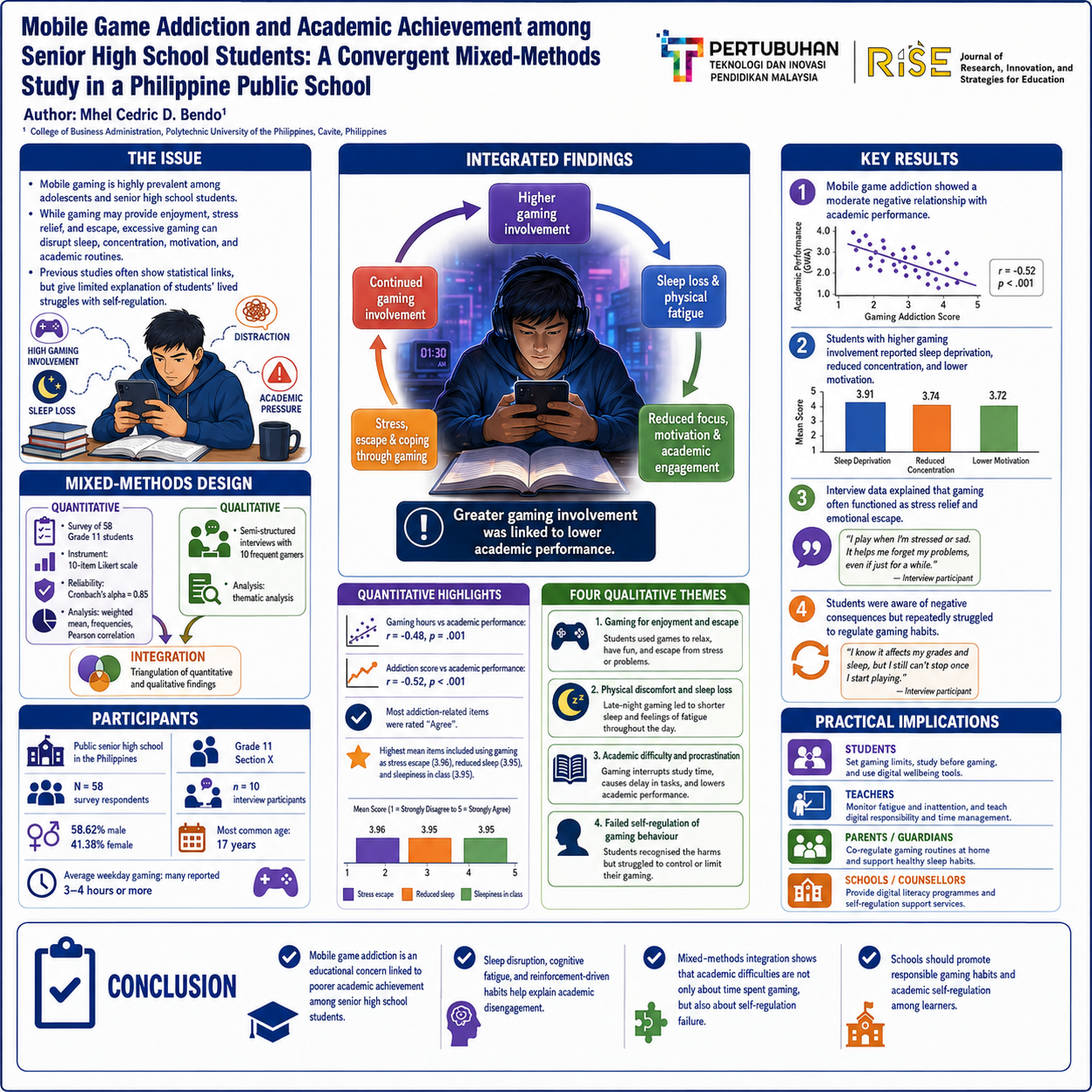
This study employed a Convergent Mixed-Methods Design to examine how mobile gaming influences students’ behaviour, study habits, physical well-being, and academic obligations within a senior high school educational context. The quantitative component involved 58 Grade 11 students from Section X in the Philippines who answered a 10-item Likert-scale survey assessing gaming habits, academic distractions, sleep problems, physical symptoms, and coping strategies. Data were analyzed using weighted means, frequency distributions, and Pearson’s correlations. The qualitative component consisted of semi-structured interviews with ten purposively selected participants. The thematic analysis revealed three major themes: (1) gaming for enjoyment and escape, (2) physical discomfort and sleep loss, and (3) difficulty managing academic responsibilities alongside failed attempts at self-regulation. Findings indicated that greater gaming involvement was associated with reduced focus, sleep deprivation, decreased motivation, and neglect of academic tasks. Quantitative results revealed a moderate negative relationship between mobile game addiction and academic performance (r = −.52, p < .001). Qualitative narratives further explained how sleep loss, cognitive fatigue, and reinforcement-driven habits contributed to academic disengagement despite students’ awareness of negative consequences. The study highlights the importance of digital literacy programs, structured guidance interventions, and school-based strategies that promote responsible gaming habits and academic self-regulation among learners.
References
American Academy of Pediatrics. (2016). Media and young minds. Pediatrics, 138(5), e20162591. https://doi.org/10.1542/peds.2016-2591
Arreola, P. J., Santos, L. R., & Vega, A. J. (2023). Video gaming and stress reduction: Behavioural and psychological perspectives. Journal of Behavioral Health & Digital Engagement, 5(1), 45–58. https://doi.org/10.20849/jbhde.2023.05145
Choi, S. W., Kim, H. D., & Shin, S. H. (2018). Associations between internet gaming behavior and health outcomes among adolescents. Journal of Adolescent Health, 62(1), 65–72. https://doi.org/10.1016/j.jadohealth.2017.07.012
Creswell, J. W., & Plano Clark, V. L. (2018). Designing and conducting mixed methods research (3rd ed.). SAGE Publications. https://us.sagepub.com/en-us/nam/designing-and-conducting-mixed-methods-research/book241842
Tai, C.-L., Liu, Y.-C., & Chao, C.-F. (2004). Computer use and musculoskeletal disorders among university students: An epidemiological study. Ergonomics, 47(6), 594–601. https://doi.org/10.1080/00140130410001682435
Sweller, J. (1988). Cognitive load during problem solving: Effects on learning. Cognitive Science, 12(2), 257–285. https://doi.org/10.1207/s15516709cog1202_4
Skinner, B. F. (1957). Verbal behavior. Copley Publishing Group.
Sayeed, M. A., Rasel, M. S. R., Habibullah, A. A., & Hossain, M. M. (2021). Prevalence and underlying factors of mobile game addiction among university students in Bangladesh. Global Mental Health, 8, e35. https://doi.org/10.1017/gmh.2021.34
Demir, Y., & Kutlu, M. (2018). The relationship between video game addiction and academic achievement. Educational Research and Reviews, 13(23), 1156–1163. https://doi.org/10.5897/ERR2018.3602
Islam, M. S., Hossin, M. Z., Amar, S. A., & Iqbal, M. N. (2020). Association between excessive online gaming and academic performance among secondary school students in Bangladesh. Heliyon, 6(5), e03977. https://doi.org/10.1016/j.heliyon.2020.e03977
Israel, V. (2018). Gaming disorder and effects of gaming on health: An overview. Journal of Addiction Medicine and Therapeutic Science, 4(1), 1–4.
Shiers, J. (2020, January 6). Expert advice on gaming addiction in young people and children. InternetMatters. https://www.internetmatters.org/hub/news-blogs/expert-advice-on-gaming-addiction-in-young-people-and-children/
Jackson, L. A., von Eye, A., Witt, E. A., Zhao, Y., & Fitzgerald, H. E. (2011). A longitudinal study of the effects of Internet use and videogame playing on academic performance and the roles of gender, race, and income in these relationships. Computers in Human Behavior, 27(1), 228–239. https://doi.org/10.1016/j.chb.2010.08.001
Zamani, E., Chashmi, M., & Hedayati, N. (2009). Effect of addiction to computer games on physical and mental health of female and male students of guidance school in the city of Isfahan. Addiction & Health, 1(2), 98–105. https://www.ncbi.nlm.nih.gov/pmc/articles/PMC3905489/
Montag, C., Wegmann, E., Sariyska, R., Demetrovics, Z., & Brand, M. (2021). On the psychology of TikTok use: A first glimpse from empirical findings. Frontiers in Public Health, 9, 641673. https://doi.org/10.3389/fpubh.2021.641673
Männikkö, N., Billieux, J., & Kääriäinen, M. (2015). Problematic digital gaming behaviour and its relation to the psychological and physical health symptoms. Journal of Behavioral Addictions, 4(3), 178–186. https://doi.org/10.1556/2006.4.2015.040
Tholl, C., Bickmann, P., Wechsler, K., Froböse, I., Grieben, C., & et al. (2022). Musculoskeletal disorders in video gamers – A systematic review. BMC Musculoskeletal Disorders, 23(1), 614. https://doi.org/10.1186/s12891-022-05614-0
Jenkins, P. J., Srikantharajah, D., Duckworth, A. D., Watts, A. C., & McEachan, J. E. (2013). Carpal tunnel syndrome: The association with occupation at a population level. Journal of Hand Surgery (European Volume), 38(1), 67–72. https://doi.org/10.1177/1753193412455790
Sheppard, A. L., & Wolffsohn, J. S. (2018). Digital eye strain: Prevalence, measurement and amelioration. BMJ Open Ophthalmology, 3(1), e000146. https://doi.org/10.1136/bmjophth-2018-000146
We Are Social & Meltwater. (2024). Digital 2024: The Philippines. Retrieved from https://datareportal.com/reports/digital-2024-philippines
Király, O., Griffiths, M. D., & Demetrovics, Z. (2015). Internet gaming disorder: Concepts, assessment, and epidemiology. Current Addiction Reports, 2(2), 254–262. https://doi.org/10.1007/s40429-015-0058-6
Griffiths, M. D. (2005). A “components” model of addiction within a biopsychosocial framework. Journal of Substance Use, 10(4), 191–197. https://doi.org/10.1080/14659890500114359
World Health Organization. (2019). Gaming disorder. International Classification of Diseases (11th ed.). https://www.who.int/standards/classifications/frequently-asked-questions/gaming-disorder
King, D. L., Delfabbro, P. H., Wu, A. M. S., Doh, Y. Y., Kuss, D. J., Pallesen, S., ... Sakuma, H. (2020). Treatment of Internet gaming disorder: An international systematic review and CONSORT evaluation. Clinical Psychology Review, 54, 123–133. https://doi.org/10.1016/j.cpr.2017.04.002
Hawi, N. S., Samaha, M., & Griffiths, M. D. (2021). The digital addiction scale for children: Development and validation. Cyberpsychology, Behavior, and Social Networking, 24(2), 82–89. https://doi.org/10.1089/cyber.2020.0320
Adams, B. L., Stavropoulos, V., Burleigh, T., Liew, L., Beard, C., & Griffiths, M. D. (2022). Internet gaming disorder behaviors in adolescence: A systematic review and meta-analysis. Journal of Behavioral Addictions, 11(2), 278–296. https://doi.org/10.1556/2006.2022.00030
Kwok, C., Leung, P. Y., Poon, K. Y., & Fung, X. C. (2021). The effects of internet gaming and social media use on sleep and academic performance among adolescents. Sleep and Biological Rhythms, 19(2), 189–198. https://doi.org/10.1007/s41105-020-00296-0
Scott, H., Biello, S. M., & Woods, H. C. (2019). Social media use and adolescent sleep patterns: A systematic review. Sleep Medicine Reviews, 47, 59–70. https://doi.org/10.1016/j.smrv.2019.05.001
Downloads
Published
Issue
Section
License
Copyright (c) 2025 Mhel Cedric D. Bendo (Author)

This work is licensed under a Creative Commons Attribution 4.0 International License.