Exploring the effects of Artificial Intelligence on Student Learning and Instruction in Educational Training Providers (ETPS) in Botswana
DOI:
https://doi.org/10.70148/rise.v3i3.13Keywords:
Artificial Intelligence, Student Learning and Instruction, Educational Training ProvidersAbstract
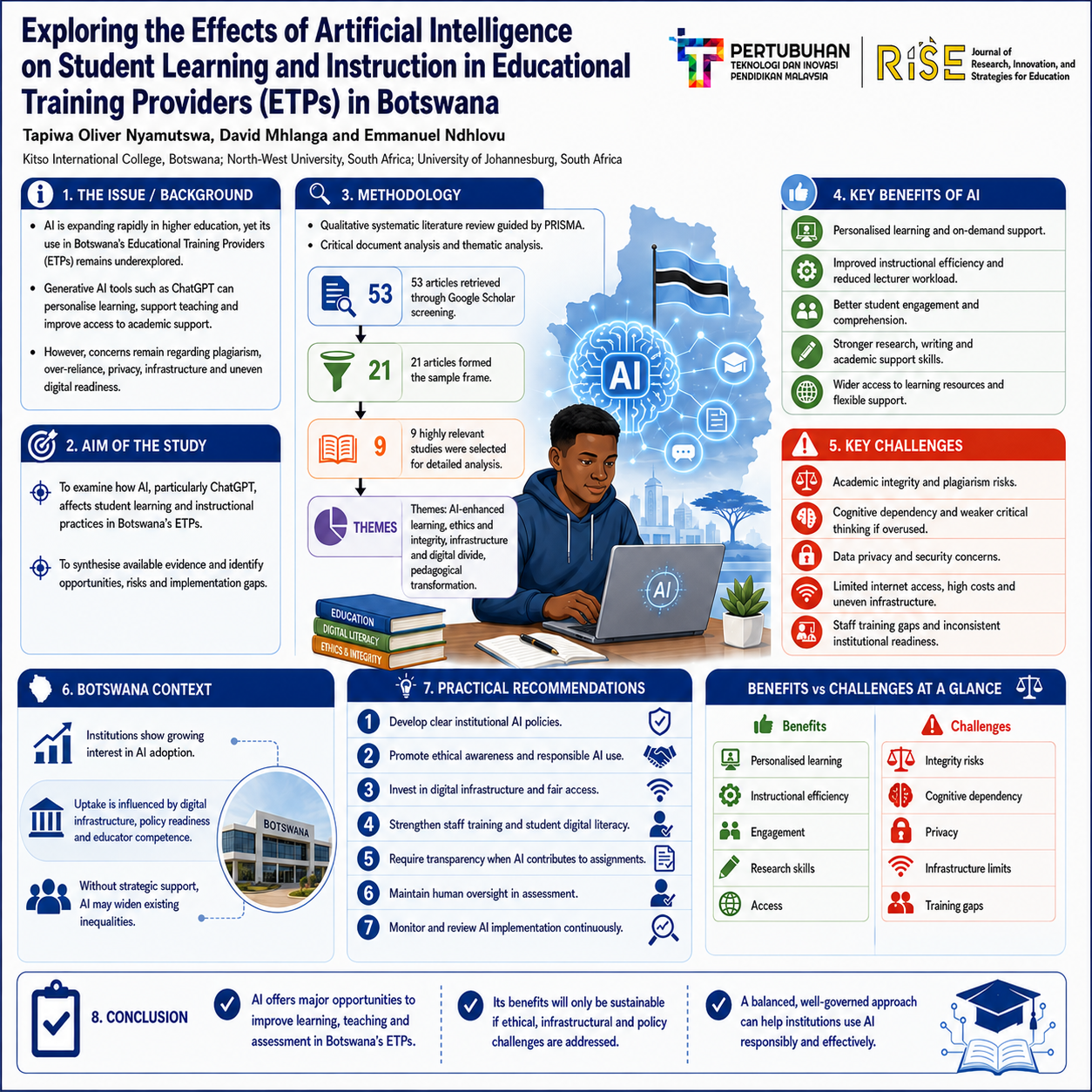
The integration of Artificial Intelligence (AI) in higher education has gained global attention; however, its application in Botswana’s Educational Training Providers (ETPs) remains underexplored. This study investigates the effects of AI, particularly ChatGPT, on student learning and instructional practices. A PRISMA-guided systematic literature review was employed, using Boolean operators to retrieve 53 articles from Google Scholar, from which a sample of 9 highly relevant studies was selected for detailed analysis. Findings reveal that AI enhances personalised learning, improves instructional efficiency, supports research skills, and increases student engagement. However, challenges such as academic integrity risks, cognitive dependency, data privacy concerns, and infrastructural limitations persist. The study concludes that AI presents both opportunities and risks for Botswana’s higher education sector. It recommends the development of ethical frameworks, investment in digital infrastructure, and capacity building to ensure effective and responsible AI integration aligned with evolving educational demands.
References
Akrami, L. et al., 2025. AI-related misconduct trends in higher education. Journal of Academic Integrity, 23(2), pp. 78-90.
Bervell, B., Mireku, D. O., Dzamesi, P. D., Nimo, E. B., Andoh, R. P. K., & Segbenya, M. (2025). AI acceptance and usage in Sub-Saharan African education: A systematic review of literature. Journal of Advocacy, Research and Education, 12(1), 82–106.
Chen, L., Chen, P. and Lin, Z., (2021). Artificial intelligence in blended learning: Supporting research skills development. Educational Technology Research and Development, 69(4), pp. 1897-1916.
Dake, D. K., & Gbagbo, F. Y. (2025). ChatGPT’s benefits, acceptance, and ethical challenges for teaching and learning in key African countries: A systematic review of literature from 2022 to 2024. Discover Education.
David, J., (2024). Digitalisation as a transformative force in pedagogy. Journal of Educational Innovation, 12(3), pp. 101-115.
Dwivedi, Y. K., Kshetri, N., Hughes, L., Slade, E. L., Jeyaraj, A., Kar, A. K., Baabdullah, A. M., Koohang, A., Raghavan, V., Ahuja, M., Albanna, H., Albashrawi, M., Al-Busaidi, K. A., Balakrishnan, J., Barlette, Y., Basu, S., Bose, I., Brooks, L., Buhalis, D., … Wright, R. (2023). “So what if ChatGPT wrote it?” Multidisciplinary perspectives on opportunities, challenges and implications of generative conversational AI for research, practice and policy. International Journal of Information Management, 71, 102642.
Holmes, W., Bialik, M. and Fadel, C., (2019). Artificial intelligence in education: Promises and implications for teaching and learning. Boston: Center for Curriculum Redesign.
Ifiegbu, G. C., & Mlambo, G. (2024). Adoption and utilization of emerging digital technologies in engineering education: A systematic literature review with a focus on Botswana higher education institutions.
Indrawati I, Letiani K. P., Khaerudin K. And Muthaivha S (2024), Adoption of ChatGPT: A customer perspective, 2024. Empirical adoption factors via UTAUT2. Botswana Journal of Educational Technology, 8(1), pp. 45-56.
Kasneci, E., Sessler, K., Küchemann, S., Bannert, M., Dementieva, D., Fischer, F., Gasser, U., Groh, G., Günnemann, S., Hüllermeier, E., Krusche, S., Kutyniok, G., Michaeli, T., Nerdinger, F. W., Pfeffer, J., Poquet, O., Sailer, M., Schmidt, A., Seidel, T., Kasneci, G. (2023). ChatGPT for good? On opportunities and challenges of large language models for education. Learning and Individual Differences, 103, 102274.
Letjani, T. (2024). Measurement tool for the adoption of ChatGPT in Botswana’s higher education. Botswana Journal of Educational Technology, 8(1), pp. 23-35.
Luckin, R., Holmes, W., Griffiths, M. and Forcier, L.B., (2016). Intelligence unleashed: An argument for AI in education. London: Pearson.
Maluleke, A. F. (2025). Educational technology for sustainable development in SADC higher education: A systematic review. Journal of Educational Learning Technology, 6(12), 1309–1329.
Mashaba, K., Monageng, R. O., Kgwadi, M., Chikati, R., & Majoo, P. A. (2024). Challenges and opportunities in integrating artificial intelligence education at the University of Botswana: Addressing infrastructure and educational priorities for a knowledge-based society.
Mbotho, A., & Mabina, A. (2025). Ethical implications of ChatGPT in higher education: A systematic review. COMPETITIVE: Journal of Education, 4(2), 172–184.
Mhlanga, D., (2023). Ethical implications of AI in African higher education. African Journal of Higher Education, 12(2), pp. 89-102.
Mhlanga, D., & Ndhlovu, E. (2024). Digital transformation in higher education and postgraduate research supervision in Africa: A critique of 4IR-based interventions in open distance learning. Journal of Southwest Jiaotong University, 59(5), 142-156.
Moher, D., Liberati, A., Tetzlaff, J. and Altman, D.G., (2009). Preferred reporting items for systematic reviews and meta-analyses: The PRISMA statement. PLoS Medicine, 6(7), p. e1000097.
Moher, D.; Shamseer, L.; Clarke, M.; Ghersi, D.; Liberati, A.; Petticrew, M.; Shekelle, P.; Stewart, L.A. (2015) Preferred Reporting Items for Systematic Review and Meta-Analysis Protocols (PRISMA-P) Statement. Syst. Rev. 2015, 4, 1.
Nyamutswa, T. O., & David, O. O. (2025). Mutual feedback shocks between ICT and Poverty in South Africa. Acta Economica, 23(42), 197-214.
OECD, (2024a). AI in education: Policy frameworks for responsible adoption. Paris: OECD Publishing.
OECD, (2024b). Thematic synthesis in educational research: Methods and applications. Paris: OECD Publishing.
Page, M.J. (2021). The PRISMA 2020 statement: An updated guideline for reporting systematic reviews. BMJ, 372, p. n71.
Roll, I. and Wylie, R., (2016). Evolution and revolution in artificial intelligence in education. International Journal of Artificial Intelligence in Education, 26(2), pp. 582-599.
Roose, K. (2025). Student perceptions of AI tools in Sub-Saharan Africa. Education and Technology Review, 20(4), pp. 56-68.
Russell, S., & Norvig, P. (2021). Artificial intelligence: A modern approach (4th ed.). Pearson.
Schumpeter, J.A., (1934). The theory of economic development: An inquiry into profits, capital, credit, interest, and the business cycle. Cambridge, MA: Harvard University Press.
Sebopelo, P. (2024). Leveraging AI to enhance quality for higher education institutions (HEIs). Review of Artificial Intelligence in Education, 5, e032–e032.
Smutny, P. and Schreiberová, P., (2023). AI and critical thinking: Risks of over-reliance. Journal of Learning Analytics, 10(2), pp. 78-89.
Smutny, P., & Schreiberová, P. (2023). ChatGPT and education: Opportunities, challenges, and limitations.
Stanford HAI, (2025). AI Index 2025: Trends in educational applications. Stanford: Stanford University.
The Guardian, (2025). AI and academic misconduct: Emerging trends. Available at: https://www.theguardian.com/education/2025/ai-misconduct-trends [Accessed 2 September 2025].
Tlhalerwa, L. and Leeuw, P., (2024). Adoption of ChatGPT in Botswana’s higher education: A UTAUT2 analysis. Botswana Journal of Educational Technology, 8(1), pp. 23-35.
University of Botswanan, (2025). University of Botswana AI Bootcamp: Faculty preparation for AI integration. Available at: https://www.ub.bw/ai-bootcamp-2025 [Accessed 2 September 2025].
Uleanya, C. (2023). Scholarly discourse of the fourth industrial revolution (4IR) and education in Botswana: A scoping review. Education and Information Technologies, 28(3), 3249–3265.
UNESCO. (2024). Artificial intelligence in education: Policy guidance for Sub-Saharan Africa. UNESCO Publishing.
Wardat, Y., Alali, R., Jarrah, A. M., & Tarawneh, M. (2023). ChatGPT and academic writing: Enhancing research skills among postgraduate students.
Zawacki-Richter, O., Marín, V.I., Bond, M. and Gouverneur, F., 2019. Systematic review of research on artificial intelligence applications in higher education – where are the educators? International Journal of Educational Technology in Higher Education, 16(1), pp. 1-27.
Zitha, M.G., Ndhlovu, E. & Lumadi, R.I. (2024). Perceived Impact of Culture on the Progress of Women as School Leaders in South Africa. Social Sciences and Education Research Review, 11(2), 135 – 145.
Zlotnikova, I., & Hlomani, H. (2025). GenAI in the context of African universities: A crisis of tertiary education or its new dawn? Digital Government: Research and Practice, 6(2), 1–11.
Zohaib, M., Ndlovu, S., & Phiri, T. (2024). AI-powered chatbots and student support in African higher education: Evidence from Zambia.
Downloads
Published
Issue
Section
License
Copyright (c) 2025 Tapiwa Oliver Nyamutswa, David Mhlanga, Emmanuel Ndhlovu (Author)

This work is licensed under a Creative Commons Attribution 4.0 International License.