Facing the Challenges of PBD: An Analysis of the Relationship between Teachers’ Knowledge, Skills, and Attitudes in Batu Pahat District
DOI:
https://doi.org/10.70148/rise.11Keywords:
Classroom Assessment (PBD); Mastery Level (TP); Teacher Knowledge; Teacher Skills; Teacher Attitude; Mathematics Education; Elementary SchoolAbstract
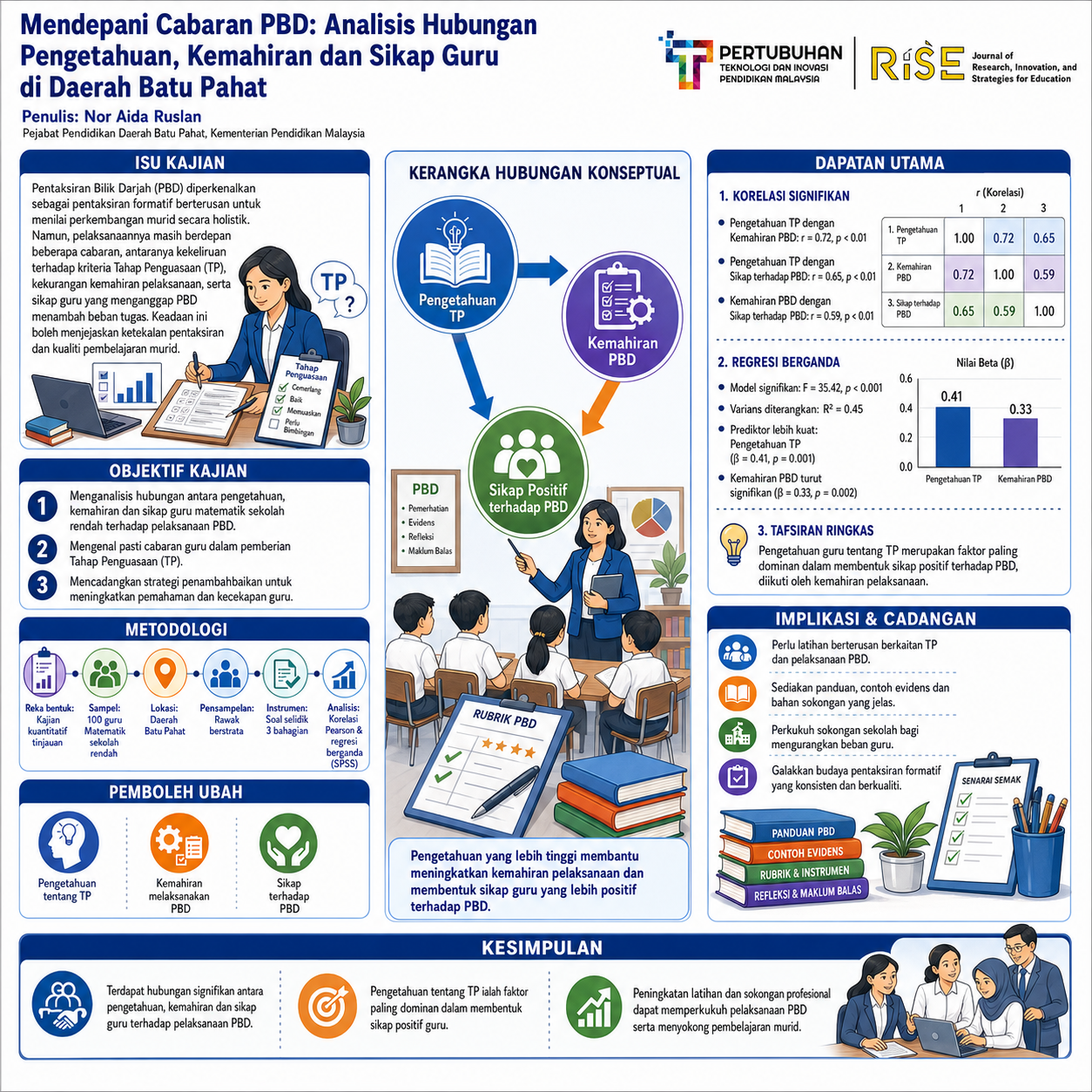
This study aims to analyze the relationship between the knowledge, skills, and attitudes of primary school mathematics teachers in Batu Pahat towards the provision of Mastery Level (TP) in Classroom Assessment (PBD). PBD, as a formative assessment tool, has been introduced in the Malaysian education system to assess student development continuously without the pressure of traditional exams. Although PBD brings great potential in improving the quality of education, its implementation faces several challenges. Previous studies have found that confusion about TP evaluation criteria, lack of skills in the implementation of PBD, as well as teachers' negative attitudes, such as the assumption of additional burden, have hindered the effectiveness of this assessment. This study uses a quantitative approach with a questionnaire method involving a stratified random sample consisting of 100 primary school mathematics teachers in Batu Pahat. The questionnaire instrument used measures the level of knowledge, skills, and attitudes of teachers in the context of PBD implementation, as well as involving an analysis of the instrument's reliability. The data obtained was analyzed using statistical techniques such as correlation analysis and multiple regression to determine the strength of the relationship between knowledge, skills, and teachers' attitudes towards the implementation of PBD. The results of the study show that there is a significant relationship between these factors, with knowledge and skills as the main predictors of PBD implementation efficiency. A positive attitude towards PBD also played an important role in the success of this assessment. The findings of this study are expected to provide concrete recommendations to improve the level of understanding and competence of teachers in implementing PBD, thereby improving the learning process of students in Malaysia.
References
Ahmad, I., & Akbar, R. A. (2020). Examining relationship between self-efficacy beliefs of elementary level English
teachers and their implementation practices of formative assessment in Punjab. International Journal of
Education, 3(2), 123-134. https://www.iiste.org/Journals/index.php/JEP/article/view/51252
Ahmad, N., & Ismail, M. (2017). Impact of teacher attitudes on formative assessment implementation: A case study
in Malaysian schools. Malaysian Journal of Education, 34(2), 123-134.
https://ejournal.ukm.my/jpend/article/view/20791
Ahmedi, V. (2019). Teachers’ attitudes and practices towards formative assessment in primary schools. Journal of
Social Studies Education Research, 10, 161-175. https://jsser.org/index.php/jsser/article/view/1646
Boström, E., & Palm, T. (2023). The effect of a formative assessment practice on student achievement in
mathematics. Frontiers in Education, 8. https://doi.org/10.3389/feduc.2023.1101192
Cuizon, R. O., & Haider, A. (2019). Intervening effect of teacher-quality on the relationship between student
attitude and academic outcomes in mathematics. International Journal of Engineering and Future
Technology, 16, 43-51. https://www.ijeft.org
Gotch, C. M., Poppen, M. I., Razo, J. E., & Modderman, S. L. (2021). Examination of teacher formative assessment
self-efficacy development across a professional learning experience. Teacher Development, 25, 534-
https://doi.org/10.1080/13664530.2021.1943503
Hwang, S., & Son, T. (2021). Students’ attitude toward mathematics and its relationship with mathematics
achievement. Journal of Education and e-Learning Research, 8(3), 272-280. https://doi.org/10.20448/journal.509.2021.83.272.280
Ismail, I., & Zahari, R. (2018). Research progress on quantum memory. Journal of Quantum Information Science.
https://doi.org/10.29329/ijpe.2018.139.6
Jamaludin, M. S., Ismail, Z., & Yusoff, R. (2019). Teacher assessment practices in formative assessment: Exploring
teachers' attitudes. Educational Measurement and Evaluation Review, 45, 161-175.
https://www.pssc.org.ph/product-category/journal-issues/
Kültür, Y. Z., & Kutlu, M. (2021). The effect of formative assessment on high school students' mathematics
achievement and attitudes. Journal of Pedagogical Research, 5(3), 203-218. https://doi.org/10.33902/jpr.2021474302
Matthews, J. S. (2020). Formative learning experiences of urban mathematics teachers and their role in classroom
care practices and student belonging. Urban Education, 55(4), 507-541. https://doi.org/10.1177/0042085919842625
Mohd Noor, S., & Saad, Z. (2020). Challenges in implementing formative assessment in primary schools. Journal of
Education and Social Sciences, 15(3), 85-102. https://jesoc.com/issues/
Pinger, P., Rakoczy, K., Besser, M., & Klieme, E. (2018). Interplay of formative assessment and instructional
quality—Interactive effects on students’ mathematics achievement. Learning Environments Research, 21, 61-79. https://doi.org/10.1007/s10984-017-9240-2
Ramollo, J. K., & Kanjee, A. (2023). Supporting teachers to develop formative assessment knowledge and skills in
no-fee schools. South African Journal of Childhood Education, 13(1), 1247. https://doi.org/10.4102/sajce.v13i1.1247
Schildkamp, K., van der Kleij, F., Heitink, M., Kippers, W., & Veldkamp, B. (2020). Formative assessment: A
systematic review of critical teacher prerequisites for classroom practice. International Journal of Educational Research, 101602. https://doi.org/10.1016/j.ijer.2020.101602
Xiang, X., Yum, S., & Lian, R. (2023). Effect of cognitive attitude and affective attitude on formative assessment
practice: Intention as a mediator. Social Behavior and Personality: An International Journal. https://doi.org/10.2224/sbp.12484
Downloads
Published
Issue
Section
License
Copyright (c) 2025 Nor Aida Ruslan (Author)

This work is licensed under a Creative Commons Attribution 4.0 International License.