The Heart of Teaching: Can Empathy-Focused CPD Elevate Tutoring?
DOI:
https://doi.org/10.70148/rise.12Keywords:
Empathy-Based Pedagogy, Continuous Professional Development (CPD), Social-Emotional Learning (SEL), Nonviolent Communication (NVC)Abstract
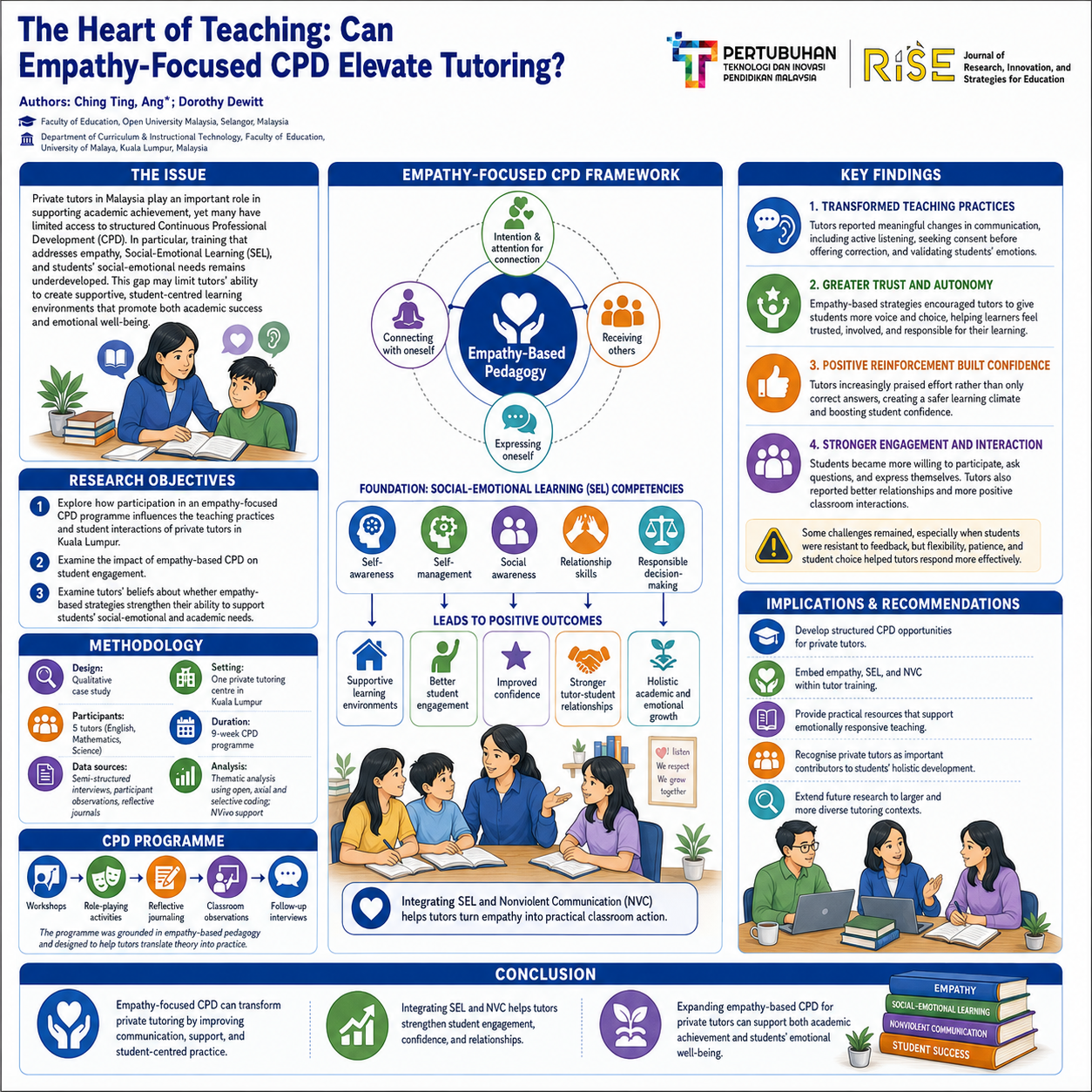
This study aims to explore how a Continuous Professional Development (CPD) programme focused on empathy-based pedagogy can influence the teaching practices of private tutors, with a particular focus on enhancing social-emotional learning (SEL) and student well-being. Given the critical role private tutors play in the academic and emotional development of students, the research seeks to fill the gap in professional development opportunities that support empathy-driven teaching approaches. The methodology used for this qualitative case study includes semi-structured interviews, participant observation, and reflective journaling to collect data on how private tutors perceive and implement empathy-based strategies. The study was conducted at a private tutoring centre, with a focus on understanding the challenges tutors face when applying empathy-based pedagogy and how these strategies impact student engagement and interactions. The findings suggest that empathy-based CPD has a transformative effect on tutors' teaching practices. It enhances their ability to foster stronger student-teacher relationships, create more supportive learning environments, and improve student engagement. Tutors reported that the programme helped them develop greater emotional awareness and communication skills, which in turn positively influenced their students' academic and social development. However, the research is limited by its focus on a single tutoring centre, which may affect the generalisability of the findings to other contexts. Additionally, the study’s reliance on qualitative data means that further quantitative research could be beneficial to corroborate the results.
References
Bandura, A. (1977). Social learning theory. Prentice Hall.
Bozgün, K., & Akın-Kösterelioğlu, M. (2021). The roles of social-emotional development, academic grit and subjective well-being in primary school students’ reading-writing motivation. Reading Psychology, 42(8), 836-857.
Collaborative for Academic, Social, and Emotional Learning. (2020). CASEL’s SEL framework. https://casel.org/wp-content/uploads/2020/10/CASEL-SEL-Framework-10.2020-1.pdf
Creswell, J. W. (2014). Research design: Qualitative, quantitative, and mixed methods approaches. Sage Publications.
Creswell, J. W., & Poth, C. N. (2016). Qualitative inquiry and research design: Choosing among five approaches. Sage Publications.
Diaz-Maggioli, G. (2004). Teacher-centered professional development. ASCD.
Foong, L., Veloo, P. K., Dhamotharan, M., & Loh, C. (2018). Private sector early child care and education in Malaysia: workforce readiness for further education. Kajian Malaysia: Journal of Malaysian Studies, 36(1), 67-82.
Ghazali, S. R., Kirby, K., Armour, C., Goetzke, K., Dunne, M., Gibbons, W., Mc Fadden, P., & Mallett, J. (2021). The effectiveness of hopeful mind program among primary school children in Malaysia: A preliminary study. Global Business and Management Research: An International Journal, 13(2), 96-106.
Goleman, D. (1995). Emotional intelligence. Bloomsbury Publishing.
Halaweh, M., Fidler, C., & McRobb, S. (2008). Integrating the grounded theory method and case study research methodology within is research: A possible 'road map'. Proceedings of the International Conference on Information Systems (ICIS), 165. http://aisel.aisnet.org/icis2008/165
Heath, H., & Cowley, S. (2004). Developing a grounded theory approach: A comparison of Glaser and Strauss. International Journal of Nursing Studies, 41(2), 141-150.
Ilhavenil, N., & Aravindan, K., L. (2023). ‘Teacher, am I empathetic?’ Instilling empathy in adolescents. Malaysian Journal of Learning & Instruction, 20(1), 151-174.
Jennings, P. A., & Greenberg, M. T. (2009). The prosocial classroom: Teacher social and emotional competence in relation to student and classroom outcomes. Review of Educational Research, 79(1), 491-525.
Kenayathulla, H. B. (2016). Research on private tutoring in Malaysia: Methodological insights from a quantitative study. In Researching private supplementary tutoring: Methodological lessons from diverse cultures (pp. 49-58). Springer International Publishing.
Kenayathulla, H. B. (2013). Household expenditures on private tutoring: Emerging evidence from Malaysia. Asia Pacific Education Review, 14, 629-638.
Koopman, S., & Seliga, L. (2021). Teaching peace by using nonviolent communication for difficult conversations in the college classroom. Peace and conflict studies, 27(3), 2.
Lincoln, Y. S., & Guba, E. G. (1985). Naturalistic Inquiry. Sage Publications.
Liu, J., & Bray, M. (2017). Determinants of demand for private supplementary tutoring in China: Findings from a national survey. Education Economics, 25(2), 205-218.
Mahyuddin, R., Abdullah, M., Roslan, S., Elias, H., & Sulaiman, T. (2007). The relationship between emotional quotient and the acquisition of basic skill among primary school children. International Journal of Learning, 14(7), 49-55.
Merriam, S. B., & Tisdell, E. J. (2015). Qualitative research: A guide to design and implementation. John Wiley & Sons.
Ministry of Education Malaysia. (2018, December 2). National Education Philosophy. https://www.moe.gov.my/index.php/en/dasar/falsafah-pendidikan-kebangsaan.
Ministry of Education Malaysia. (2012). Malaysia Education Blueprint 2013-2025. Ministry of Education Malaysia.
Nordin, N. S., Junaidi, J., & Hanid, M. F. A. (2024). Integrating Problem-Based Learning And Design Thinking: Innovative Approaches To Enhancing Student Engagement. Journal of Research, Innovation, and Strategies for Education (RISE), 1(1), 41-57.
Nosek, M., Gifford, E., & Kober, B. (2014). Nonviolent Communication training increases empathy in baccalaureate nursing students: A mixed method study. Journal of Nursing Education & Practice, 4(10), 1-15.
Rogers, C. R. (1961). On becoming a person. Houghton Mifflin.
Rosenberg, M. B. (2015). Nonviolent communication: A language of life (3rd ed.). Puddle Dancer Press.
Vygotsky, L. S. (1978). Internalization of higher psychological functions. Mind in society: The development of higher psychological processes, 37(2), 52-57.
Vygotsky, L. S. (1978). Socio-cultural theory. Mind in Society, 6(3), 23-43.
Wong, F. W. L. (2024). Nurturing Innovation, Transforming Education: A Longitudinal Study. Journal of Research, Innovation, and Strategies for Education (RISE), 1(1), 1-16.
Yin, R. K. (2018). Case study research and applications: Design and methods (6th ed.). Sage.
Zhang, W., & Bray, M. (2020). Comparative research on shadow education: Achievements, challenges, and the agenda ahead. European Journal of Education, 55(3), 322-341.
Downloads
Published
Issue
Section
License
Copyright (c) 2025 Ang Ching Ting, Dorothy Dewitt (Author)

This work is licensed under a Creative Commons Attribution 4.0 International License.