Students’ Perceptions of the Virtual Reality (VR) Environment through GeoVR-Xplorer at Kelantan Matriculation College
DOI:
https://doi.org/10.70148/rise.15Keywords:
Virtual Reality; Exploratory; Realistic; Molecular Geometry; 3DAbstract
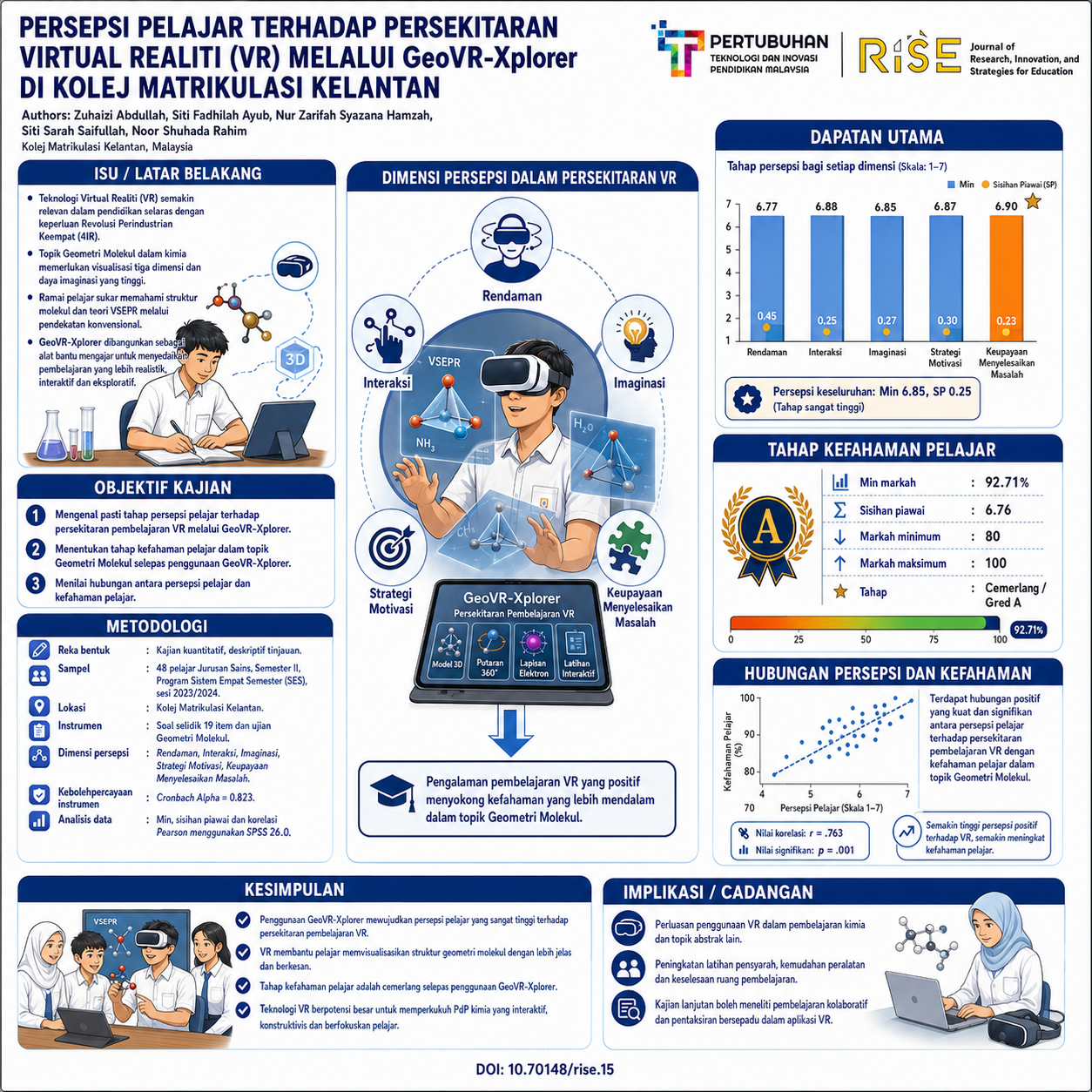
The use of Virtual Reality (VR) technology in education is a new approach introduced to address the challenges of the Fourth Industrial Revolution (4IR). VR provides a realistic learning environment by employing an exploratory approach, particularly for science students studying chemistry. Molecular Geometry is one of the topics that requires a high level of imagination to understand the shapes of molecular compounds. Students' difficulties in visualizing these molecular structures in three dimensions (3D) have led researchers to develop a teaching aid called GeoVR-Xplorer. This study aims to identify students’ perceptions of the VR learning environment through the use of GeoVR-Xplorer. This descriptive study involved 48 students from the Science Department in their second semester of the Four-Semester System (SES) Programme for the 2023/2024 academic session. A set of questionnaires was used in this study, comprising five dimensions: immersion, interaction, imagination, motivational strategy, and problem-solving ability. The findings indicate that students’ perceptions of the VR learning environment using GeoVR-Xplorer were at a very high level, with a mean score of 6.85. Correlation tests conducted in this study revealed a strong positive relationship between students’ perceptions and their understanding. It is hoped that the findings of this study will provide valuable insights for lecturers and educational institutions regarding students' perceptions of the VR learning environment, enabling the broader adoption of this medium in the future.
References
Bahagian Matrikulasi Kementerian Pendidikan Malaysia. Buku Panduan Program Matrikulasi Satu Tahun. (2016). https://www.slideshare.net/slideshow/buku-panduan-pelajar-kolej-matikulasi/67756732
Chwen, Jen Chen (2009) Theoretical Bases for Using Virtual Reality in Education. Themes in Science and Technology Education, 2 (1-2). pp. 71-90. ISSN 1792-8788
Fahmi A. Rosli (2023, November 8,). Dasar pendidikan digital dilancar hari ini. BH online.https://www.bharian.com.my/berita/nasional/2023/11/1182824/dasar-pendidikan-digital-dilancar-hari-ini
Fardani, A. T. (2020). Penggunaan teknologi virtual reality untuk sekolah menengah pertama pada tahun 2010-2020. E-Tech, 8(1), 391851. https://ejournal.unp.ac.id/index.php/e-tech/article/view/108475
Farhana Safar & Noor Azah Abdul Rahman (2021). Pendidikan Interaktif: Penerokaan Virtual Reality (VR) Dalam Visualisasi Model Seni Bina. ANP Journal of Social Science and Humanities, 2(2), 26-38. https://journalarsvot.com/index.php/anp-jssh/article/view/74
Fauzi Hussin, Jamal Ali, & Mohd Saifoul Zamzuri Noor (2014). Kaedah penyelidikan & analisis data SPSS. Universiti Utara Malaysia.
Fernandez, M. (2017). Augmented virtual reality: How to improve education systems. Higher Learning Research Communications, 7(1), 1–15. https://eric.ed.gov/?id=EJ1150087
Gabunilas, L. M., Adlao, E., Burns, K., Chiu, J. S., & Sanchez, S. S. A. (2018). Utilizing portable Virtual reality in teaching chemistry. Sci. Int.(Lahore), 30(2), 263-266. https://shorturl.at/fNSX8
Henry Matovu, Dewi Ayu Kencana Ungu, Mihye Won, Chin-Chung Tsai, David F. Treagust, Mauro Mocerino & Roy Tasker (2023) Immersive virtual reality for science learning: Design, implementation, and evaluation, Studies in Science Education, 59:2, 205-244, DOI: 10.1080/03057267.2022.2082680
Hsiu-Mei Huang, Ulrich Rauch, Shu-Sheng Liaw (2010) Investigating learners’ attitudes toward virtual reality learning environments: Based on a constructivist approach. Computers & Education (2010), doi:10.1016/j.compedu.2010.05.014
Hsiu-Mei Huang & Shu-Sheng Liaw. (2018). An Analysis of Learners’ Intentions Toward Virtual Reality Learning Based on Constructivist and Technology Acceptance Approaches. International Review of Research in Open and Distributed Learning Volume 19, Number 1
Kementerian Pendidikan Malaysia (2013). Pelan Pembangunan Pendidikan Malaysia 2013-2025.https://www.pmo.gov.my/wp-content/uploads/2019/07/Pelan-Pembangunan-Pendidikan-2013_2025.pdf
Lege, Ryan & Bonner, Euan. (2020). Virtual reality in education: The promise, progress, and challenge. JALT CALL Journal. 16. 167-180. 10.29140/jaltcall.v16n3.388.
Lim Chong Hin. (2007). Penyelidikan pendidikan: Pendekatan kuantiatif dan kualitatif. Selangor: McGraw- Hill (Malaysia).https://repo.uum.edu.my/id/eprint/29469/1/MJLI%2014%2001%202017%20211-265.pdf
Lim, G. F., Jalil, N. A., Hidup, D. S. A., & Omar, M. (2024). Pengintegrasian Teknologi dalam Pendidikan: Cabaran Guru. International Journal of Modern Languages And Applied Linguistics, 8(1), 49-67. https://myjms.mohe.gov.my/index.php/ijmal/article/view/24217
Pallant, J. (2011). SPSS Survival Manual: A Step by Step Guide to Data Analysis Using SPSS (4th Ed). Australia: Allen and Unwin. Diperolehi dari http://dx.doi.org/10.6007/IJARBSS/v7-i8/3301
Romainor, N., Abdul Talib, C., & Aliyu, F. (2022). Augmented Reality in Chemistry Education: A Literature Review of Advantages on Learners. Journal of Natural Science and Integration, 5(1), 126–135. https://doi.org/10.24014/JNSI.V5I1.16805.
Safar, F., & Raman, N. A. A. (2021). Pendidikan Interaktif: Penerokaan Virtual Reality (VR) Dalam Visualisasi Model Seni Bina. ANP Journal of Social Science and Humanities, 2(2), 26-38. https://doi.org/10.53797/anpjssh.v2i2.4.2021
Sekaran U., & Bougie, R. (2013). Research methods for business: A skill-building approach.Wiley.
Downloads
Published
Issue
Section
License
Copyright (c) 2025 Zuhaizi Abdullah, Siti Fadhilah Ayub, Nur Zarifah Syazana Hamzah, Siti Sarah Saifullah, Noor Shuhada Rahim (Author)

This work is licensed under a Creative Commons Attribution 4.0 International License.