The Writing Skills Gap and the Potential of Augmented Reality for Students with Special Educational Needs (Learning Disabilities)
DOI:
https://doi.org/10.70148/rise.13Keywords:
Writing Skills; Learning Disabilities; Content Analysis; Augmented Reality; Malay LanguageAbstract
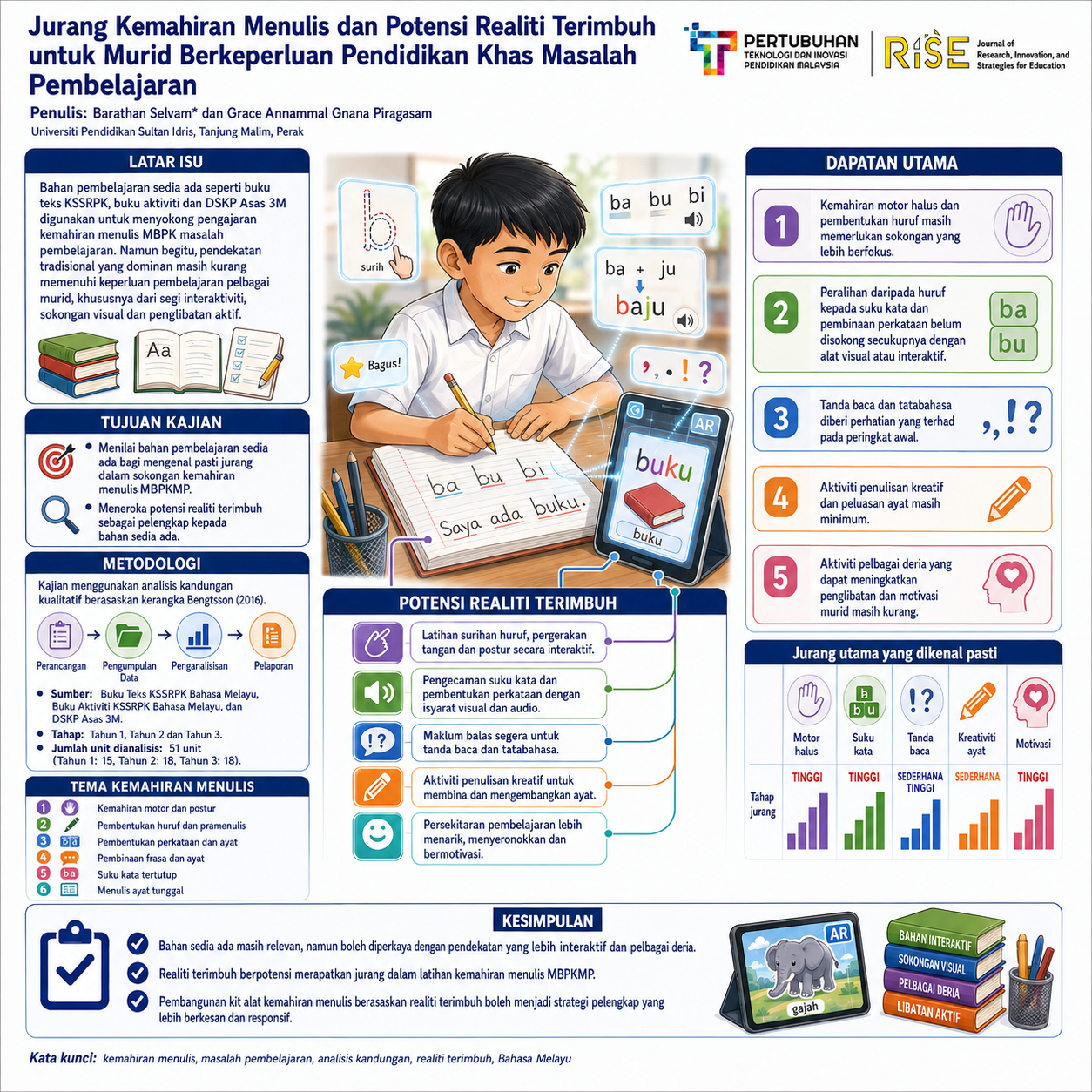
This study evaluates three types of existing learning materials, namely the Special Education Standard Based Curriculum for Primary School Standard Curriculum textbooks (KSSRPK), the KSSRPK activity book and the 3M Basic Standards-Based Curriculum and Assessment Document (DSKP) used to support the teaching of writing skills among students with learning disabilities in Special Education Integration Programme (PPKI) primary schools. The use of Bengtsson's (2016) qualitative content analysis framework helped identify five gaps in writing skills, such as limited support in fine motor skills training, syllable recognition, punctuation, grammar, and creative writing. Existing learning materials also rely heavily on traditional teaching methods, lacking interactive elements needed to meet the diverse learning needs of today’s students. To address this gap, this study suggests the potential of innovative technologies such as augmented reality (AR) to complement existing materials. AR offers interactive and visually appealing solutions to constraints such as providing instant feedback, increasing engagement, and offering appropriate exercises to reinforce understanding. This technology aligns with the needs of students and enables teachers to modernize their teaching approach. These findings emphasize the need to adapt teaching resources to evolving student requirements. While current learning materials are appropriate, incorporating an interactive approach can help bridge the gap and create a more effective and relevant learning environment. This study highlights the importance of implementing innovative teaching strategies and resources to support the growing needs of students.
References
Almaiah, M. A., Alamri, M. M., & Al-Rahmi, W. M. (2019). Analysis the effect of different factors on the development of Mobile learning applications at different stages of usage. Ieee Access, 8, 16139–16154.
Aydoğdu, F., & Kelpšiene, M. (2021). Uses of Augmented Reality in Preschool Education. International Technology and Education Journal, 5(1), 11–20.
Ayvazo, S., Inbar-Furst, H., & Meadan, H. (2021). Technology-Based Model to Support and Enhance Field Experience in Special Education Training Programs in Israel. Journal of Higher Education Theory & Practice, 21(9).
Azalina Mokmin, & Nabilah Izzati Ridhuan. (2022). Immersive Technologies in Physical Education in Malaysia for Students with Learning Disabilities. IAFOR Journal of Education, 10(2), 91–110.
Bengtsson, M. (2016). How to plan and perform a qualitative study using content analysis. NursingPlus Open, 2, 8–14. https://doi.org/10.1016/j.npls.2016.01.001
Berelson, B. (1952). Content analysis in communication research. Free press.
Berg, B. L. (2001). Qualitative research methods for the social sciences. Allyn & Bacon.
Boyle, J. R., Rosen, S. M., & Forchelli, G. (2016). Exploring metacognitive strategy use during note-taking for students with learning disabilities. Education 3-13, 44(2), 161–180. https://doi.org/10.1080/03004279.2014.929722
Calabuig-Moreno, F., González-Serrano, M. H., Fombona, J., & Garcia-Tascon, M. (2020). The emergence of technology in physical education: A general bibliometric analysis with a focus on virtual and augmented reality. Sustainability, 12(7), 2728.
Cheng, K. H. (2017). Reading an augmented reality book: An exploration of learners’ cognitive load, motivation, and attitudes. Australasian Journal of
Educational Technology, 33(4), 53–69. https://doi.org/10.14742/ajet.2820
Delima 2.0. (2023). Repositori Buku Teks Digital KPM › Pendidikan Khas. https://lookerstudio.google.com/u/0/reporting/19d52769-d10b-40c7-a11b-720cf7186ca9/page/p_ghhj3egz4c
Farah Adlina Mokter. (2019). Keberkesanan Pembelajaran Berasaskan Masalah Terhadap Pencapaian Dan Kemahiran Berfikir Aras Tinggi Pelajar Dalam Penulisan Karangan Bahasa Melayu. Jurnal Pendidikan Bahasa Melayu, 9(3), 33–46.
Graham, S., Collins, A. A., & Rigby-Wills, H. (2017). Writing characteristics of students with learning disabilities and typically achieving peers: A meta-analysis. Exceptional Children, 83(2), 199–218. https://doi.org/10.1177/0014402916664070
Graham, S., & Harris, K. (2000). The role of self-regulation and transcription skills in writing and writing development. Educational Psychologist, 35(1), 3–12.
Graham, S., & Harris, K. R. (2003). Students with learning disabilities and the process of writing: A meta-analysis of SRSD studies. The Guilford Press.
Hebert, M., Kearns, D. M., Hayes, J. B., Bazis, P., & Cooper, S. (2018). Why
Children With Dyslexia Struggle With Writing and How to Help Them. Language, Speech, and Hearing Services in Schools, 49(4), 843–863. https://doi.org/10.1044/2018_LSHSS-DYSLC-18-0024
Hrishikesh, N., & Nair, J. J. (2016). Interactive learning system for the hearing impaired and the vocally challenged. 2016 International Conference on Advances in Computing, Communications and Informatics (ICACCI), 1079–1083. https://doi.org/10.1109/ICACCI.2016.7732188
Kementerian Pendidikan Malaysia. (2013). Peraturan-peraturan Pendidikan (Pendidikan Khas) 2013. Warta Kerajaan Persekutuan, P. U. (A)(July), 1–16.
Kementerian Pendidikan Malaysia. (2019). Pelan Transformasi ICT Kementerian Pendidikan Malaysia 2019-2023. In Bahagian Pengurusan Maklumat, KPM.
Köse, H., & Güner-Yildiz, N. (2021). Augmented reality (AR) as a learning material in special needs education. Education and Information Technologies, 26(2), 1921–1936. https://doi.org/10.1007/s10639-020-10326-w
Krippendorff, K. (2018). Content analysis: An introduction to its methodology. Sage publications.
Kroesch, A. M., Peeples, K. N., Pleasant, C. L., & Cuenca-Carlino, Y. (2022). Let’s Argue: Developing Argumentative Writing Skills for Students with Learning Disabilities. Reading & Writing Quarterly, 38(5), 399–414. https://doi.org/10.1080/10573569.2021.1970659
Kun-Hung Cheng. (2017). Reading an augmented reality book: An exploration of learners’ cognitive load, motivation, and attitudes. Australasian Journal of Educational Technology. https://doi.org/10.14742/ajet.2820
Mohd Yusof, A., Daniel, E. G. S., Low, W. Y., & Ab. Aziz, K. (2014). Teachers perception of mobile edutainment for special needs learners: The Malaysian case. International Journal of Inclusive Education, 18(12), 1237–1246. https://doi.org/10.1080/13603116.2014.885595
Na, K., & Prince, E. (2021). The Use Of Augmented Reality Book To Enhance Writing Skill Of Primary School Students using Thai As A Second Language. 20(6), 1163–1171. https://doi.org/10.17051/ilkonline.2021.06.123
Norfaizah Jobar, Anida Sarudin, & Idris Radzi. (2014). Pola Tematik Dan Implikasinya Dalam Pengajaran Penulisan Karangan: Thematic Patterns and their Implications in Teaching Essay Writing. PENDETA, 5, 71–88.
Nur Shakirah Azizan, & Saiful Haq Hussin. (2017). Penguasaan Asas Membaca Bahasa Melayu Melalui Program Linus di Utara Semenanjung Malaysia: Basic Mastery of Reading Malay Through The Linus Program In Northern Area of Peninsular Malaysia. Jurnal Pengajian Melayu (JOMAS), 28(1), 135–163.
Ong, S. W., & Faridah Mydin Kutty. (2022). Potensi Penggunaan Augmented Reality dalam Meningkatkan Motivasi dan Penglibatan Murid Pemulihan dalam Aktiviti Penulisan. Malaysian Journal of Social Sciences and Humanities (MJSSH), 7(3), e001366. https://doi.org/10.47405/mjssh.v7i3.1366
Pitamber Gautam. (2019). Writing skill: An instructional overview. Journal of NELTA Gandaki, 2, 74–90.
Rasid Jamian. (2021). Permasalahan kemahiran membaca dan menulis Bahasa Melayu murid-murid sekolah rendah di luar bandar. Jurnal Pendidikan Bahasa Melayu, 1(1), 1–12.
Saddler, B., Asaro-Saddler, K., Moeyaert, M., & Cuccio-Slichko, J. (2019). Teaching Summary Writing to Students with Learning Disabilities via Strategy Instruction. Reading & Writing Quarterly, 35(6), 572–586. https://doi.org/10.1080/10573569.2019.1600085
Saddler, B., Moran, S., Graham, S., & Harris, K. R. (2004). Preventing writing difficulties: The effects of planning strategy instruction on the writing performance of struggling writers. Exceptionality, 12(1), 3–17.
Sáez-López, J.-M., Sevillano-García-García, M. L., & Pascual-Sevillano, M. de los Á. (2019). Application of the ubiquitous game with augmented reality in Primary Education. Comunicar, 27(61), 71–82. https://doi.org/10.3916/C61-2019-06
Swanson, H. L., Harris, K. R., & Graham, S. (2014). The writing of students with LD and a meta-analysis of SRSD writing intervention studies. In Handbook of Learning Disabilities (2nd ed.). Guilford Publications. https://books.google.com.my/books?id=_xk6BAAAQBAJ
Wei, C. Y., Kuah, Y. C., Ng, C. P., & Lau, W. K. (2021). Augmented Reality (AR) as an Enhancement Teaching Tool: Are Educators Ready for It? Contemporary Educational Technology, 13(3), ep303. https://doi.org/10.30935/cedtech/10866
Yoke, N. T., & Syawal Amran. (2021). Pembelajaran menggunakan kaedah brainwriting dalam membantu murid menguasai kemahiran menulis. Sains Insani, 6(2).
Zajda, J. (2024). Curriculum Design and Evaluation in the Global Culture. In P. P. Trifonas & S. Jagger (Eds.), Handbook of Curriculum Theory, Research, and Practice (pp. 783–797). Springer International Publishing. https://doi.org/10.1007/978-3-031-21155-3_23
Downloads
Published
Issue
Section
License
Copyright (c) 2025 Barathan Selvam, Grace Annammal Gnana Piragasam (Author)

This work is licensed under a Creative Commons Attribution 4.0 International License.