The Impact of Generative AI in Thesis Writing Support on Research Quality of Postgraduate Students: Mediating Role of Writing Confidence
DOI:
https://doi.org/10.70148/rise.17Keywords:
Generative AI, Thesis Writing, Research Quality, Writing Confidence, Postgraduate Students.Abstract
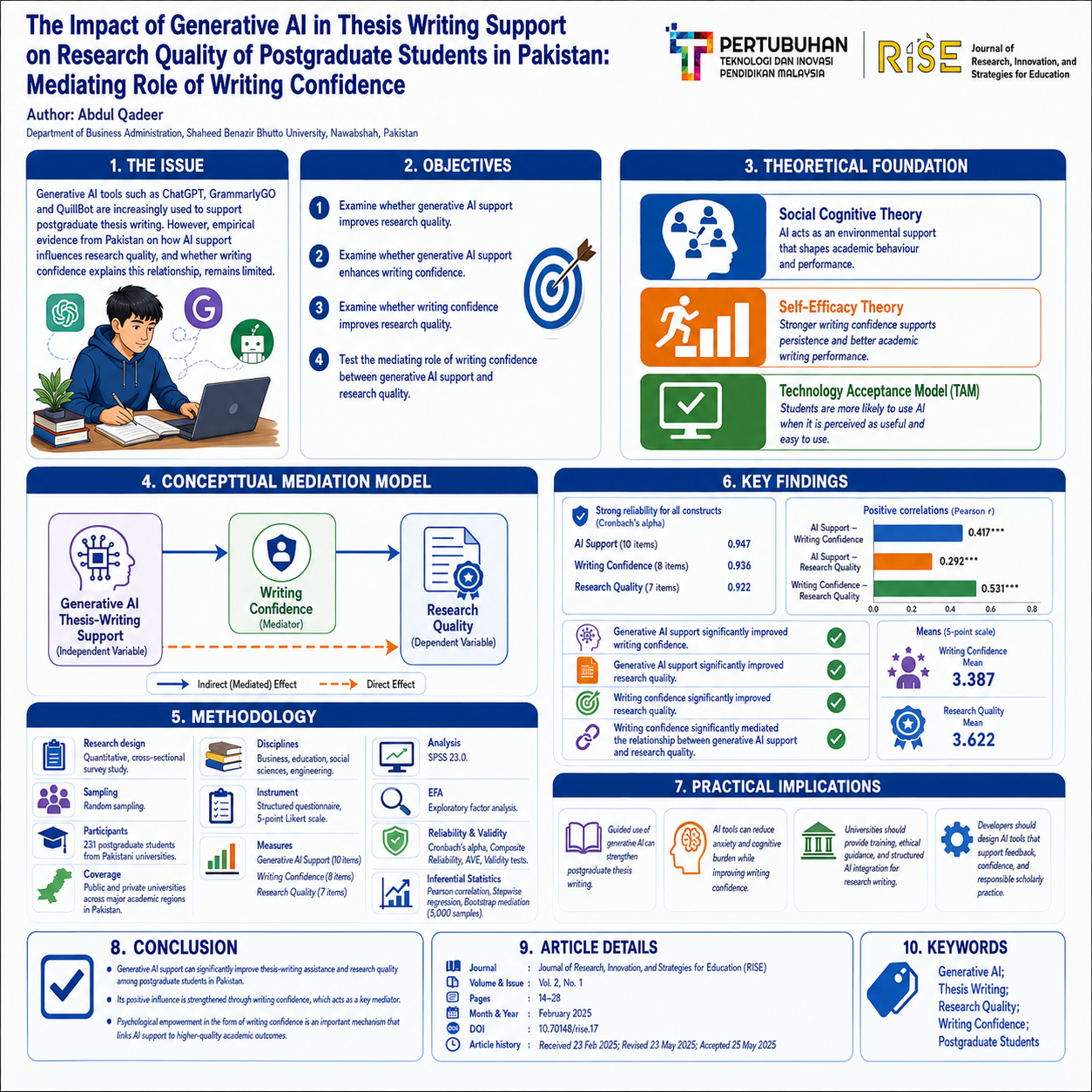
This research explores the effects of generative AI tools on the thesis writing assistance and research activities of postgraduate students, paying particular attention to the mediating influence of confidence in writing. Information was obtained from 231 respondents—who are postgraduates from various Pakistani universities—through structured questionnaires. SPSS 23.0 was used to conduct a number of statistical analyses such as reliability and validity testing, exploratory factor analysis (EFA), and mediation analysis to test hypothesized relationships among constructs. The findings indicate that the application of generativeAI tools markedly improves the students’ research quality by increasing their confidence in academic writing. In addition, writing confidence was identified as a crucial mediating factor that linked AI assistance with better research outputs. These findings add to our knowledge of the use of digital technologies, and generative AI in particular, as powerful facilitators of achieving academic excellence. The research advances the debate on technology-enhanced learning by providing concrete recommendations on the use of AI tools in the postgraduate education system of Pakistan.
References
Alghizzawi, M., Hussain, Z., Abualfalayeh, G., Abu-AlSondos, I. A., Alqsass, M., & Chehaimi, E. M. (2025). The Impact of AI-driven Strategy on Salespeople Training and Performance. International Review of Management and Marketing, 15(2), 1-11.
Almagharbeh, W. T. (2025). The impact of AI‐based decision support systems on nursing workflows in critical care units. International nursing review, 72(2), e13011.
Al-Akash, H., Aldarawsheh, A., Elshatarat, R., Sawalha, M., Saifan, A., Al-Nsair, N., … & Eltayeb, M. (2024). “We do others’ Jobs”: a qualitative study of non-nursing task challenges and proposed solutions. BMC nursing, 23(1), 478.
Almagharbeh, W. T., Alfanash, H. A., Alnawafleh, K. A., Alasmari, A. A., Alsaraireh, F. A., Dreidi, M. M., & Nashwan, A. J. (2025). Application of artificial intelligence in nursing practice: a qualitative study of Jordanian nurses’ perspectives. BMC nursing, 24(1), 92.
Aldarawsheh, A. A., Saifan, A. R., Sawalha, M. A., Assaf, E. A., Alrimawi, I., Elshatarat, R. A., … & Eltayeb, M. M. (2024). Exploring the causes and consequences of non-nursing tasks among nurses in Jordan: An in-depth qualitative investigation. Applied Nursing Research, 77, 151791.
Alsharawneh, A., Sawalha, M., Tabar, N. A., Elshatarat, R. A., Almarwani, A. M., Saleh, Z. T., … & Eltayeb, M. M. (2024). Impact of triage nurses’ recognition of acute coronary syndrome on patients’ clinical outcomes: A retrospective study. Heart & Lung, 68, 60-67.
Ashour, A. M., Masa’deh, R., Hamaideh, S. H., Elshatarat, R. A., Yacoub, M. I., Almagharbeh, W. T., … & Eltayeb, M. M. (2024). Examining the influence of anxiety and depression on medication adherence among patients diagnosed with acute myocardial infarction. BMC psychology, 12(1), 473.
Agbonselohbor, B., Aslanoğlu, A., Bilgiç, N., Alsharawneh, A., Elshatarat, R. A., Saleh, Z. T., … & Eltayeb, M. M. (2025). Associated factors of Nigerian Nurses’ Emotion regulation, perceived stress, and coping mechanism during COVID-19 Pandamic: a cross-sectional study. African Health Sciences, 25(1), 84-110.
Alzaareer, M., Aslanoğlu, A., Elshatarat, R. A., Almagharbeh, W. T., Saleh, A. A., Al-Akash, H. Y., … & Ismail, N. (2024). Opportunistic Bacterial Infections and Control Measures in Saudi Arabian Healthcare Facilities: A Literature Review. Research Journal of Pharmacy and Technology, 17(7), 3521-3526.
Abdulghani, M. F., Barzegari, R., Almagharbeh, W. T., Yazdani, Z., Amandadi Ghotbabadi, A., Seyed Bagheri, S. H., … & Dehghan, M. (2025). Treatments of psychosomatic symptoms in Alzheimer’s disease: a scoping review of the potential therapeutic effects of essential oils. Psychogeriatrics, 25(2), e70007.
Alsaraireh, M., Al-Kalaldeh, M., Alnawafleh, K., Dwairej, D. A., & Almagharbeh, W. (2025). Associated Factors Influencing Quality of Life and Knowledge Among Type 2 Diabetic Patients: A Cross-Sectional Study. Current Diabetes Reviews, 21(2), E090224226838.
Bandura, A. (1986). Social foundations of thought and action. Englewood Cliffs, NJ, 1986(23-28), 2.
Bandura, A. (1999). Social cognitive theory: An agentic perspective. Asian journal of social psychology, 2(1), 21-41.
Chanpradit, T. (2025). Generative artificial intelligence in academic writing in higher education: A systematic review. Edelweiss Applied Science and Technology, 9(4), 889-906.
Chan, S., Lo, N., & Wong, A. (2025). Leveraging generative AI for enhancing university-level English writing: comparative insights on automated feedback and student engagement. Cogent Education, 12(1), 2440182.
Cheng, Y., Lyons, K., Chen, G., Gašević, D., & Swiecki, Z. (2024, March). Evidence-centered assessment for writing with generative AI. In Proceedings of the 14th Learning Analytics and Knowledge Conference (pp. 178-188).
Din, A. L., Qamar, N., Abaid, T., Akhter, N., Alfanash, H. A., & Almagharbeh, W. T. (2024). Daily Management Insights: A Social Phenomenological Study Of Head Nurses. Frontiers in Health Informatics, 13(4).
Davis, F. D. (1989). Perceived usefulness, perceived ease of use, and user acceptance of information technology. MIS quarterly, 319-340.
Dreidi, M., Abed, D., Salameh, H., Sbeih, I. A., Asmar, S., Salameh, S., … & Almagharbeh, W. T. (2024). The effect of self-esteem on stress and coping mechanisms among nursing students during clinical training in Palestinian universities. International Journal of Practice-based Learning in Health and Social Care, 12(1), 59-69.
El Gareh, F., Elmenssouri, A., Oulamine, A., & Hussain, Z. (2025). A PRISMA-Based Systematic Review on Organizational Commitment and Logistic Performance. Knowledge Sharing and Fostering Collaborative Business Culture, 213-240.
George, A. S. (2023). The potential of generative AI to reform graduate education. Partners Universal International Research Journal, 2(4), 36-50.
Hussain, Z. (2023, April). Analyzing the Emerging Trends of Digital Literacy Among Muslim Students Zahid Hussain. In The 1st Annual Conference of Islamic Education (pp. 125-134). Atlantis Press.
Hysaj, A., Dean, B. A., & Freeman, M. (2025). Exploring the purposes and uses of generative artificial intelligence tools in academic writing for multicultural students. Higher Education Research & Development, 1-15.
Hussain, Z., Khan, A., & Ali, A. (2023). The impact of user-generated content, social interactions and virtual economies on metaverse environments. Journal of Sustainable Economics, 1(2), 34-44.
Ironsi, C. S., & Solomon Ironsi, S. (2025). Experimental evidence for the efficacy of generative AI in improving students’ writing skills. Quality assurance in education, 33(2), 237-252.
Ilma, A., & Sampurna, R. A. (2024). Exploring the Impact of Language Models on Undergraduate Thesis Writing Skills among Higher Education Students. Peradaban Journal of Interdisciplinary Educational Research, 2(1), 1-21.
Khan, A., Hamid, A. B. A., Saad, N. M., Hussain, Z., & Arif, A. R. (2023). Effectiveness of artificial intelligence in building customer loyalty: investigating the mediating role of chatbot in the tourism sector of Pakistan. International Journal of Academic Research in Business and Social Sciences, 13(9), 657-671.
Khan, A., Hussain, Z., Majeed, M. U., & Padhi, A. (2024). Analyzing the Effectiveness of Influencer Campaigns in Driving Customer Acquisition and Retention: Perspectives from Unilever Pakistan. In Advances in Data Analytics for Influencer Marketing: An Interdisciplinary Approach (pp. 241-256). Cham: Springer Nature Switzerland.
Kim, J., Yu, S., Detrick, R., & Li, N. (2025). Exploring students’ perspectives on generative AI-assisted academic writing. Education and Information Technologies, 30(1), 1265-1300.
Li, Z., Liang, C., Peng, J., & Yin, M. (2024, May). The value, benefits, and concerns of generative ai-powered assistance in writing. In Proceedings of the 2024 CHI Conference on Human Factors in Computing Systems (pp. 1-25).
Lee, H. P., Sarkar, A., Tankelevitch, L., Drosos, I., Rintel, S., Banks, R., & Wilson, N. (2025, April). The impact of generative AI on critical thinking: Self-reported reductions in cognitive effort and confidence effects from a survey of knowledge workers. In Proceedings of the 2025 CHI Conference on Human Factors in Computing Systems (pp. 1-22).
Maphoto, K. B., Sevnarayan, K., Mohale, N. E., Suliman, Z., Ntsopi, T. J., & Mokoena, D. (2024). Advancing students’ academic excellence in distance education: Exploring the potential of generative AI integration to improve academic writing skills. Open Praxis, 16(2), 142-159.
Parker, J. L., Becker, K., & Carroca, C. (2023). ChatGPT for automated writing evaluation in scholarly writing instruction. Journal of Nursing Education, 62(12), 721-727.
Rowland, D. R. (2023). Two frameworks to guide discussions around levels of acceptable use of generative AI in student academic research and writing. Journal of Academic Language and Learning, 17(1), T31-T69.
Ringo, D. S. (2025). The effect of generative AI use on doctoral students’ academic research progress: the moderating role of hedonic gratification. Cogent Education, 12(1), 2475268.
Subih, M., Rababa, M., Aryan, F. S., Alnaeem, M., AlRahahleh, M. H., Al Niarat, T. F., … & Elshatarat, R. A. (2025). Factors influencing nurses’ knowledge and competence in warfarin-drug and nutrient interactions and patient counseling practices. BMC Medical Education, 25(1), 540.
Suglo, E. K., Mejira, A., Bayor, N., Nyemewero, I., & Godfred, A. A. (2024). Integrating Generative AI in Contemporary Research Writing: Exploring Postgraduates’ Knowledge and Willingness to Use GenAI in the Upper East Region of Ghana. American Journal of Technology, 3(1), 33-51.
Saleh, Z. T., Rababa, M., Elshatarat, R. A., Alharbi, M., Alhumaidi, B. N., Al-Za’areer, M. S., … & Fadila, D. E. S. (2025). Exploring faculty perceptions and concerns regarding artificial intelligence Chatbots in nursing education: potential benefits and limitations. BMC nursing, 24(1), 440.
Saleh, Z. T., Aslanoglu, A., Al-Dgheim, R., Sawalha, M. A., Elshatarat, R. A., Al-Akash, H. Y., … & Alharbi, M. K. (2024). Effectiveness of Triage Professionals’ Knowledge and Experience on Their Ability in Early Diagnosis and Consequent Treatment of Acute Coronary Syndrome: A Literature Review Study. Research Journal of Pharmacy and Technology, 17(8), 4075-4082.
Saleh, Z. T., Aslanoğlu, A., Almagharbeh, W. T., Fadila, D. E. S., Nagoor Thangam, M. M., Al‐Dgheim, R., … & Ebeid, I. A. (2025). Reducing sedentary behavior improves depressive symptoms among patients with heart failure enrolled in a home‐based mobile health app cardiac rehabilitation. Journal of Nursing Scholarship, 57(3), 394-403.
Tiandem-Adamou, Y. (2024). Using Generative Artificial Intelligence to Support EFL Students’ Writing Proficiency in University in China. Journal of Educational Technology and Innovation, 6(4).
Washington, J. (2023). The impact of generative artificial intelligence on writer’s self-efficacy: a critical literature review. Available at SSRN 4538043.
Yeung, S. (2025). University students’ engagement with generative AI-supported automated writing evaluation (AWE) feedback. Journal of Second Language Writing, 68, 101203.
Downloads
Published
Issue
Section
License
Copyright (c) 2025 Abdul Qadeer (Author)

This work is licensed under a Creative Commons Attribution 4.0 International License.