Analysing Translation Errors of Higher Education Learners Using MQM and ISO 17100: Implications for Language Education
DOI:
https://doi.org/10.70148/rise.20Keywords:
ISO17100, MQM framework, Linguistic conventions, Translation errors, Translation qualityAbstract
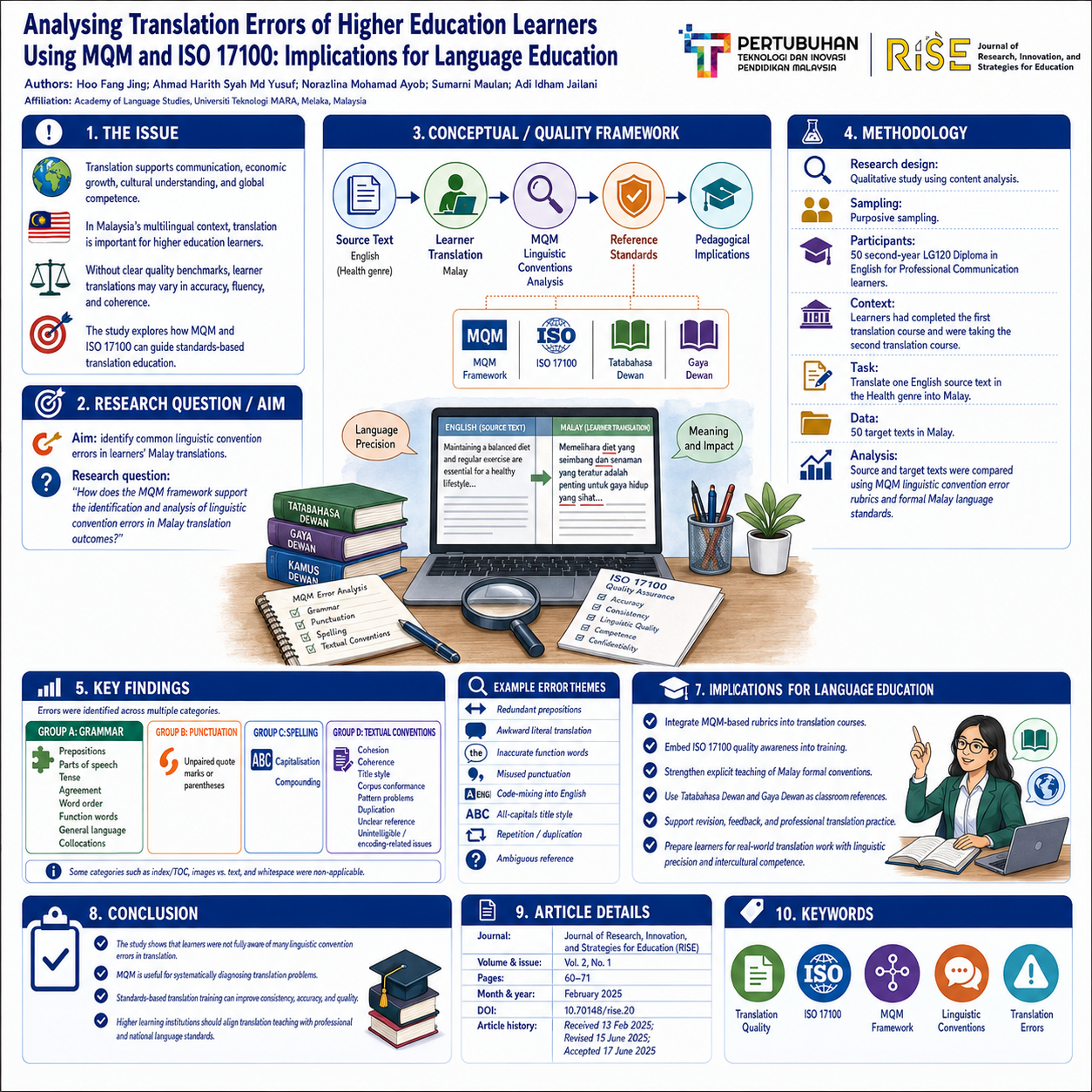
Translation enhances communication, political cooperation, economic growth, and cultural acceptance in today's globalised society. As the world gets increasingly interconnected, translation becomes more important for understanding diversity. Due to the many cultures and languages in Malaysia, mastering translation is crucial for higher education learners to bridge communities and perform global competency. Unfortunately, the lack of a quality benchmark will only aggravate the quality issue if translated work varies greatly in correctness, fluency, and coherence. The MQM framework with an emphasis on linguistic is used to identify common translation errors in learners' works concerning Malay language conventions and formal standards. This study examined 50 target texts in Malay derived from a single source text translated by the LG120 Diploma in English for Professional Communication program. The result shows 13 linguistic convention error categories and non-applicable errors in the index, TOC, images vs. text, and whitespace. This shows that learners were unaware of translation issues, which could be a concern if not addressed during learning. This article provides important information on linguistic convention errors and MQM, although the number of learners was limited and their language proficiency in both languages was not measured. Filing this gap with future research would deepen the findings' interpretation and provide more specific translation training pedagogical ideas.
References
Abd Hamid, M. F., Mokhtar, D. S., & Haron, R. (2022). Analisis Kesalahan Tatabahasa dalam Teks Perutusan Khas Perintah Kawalan Pergerakan (PKP) untuk Mengawal Wabak COVID-19. PENDETA, 13(1), 84-102. https://doi.org/10.37134/pendeta.vol13.1.8.2022
Beseghi, M. (2021). Bridging the gap between non-professional subtitling and translator training: a collaborative approach. The Interpreter and Translator Trainer, 15(1), 102–117. https://doi.org/10.1080/1750399x.2021.1880307
Dewan Bahasa dan Pustaka. (1992). Pedoman umum ejaan Bahasa Melayu. Dewan Bahasa dan Pustaka.
Dewan Bahasa dan Pustaka. (2016). Daftar kata bahasa Melayu. Dewan Bahasa dan Pustaka.
Exeter. (2018). Translation studies at Exeter. Retrieved https://blogs.exeter.ac.uk/translation/blog/author/ak609/
Berk, L. E., & Garvin, R. A. (1984). Development of private speech among low-income Appalachian children. Developmental Psychology, 20(2), 271–286. https://doi.org/10.1037/0012-1649.20.2.271
Hatim, B., & Munday, J. (2004). Translation: An advanced resource book. New York: Routledge.
Latorraca, R., & Aiello, J. (2021). Investigating translation trainees’ self-perceived competence. Babel Revue Internationale De La Traduction / International Journal of Translation / Revista Internacional De Traducción, 67(4), 460–481. https://doi.org/10.1075/babel.00232.lat
Nik Safiah Karim, Farid M. Onn & Hashim Musa. (2015). Tatabahasa Dewan. Dewan Bahasa dan Pustaka.
The Star. (2024, May 31). DBP to Translate Chinese Works on AI Field. Retrieved from https://www.thestar.com.my
KLSE.i3investor.com. (2024, October 10). DBP to expand Malay language programs abroad. Retrieved from https://klse.i3investor.com
Krippendorff, K. (2013). Content analysis: An introduction to its methodology (3rd ed.). Thousand Oaks, CA: Sage.
Rafidah Mat Ruzki. (2021). Tingkatkan penguatkuasaan penggunaan bahasa Melayu. Diperoleh pada 28 Julai 2022 dari https://www.bharian.com.my/berita/nasional/2021/11/893318/tingkat-penguatkuasaan- penggunaan-bahasa-melayu
De Céspedes, B. R. (2020). Beyond the margins of academic education: identifying translation industry training practices through action research. The International Journal of Translation and Interpreting Research, 12(1), 115–126. https://doi.org/10.12807/ti.112201.2020.a07
Salinah Jaafar & Rohaidah Haron. (2016). Kesilapan bahasa Melayu dalam kalangan pelajar-pelajar Universiti Kebangsaan Yunnan di Akademi Pengajian Melayu. Jurnal Melayu, 15(2), 197-209.
Siregar, R., Safriandi, F., Ramadhan, A., Kalsum, E. U., & Siregar, M. Z. (2022). Penerjemahan sebagai jembatan antar budaya. Jurnal Derma Pengabdian Dosen Perguruan Tinggi (Jurnal DEPUTI), 2(1), 42–46. https://doi.org/10.54123/deputi.v2i1.109
Tan, S., & Cho, Y. W. (2021). Towards a higher order thinking skills-oriented translation competence model. Translation Cognition & Behavior, 4(2), 187–211. https://doi.org/10.1075/tcb.00053.tan
Toury, G. (1980). In Search of a Theory of Translation. Tel Aviv: The Porter Institute for Poetics and Semiotics, Tel Aviv University.
Toury, G. (2012). Descriptive Translation Studies – and beyond. In Benjamins translation library. https://doi.org/10.1075/btl.100
Wikipedia. (2023). Translation studies. Retrieved https://en.wikipedia.org/wiki/Translation_studies
Yang, Z., & Li, D. (2021). Translation competence revisited: Toward a pedagogical model of translation competence. In New Frontiers in Translation Studies (pp. 109–138). https://doi.org/10.1007/978-981-16-2070-6_6
Downloads
Published
Issue
Section
License
Copyright (c) 2025 Hoo , Harith, Norazlina, Sumarni , Idham (Author)

This work is licensed under a Creative Commons Attribution 4.0 International License.