A Systematic Literature Review (SLR) on the Use of Augmented Reality (AR) Technology in the Teaching and Learning of Islamic Education
DOI:
https://doi.org/10.70148/rise.v2i3.1Keywords:
Augmented Reality (AR), Islamic Education, Teaching and Learning (T&L)Abstract
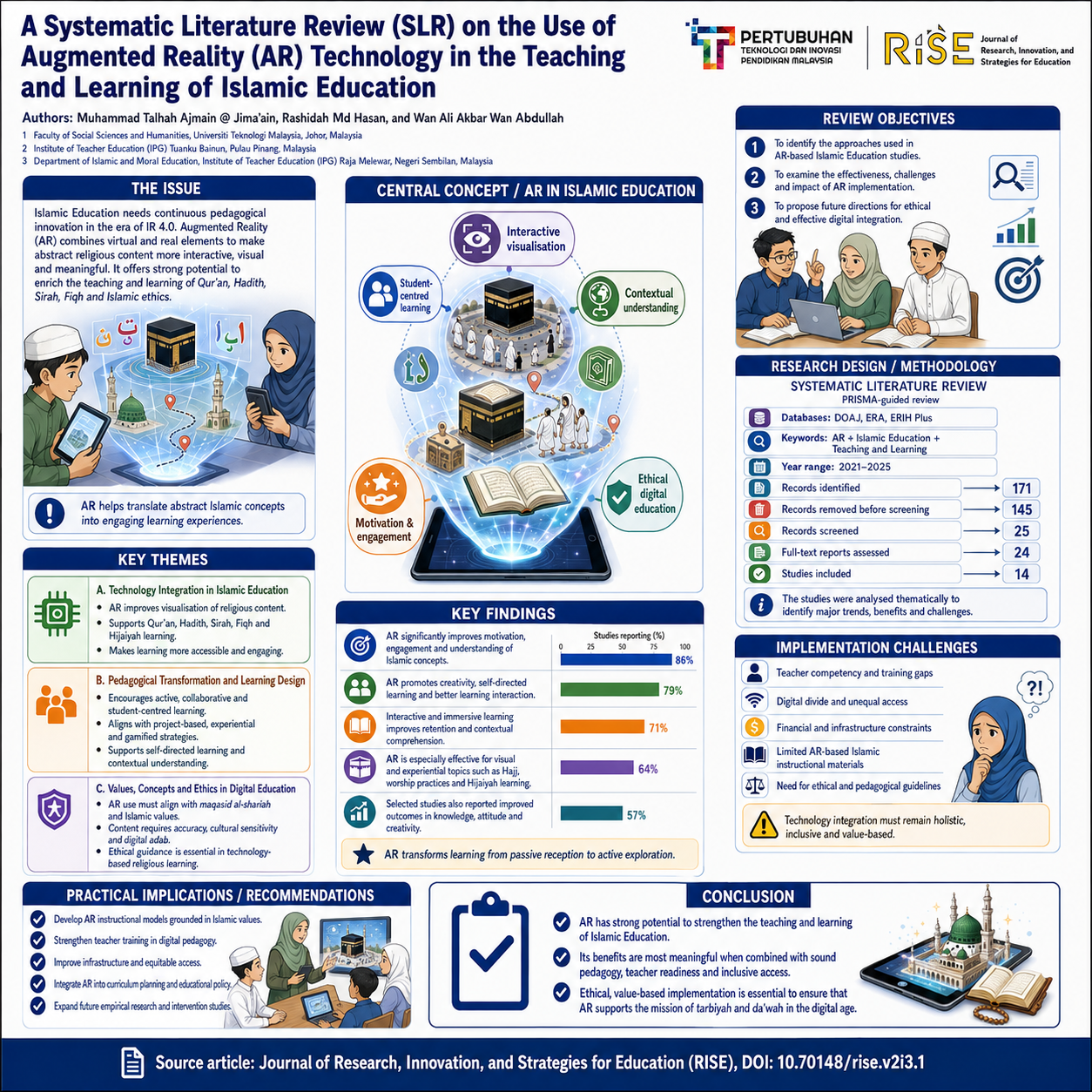
This systematic literature review (SLR) was conducted to examine the effectiveness of Augmented Reality (AR) technology in the teaching and learning (T&L) of Islamic Education. AR, as a technology that merges virtual and real elements, has the potential to enhance students' learning experiences through more interactive visualisation of religious content. The objective of this study is to identify the approaches, effectiveness, and challenges of AR implementation within the context of Islamic Education, as well as to propose directions for future research. The PRISMA method was employed to ensure a transparent and comprehensive systematic review process. Searches were conducted across three major databases DOAJ, ERA and ERIH Plus using keywords related to AR and Islamic Education, resulting in 14 selected articles based on eligibility criteria. The findings were thematically analysed and yielded three key themes: integration of technology in Islamic Education, pedagogical transformation and instructional design, and values, concepts and ethics in digital education. AR was found to significantly improve students’ motivation, engagement, and understanding of Islamic concepts, while also promoting self-directed and student-centred learning. However, the implementation of this technology faces challenges in terms of teacher competency, the digital divide, and the need for ethical guidelines anchored in maqasid shariah. This study recommends that the development of AR-based instructional models in Islamic Education be designed holistically, inclusively and grounded in Islamic values. Future research should focus on teacher training, the development of Islamic technology-based curricula, and educational policies that support ethical and effective digital integration.
References
Adhani, S. S., Gustalika, I., & A, S. M. (2022). Penggunaan Teknologi Augmented Reality Dalam Pembelajaran Agama Islam. Jurnal Online Universitas Muhammadiyah Surabaya. Dicapai dari https://journal.um-surabaya.ac.id/Mas/article/download/22684/7946/59185
Ahmad Bakati, & Cahyadi, A. (2024). Teknologi sebagai pendekatan dalam optimalisasi Pendidikan Agama Islam (PAI). Jurnal Pendidikan Agama Islam. 3(1), 173-181.
Ahmad Syafiq Yusof, Muhammad Talhah Ajmain @ Jima’ain, Sakinah Ab. Rahim, Hassan Abuhassna. (2022). Implementation of augmented reality (AR) in Malaysian education system. International Journal of Academic Research in Progressive Education and Development, 11(3), 337–347. https://hrmars.com/index.php/IJARPED/article/view/14660
Ainur Mardhiyah & Wan Ali Akbar. (2024). Kajian Kes mengenai C-Quran. Dlm Kajian Terkini tentang Penyelidikan dalam Pendidikan Islam. Seremban: IPG Kampus Raja Melewar.
Akçayır, M., & Akçayır, G. (2017). Advantages and challenges associated with augmented reality for education: A systematic review of the literature. Educational Research Review, 20, 1–11. https://doi.org/10.1016/j.edurev.2016.11.002
Al-Qudah, S. I., Al-Rawashdeh, A., Al-Hammouri, S. F., & Al-Taani, S. (2025). The Practice of Augmented Reality in Islamic Education and the Level of Motivation Among UAE Secondary School Students. ResearchGate. Dicapai dari https://www.researchgate.net/publication/388559537_The_Practice_of_Augmented_Reality_in_Islamic_Education_and_the_Level_of_Motivation_Among_UAE_Secondary_School_Students
Andrianu. (2024). Systematic Literature Review: Pemanfaatan Augmented Reality Sebagai Media Pembelajaran Terhadap Literasi Siswa di Sekolah Dasar. Al-Madrasah. Dicapai dari http://jurnal.stiq-amuntai.ac.id/index.php/al-madrasah/article/view/5064
Azhar Wahid, Miftachul Huda, Moh Abdul Rohim, Abdul Halim Ali, Khairul Ghufran Kaspin, Maskanatul Fiqiyah & Muhammad Talhah Ajmain Jima’ain. (2024). Augmented reality model in supporting instruction process: A critical review. In S. M. Yusof et al. (Eds.), Proceedings of the International Conference on Future Learning Environments (pp. 69–79). Springer. https://doi.org/10.1007/978-981-97-3305-7_6
Azuma, R. T. (1997). A survey of augmented reality. Presence: Teleoperators and Virtual Environments, 6(4), 355–385. https://doi.org/10.1162/pres.1997.6.4.355
Bacca, J., Baldiris, S., Fabregat, R., Graf, S., & Kinshuk. (2014). Augmented reality trends in education: A systematic review of research and applications. Educational Technology & Society, 17(4), 133–149.
Chen, C. M., Liu, H., & Chang, Y. C. (2017). Personalized curriculum sequencing utilizing modified knowledge engineering-based fuzzy expert system. Computers & Education, 72, 1–11.
Cooke, A., Smith, D., & Booth, A. (2012). Beyond PICO: The SPIDER tool for qualitative evidence synthesis. Qualitative Health Research, 22(10), 1435–1443. https://doi.org/10.1177/1049732312452938
Diana, N. (2022). Pemanfaatan Teknologi Augmented Reality Dalam Pembelajaran Sejarah Islam. Variable Research Journal, 2(2), 1-8.
Dunleavy, M., & Dede, C. (2014). Augmented reality teaching and learning. In J. M. Spector, M. D. Merrill, J. Elen, & M. J. Bishop (Eds.), Handbook of research on educational communications and technology (pp. 735–745). Springer.
Faqihatin, N. (2021). Etika penggunaan teknologi dalam Pendidikan Islam. Jurnal Pendidikan Agama Islam, 8(2), 123–134.
Hashim, R., & Langgulung, H. (2008). Islamic religious curriculum in Muslim countries: The experiences of Indonesia and Malaysia. Bulletin of Education and Research, 30(1), 1–19.
Holmes, W., Bialik, M., & Fadel, C. (2019). Artificial intelligence in education: Promises and implications for teaching and learning. Center for Curriculum Redesign.
Holmes, W., Bialik, M., & Fadel, C. (2019). Artificial intelligence in education. Boston: Center for Curriculum Redesign.
Luckin, R., Holmes, W., Griffiths, M., & Forcier, L. B. (2016). Intelligence unleashed: An argument for AI in education. Pearson Education.
Moher, D., Liberati, A., Tetzlaff, J., & Altman, D. G. (2009). Preferred reporting items for systematic reviews and meta-analyses: The PRISMA statement. PLoS Medicine, 6(7), e1000097. https://doi.org/10.1371/journal.pmed.1000097
Muhamad Faizzuddin Zainol Aman, Hafizhah Zulkifli. (2024). Pembelajaran Berasaskan Realiti Terimbuh dalam Pendidikan Islam [Learning Based on Augmented Reality in Islamic Education]. BITARA International Journal of Civilizational Studies and Human Sciences 7(2): 66-79.
Nurdin, A. (2023). Tantangan Pendidikan Islam di era Revolusi Industri 4.0. Jurnal Pendidikan Islam Kontemporari, 5(1), 15–30.
Page, M. J., McKenzie, J. E., Bossuyt, P. M., Boutron, I., Hoffmann, T. C., Mulrow, C. D., Shamseer, L., Tetzlaff, J. M., Akl, E. A., Brennan, S. E., Chou, R., Glanville, J., Grimshaw, J. M., Hróbjartsson, A., Lalu, M. M., Li, T., Loder, E. W., Mayo-Wilson, E., McDonald, S., ... & Moher, D. (2021). The PRISMA 2020 statement: An updated guideline for reporting systematic reviews. BMJ, 372, n71. https://doi.org/10.1136/bmj.n71
Russell, S., & Norvig, P. (2021). Artificial intelligence: A modern approach (4th ed.). Pearson.
Sarkis-Onofre, R., Catalá-López, F., Aromataris, E., & Lockwood, C. (2021). How to properly use the PRISMA statement. Systematic Reviews, 10, 117. https://doi.org/10.1186/s13643-021-01671-1.
Siti Norhafizah Arim, Muhammad Talhah Ajmain, Khadijah Abdul Razak, Muhamad Nasir Mohamad Salleh, Ahmad Syafiq Yusof & Sulaiman Shakib Mohd Noor. (2024). Navigating educational turbulence: A systematic literature review (SLR) on challenges faced by Islamic education amid the pandemic. In S. N. Arifin et al. (Eds.), Proceedings of the International Conference on Emerging Issues in Technology, Education, and Society (pp. 715–729). Springer. https://doi.org/10.1007/978-3-031-62106-2_50
Wan Ali Akbar. (2022). Guru Inovatif Pendidikan Islam dalam Inovasi Pengajaran. Tesis PhD. Universiti Kebangsaan Malaysia.
Wu, H. K., Lee, S. W. Y., Chang, H. Y., & Liang, J. C. (2013). Current status, opportunities and challenges of augmented reality in education. Computers & Education, 62, 41–49. https://doi.org/10.1016/j.compedu.2012.10.024
Yuen, S. C.-Y., Yaoyuneyong, G., & Johnson, E. (2011). Augmented reality: An overview and five directions for AR in education. Journal of Educational Technology Development and Exchange, 4(1), 119–140.
Downloads
Published
Issue
Section
License
Copyright (c) 2025 Muhammad Talhah Jima'ain, Rashidah Md Hasan, Wan Ali Akbar Wan Abdullah (Author)

This work is licensed under a Creative Commons Attribution 4.0 International License.