Leveraging Digital Technologies for Informal Learning And Teacher Competency Development in Southern Pakistan
DOI:
https://doi.org/10.70148/rise.v2i3.4Keywords:
Informal Digital Learning , Teacher Functional Competency, Digital Technologies , AI Usage, Digital CompetenciesAbstract
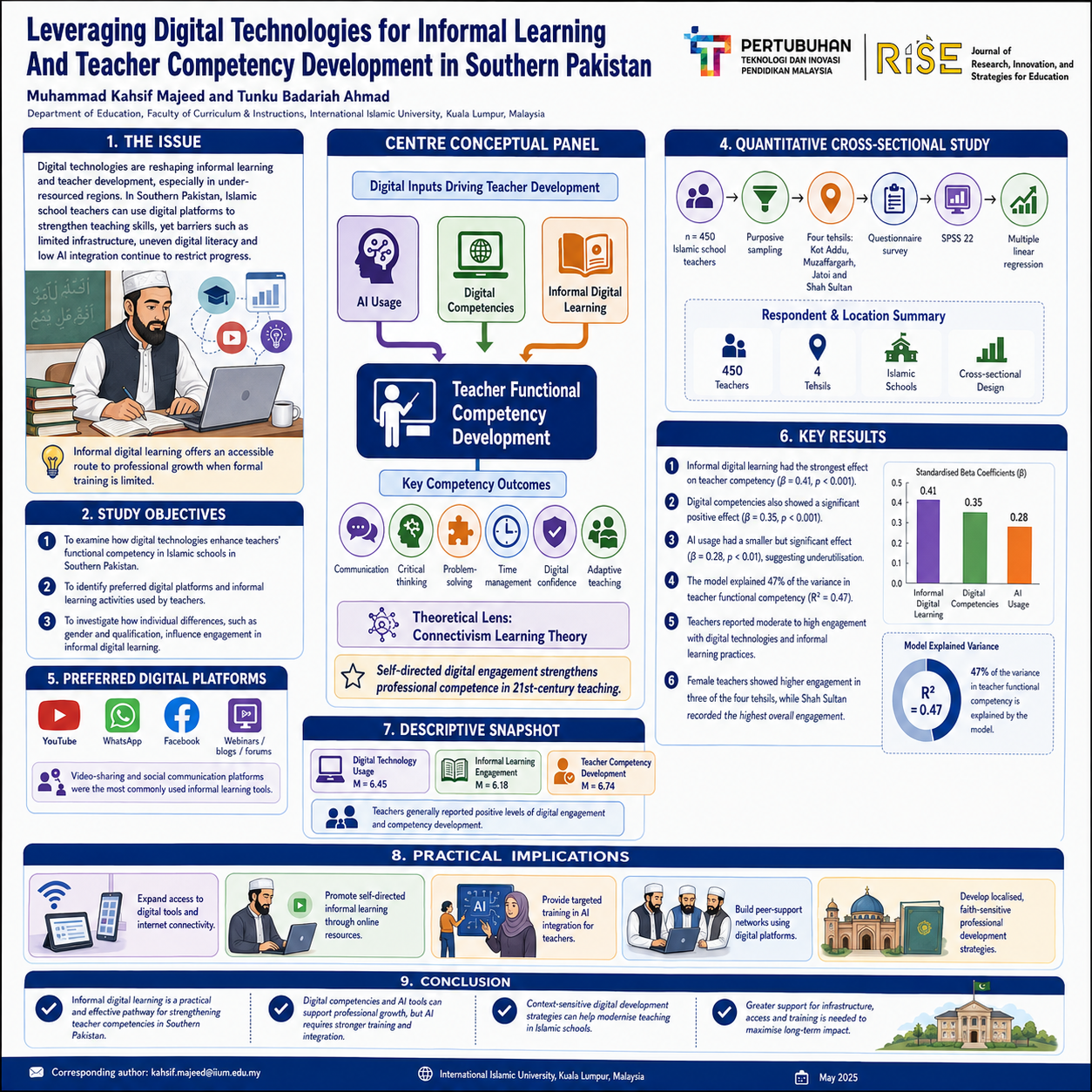
This The rapid integration of digital technologies in education has transformed informal learning and teacher competency development, particularly in regions like Southern Pakistan, where access to resources is often limited. Leveraging digital platforms enhances English language acquisition and teachers’ functional skills, fostering 21st-century learning environments. Despite the growing use of Information and Communication Technologies (ICT) in education, limited research explores the combined impact of AI usage, digital competencies, and informal digital learning on teachers’ functional skills in Islamic schools in Southern Pakistan, particularly within informal learning contexts. This has important implications for improving instructional quality not only general education setting. This study aims to investigate the role of digital technologies in enhancing teachers’ functional competency, identify preferred digital platforms and activities for informal learning, and examine the influence of individual differences on engagement in informal digital learning among Islamic school teachers in Southern Pakistan. The findings may also inform the digital training need modernizing education delivery. Adopting a quantitative cross-sectional survey design, data were collected from 450 Islamic school teachers using purposive sampling based on established inclusion criteria. Data were analyzed using SPSS 22, with multiple linear regression assessing the influence of AI usage, digital competencies, and informal digital learning on teachers’ functional skills. Results revealed that informal digital learning had the strongest effect (β = 0.41, p < 0.001), followed by digital competencies (β = 0.35, p < 0.001) and AI usage (β = 0.28, p < 0.01), explaining 47% of the variance (R² = 0.47). AI’s smaller effect size suggests its underutilization in teaching practices. These findings highlight the need for enhanced teacher training in AI integration and digital competencies to maximize informal learning benefits, which can extend to professional development program in education as well, promoting competent Islamic teachers in Southern Pakistan.
References
Azzolini, D., et al. (2022). The impact of socioeconomic status on English competence. Journal of Educational Research.
Czerkawski, B. (2017). Use of formal and informal learning networks by students. EDULEARN21 Conference Proceedings.
Dolcy, R., & Livingstone, S. (2019). Digital abilities and informal learning. Journal of Educational Technology.
Elaish, M. M., et al. (2017). Mobile-assisted language learning and learner engagement. Computers & Education.
Lee, J. S. (2019). Informal digital learning of English and its impact on language skills. Language Learning & Technology.
Lee, J. S., & Dressman, M. (2018). Informal digital learning of English: A review. Language Learning & Technology.
Masrai, A., & Milton, J. (2018). The role of informal learning in vocabulary acquisition. Language Learning.
Ministry of Education Malaysia. (2014). Teacher competency modules. Malaysian Education Development Plan.
Siraj, S., & Ibrahim, N. (2012). Characteristics of teachers’ functional competency. Malaysian Online Journal of Educational Management.
Tan, E. (2021). YouTube Kids as an informal learning tool for children. Academic Journal of Interdisciplinary Studies.
Yang, J., & Quadir, B. (2018). Individual differences in technology adoption for learning. Educational Technology Research and Development.
Azzolini, D., et al. (2022). The impact of socioeconomic status on English competence. Journal of Educational Research.
Cohen, J., McCabe, E. M., Michelli, N. M., & Pickeral, T. (2009). School climate: Research, policy, practice, and teacher education. Teachers College Record.
Dolcy, R., & Livingstone, S. (2019). Digital abilities and informal learning. Journal of Educational Technology.
Elaish, M. M., et al. (2017). Mobile-assisted language learning and learner engagement. Computers & Education.
Lee, J. S. (2019). Informal digital learning of English and its impact on language skills. Language Learning & Technology.
Lee, J. S., & Dressman, M. (2018). Informal digital learning of English: A review. Language Learning & Technology.
Masrai, A., & Milton, J. (2018). The role of informal learning in vocabulary acquisition. Language Learning.
Ministry of Education Malaysia. (2014). Teacher competency modules. Malaysian Education Development Plan.
Omar, S. N., Ismail, S. N., & Kasim, A. (2019). Technology in improving pedagogical quality. Malaysian Online Journal of Educational Management.
Şad, S. N., et al. (2020). Comparing CALL and MALL in informal learning. Language Learning & Technology.
Schugurensky, D. (2000). The forms of informal learning. Academic Journal of Interdisciplinary Studies.
Siraj, S., & Ibrahim, N. (2012). Characteristics of teachers’ functional competency. Malaysian Online Journal of Educational Management.
Tan, E. (2021). YouTube Kids as an informal learning tool for children. Academic Journal of Interdisciplinary Studies.
Thapa, A., Cohen, J., Guffey, S., & Higgins-D’Alessandro, A. (2013). School climate and teacher effectiveness. Journal of School Psychology.
Yang, J., & Quadir, B. (2018). Individual differences in technology adoption for learning. Educational Technology Research and Development.
Cohen, J. (1988). Statistical power analysis for the behavioral sciences. Routledge.
Field, A. (2018). Discovering statistics using IBM SPSS statistics. Sage.
Lee, J. S., & Dressman, M. (2018). Informal digital learning of English: A review. Language Learning & Technology.
Siraj, S., & Ibrahim, N. (2012). Characteristics of teachers’ functional competency. Malaysian Online Journal of Educational Management.
Tan, E. (2021). YouTube Kids as an informal learning tool for children. Academic Journal of Interdisciplinary Studies.
Thapa, A., Cohen, J., Guffey, S., & Higgins-D’Alessandro, A. (2013). School climate and teacher effectiveness. Journal of School Psychology.
Widarjono, A. (2010). Applied statistics for social sciences. UPP STIM YKPN.
Azzolini, D., et al. (2022). The impact of socioeconomic status on English competence. Journal of Educational Research.
Cohen, J. (1988). Statistical power analysis for the behavioral sciences. Routledge.
Field, A. (2018). Discovering statistics using IBM SPSS statistics. Sage.
Lee, J. S. (2019). Informal digital learning of English and its impact on language skills. Language Learning & Technology.
Lee, J. S., & Dressman, M. (2018). Informal digital learning of English: Are view. Language Learning & Technology.
Ministry of Education Malaysia. (2014). Teacher competency modules. Malaysian Education Development Plan.
Siraj, S., & Ibrahim, N. (2012). Characteristics of teachers’ functional competency. Malaysian Online Journal of Educational Management.
Tan, E. (2021). YouTube Kids as an informal learning tool for children. Academic Journal of Interdisciplinary Studies.
Thapa, A., Cohen, J., Guffey, S., & Higgins-D’Alessandro, A. (2013). School climate and teacher effectiveness. Journal of School Psychology.
Widarjono, A. (2010). Applied statistics for social sciences. UPP STIM YKPN.
Downloads
Published
Issue
Section
License
Copyright (c) 2025 Muhammad Kahsif Majeed, Tunku Badariah Ahmad (Author)

This work is licensed under a Creative Commons Attribution 4.0 International License.