The Use of Artificial Intelligence (ChatGPT) in Islamic Education: An Analysis of Challenges, Opportunities, and Ethical Considerations Based on Maqasid Shariah
DOI:
https://doi.org/10.70148/rise.v2i3.3Keywords:
ChatGPT; Artificial Intelligence; Islamic Education; Digital Ethics; Maqasid Shariah.Abstract
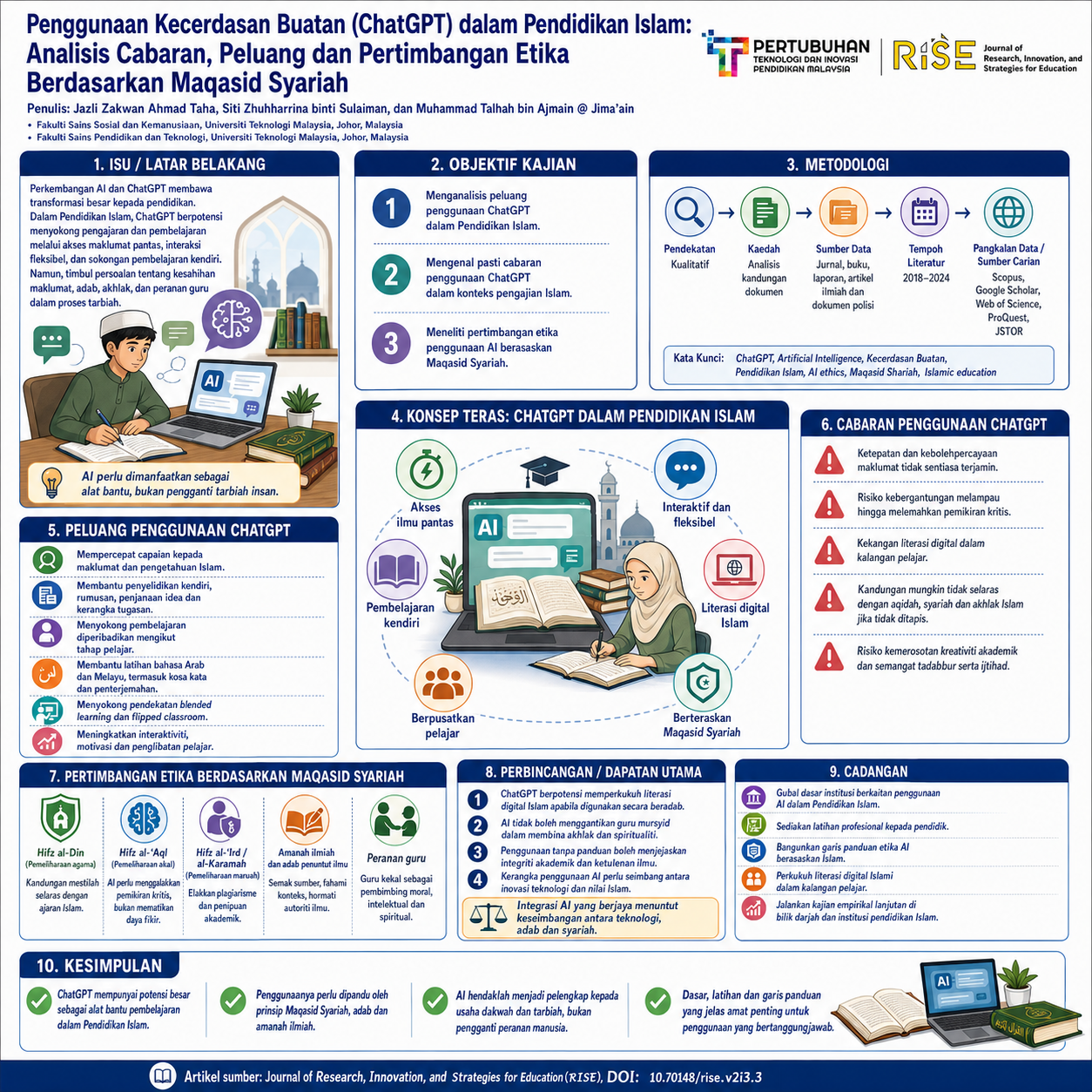
Rapid advancements in artificial intelligence (AI) have driven various innovations in education, including Islamic Education. ChatGPT, a generative language model developed by OpenAI, offers significant potential in supporting teaching and learning. This study examines the integration of ChatGPT in Islamic Education through an analysis of opportunities, challenges, and ethical considerations. In terms of opportunities, ChatGPT can accelerate access to knowledge, assist independent research, and support student-centered learning. The identified challenges include information accuracy, the risk of excessive dependence, and issues related to academic ethics violations. Ethical aspects are explored from a Shariah perspective, emphasizing the principles of Maqasid Shariah and the etiquette of knowledge seekers. This study employs a qualitative approach through document content analysis to identify key themes related to AI integration in Islamic Education. The findings highlight the need to formulate educational policies, provide professional training for educators, and develop AI usage guidelines grounded in Islamic values. Awareness of these opportunities and challenges is essential to ensure the responsible utilization of ChatGPT, thereby enhancing the delivery of religious knowledge and shaping Muslim students who are knowledgeable, well-mannered and ethical in line with the demands of the digital era.
References
Abū Masʿūd al Anṣārī. (n.d.). Man dallā ʿalā khayrin fa lahu mithlu ajri fāʿilihī (HR Muslim, no. 1893a). Dalam Ṣaḥīḥ Muslim. Sunnah.com. Dipetik daripada https://sunnah.com/muslim/1893a
Al-Attas, S. M. N. (1995). Prolegomena to the Metaphysics of Islam. ISTAC.
Al-Azawei, A., Parslow, P., & Lundqvist, K. (2022). Barriers to Adopting Educational Technologies in Islamic Learning Contexts. Computers & Education, 185, 104529.
Al-Fadhli, M. A., & Yahaya, M. F. (2022). Arabic Language Learning Using AI-based Tools: A Preliminary Review. Journal of Linguistic Studies, 14(2), 85–98.
Al-Ghazali. (2005). Ihya’ ‘Ulum al-Din. Beirut: Dar al-Kutub al-‘Ilmiyyah.
Alim, S., Yusuf, N., & Kamaruzzaman, A. (2022). AI and the Future of Islamic Learning: Potentials and Concerns. Journal of Islamic Educational Research, 6(1), 34–48.
Al-Kindi, M. (2023). Artificial Intelligence and Epistemology in Islamic Education. Journal of Islamic Pedagogy, 15(2), 87–102.
Al-Qaradawi, Y. (1994). Thaqafah al-Da’iyah. Kaherah: Maktabah Wahbah.
Al-Qaradawi, Y. (2018). Adabul ‘alim wal-muta’allim (terj.). Diva Press.
Bahrini, L., Qaffas, A. A., & Alashwal, H. (2023). ChatGPT in education: Opportunities and challenges. Education and Information Technologies, 28, 11789–11812. https://doi.org/10.1007/s10639-023-11635-3
Creswell, J. W., & Poth, C. N. (2018). Qualitative Inquiry and Research Design. Sage Publications.
Farihah, M. Z., Hassan, R., & Azman, A. (2024). Tanggungjawab ilmiah dalam penggunaan AI untuk tujuan dakwah Islamiah. Jurnal Dakwah dan Teknologi, 8(1), 45–58.
Hasan Langgulung. (1981). Pendidikan Islam dan Peranannya dalam Pendidikan Nasional di Malaysia. Kuala Lumpur: Pustaka Antara.
Hosni, A., Ariffin, M. F. M., & Ishak, H. (2023). Editorial Notes: Isu Dan Cabaran ChatGPT Terhadap Pengajian Islam. Al-Turath Journal of Al-Quran and AlSunnah, 8(1)
International Islamic University Malaysia (IIUM). (2023). Guidelines on the Use of Generative Artificial Intelligence (AI) in Academic Work
Isdayani, D., Mahfudz, A., & Fitriani, N. (2024). Artificial Intelligence in teacher professional development: Opportunities and challenges. Journal of Educational Technology Research, 8(1), 22–36.
Isdayani, D., Mahfudz, A., & Fitriani, N. (2024). Artificial Intelligence in Teacher Professional Development: Opportunities and Challenges. Journal of Educational Technology Research, 8(1), 22–36.
Kamali, M. H. (2008). Shari'ah Law: An Introduction. Oxford: Oneworld Publications.
Kementerian Pendidikan Malaysia. (2020). Pelan Tindakan Pendidikan Islam (PTEPI) 2020–2030. Bahagian Pendidikan Islam.
Khairuleffendi, M. N. (2024). Natural language processing and its implications in Malaysian education. Malaysian Journal of Educational Technology, 19(2), 54–70.
Khalil, M., & Er, E. (2023). Artificial intelligence and ChatGPT in education: A review of peer-reviewed publications and research trends. Smart Learning Environments, 10(14). https://doi.org/10.1186/s40561-023-00236-6
Khan, S., Nazir, A., & Tariq, H. (2023). Overreliance on AI Tools and the Decline of Student Cognitive Skills. Educational Technology & Society, 26(1), 12–25.
Khurana, P., Singhal, S., & Bansal, S. (2023). Applications of natural language processing in real-world scenarios: A review. International Journal of Artificial Intelligence Research, 17(1), 35–52.
Komalasari, N. (2024). Penggunaan ChatGPT Pada Mahasiswa Program Studi Pendidikan Agama Islam UIN Sunan Kalijaga Yogyakarta Angkatan 2020/2021 (Doctoral dissertation, UIN SUNAN KALIJAGA YOGYAKARTA).
Komarudin, A., Santosa, H., & Wulandari, T. (2024). Learning Analytics in AI-Based Education: A Case Study in Indonesian Secondary Schools. International Journal of Emerging Technologies in Learning, 19(2), 55–68.
Majma‘ al-Fiqh al-Islami. (2019). Qararat wa Tawsiyat, sidang ke-23, Al-Madinah al-Munawwarah.
Muslim Scholars Council. (2023). Fatwa Guidelines on Ethical Use of AI in Islamic Contexts. MSC Press.
Nasr, S. H. (2006). Islamic Science: An Illustrated Study. World Wisdom.
Nasruddin, M. N., & Basri, N. A. (2021). Pembelajaran Abad Ke-21 dan Teknologi Pendidikan: Suatu Sorotan Teori Konstruktivisme. Jurnal Ilmu Pendidikan Islam, 3(2), 12–24.
Norazah, M. N., Halimah, B. Z., & Saedah, S. (2023). Flipped Learning in Islamic Education: An AI-Supported Approach. Malaysian Online Journal of Educational Technology, 11(1), 11–21.
Oktavian, R., Lestari, S., & Nugraha, A. (2024). Personalized Learning through AI: Enhancing Student Engagement in Digital Classrooms. Educational Innovation and Practice Journal, 7(1), 13–28.
Rahman, M. R. A., Jamaludin, N. S., & Hamat, A. (2024). Penulisan Akademik Mahasiswa dan Kecerdasan Buatan: Analisis Peranan ChatGPT. Jurnal Penyelidikan Pendidikan Islam, 9(1), 51–66.
Rich, E., & Knight, K. (1991). Artificial Intelligence (2nd ed.). McGraw-Hill.
Ridzuan, A. R., Jamri, M. H., Mohd Zain, Z., Khairuddin, K., Ibrahim, N. A. N., Abdul Rani, N. S., & Ab Hadi, S. N. I. (2024). The usage of ChatGPT as an alternative way of learning. e-Journal of Media and Society (e-JOMS), 7(2), 95–10. Retrieved from https://ejoms.usim.edu.my/index.php/ejoms/article/view/xxx
Sani, R. A., Zulkifli, A., & Ibrahim, M. (2023). Integrasi AI dalam Pendidikan Islam: Analisis Peluang dan Cabaran. Jurnal Pendidikan dan Teknologi Islam, 5(2), 37–49.
Wan Mohd Nor Wan Daud. (2010). Falsafah dan Praktik Pendidikan Islam Syed Muhammad Naquib al-Attas. ISTAC.
Widodo, A., Rahmawati, N., & Syahputra, A. (2024). Bridging the Digital Divide in AI-Enhanced Education: Equity, Access and Infrastructure. Journal of Education and Learning Studies, 9(2), 71–88.
Yusoff, M. A., Harun, H., & Baharudin, N. (2023). Gamifikasi dan AI dalam Pendidikan Islam: Satu Sorotan Konseptual. Malaysian Journal of Islamic Education, 11(2), 56–69
Yusoff, N. M., & Hashim, R. (2021). Kemahiran Berfikir Aras Tinggi dalam Pendidikan Islam: Peranan Teknologi Digital. Jurnal Kurikulum & Pengajaran Asia Pasifik, 9(3), 72–83.
Zawawi, M. Z., Zulkifli, A. H., & Ramli, M. (2023). Penggunaan ChatGPT sebagai Alat Bantuan Pembelajaran dalam Pendidikan Islam: Kajian Awal. Jurnal Teknologi Pendidikan Malaysia, 7(1), 77–89.
Zulkifli, M. A. (2024). AI Dr Munir & AI Dr Munirah: Gabungan ilmu dan teknologi untuk umat. Dikeluarkan oleh Pejabat Mufti Wilayah Persekutuan. https://muftiwp.gov.my
Downloads
Published
Issue
Section
License
Copyright (c) 2025 Jazli Zakwan Ahmad Taha, Siti Zhuhharrina Binti Sulaiman, Muhammad Talhah Bin Ajmain@Jima'ain (Author)

This work is licensed under a Creative Commons Attribution 4.0 International License.