Perceptions of Differentiated Learning Approaches: A Dynamic Solution for Diverse Achievement Levels among PLaN Students in the Classroom
DOI:
https://doi.org/10.70148/rise.6Keywords:
Differentiated Learning; Student Achievement; PLaN students; Student Diversity; MathematicsAbstract
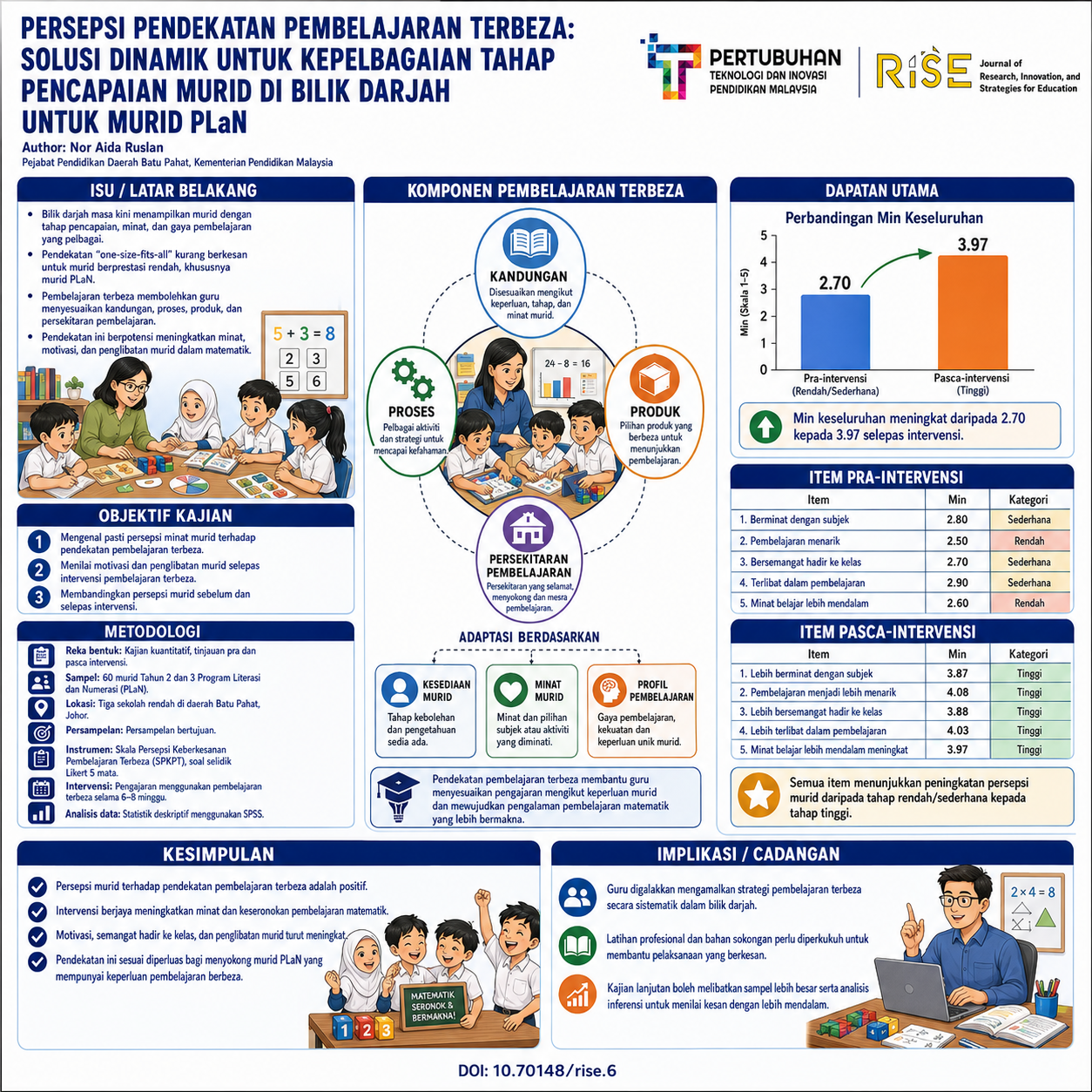
This study aims to evaluate the effectiveness of the Differentiated Pedagogy approach in improving mathematics proficiency among underachieving students in the Batu Pahat district, Johor. In this study, 60 second- and third-year students from the Linus and Numeracy Program (PLaN) in three schools were purposively selected based on their low performance in mathematics, making this sample ideal for assessing the effectiveness of adaptive teaching strategies. The main objective is to examine students' perceptions of interest and motivation towards the effectiveness of the differentiated learning approach in improving mathematics proficiency among PLaN (Program for Literacy and Numeracy) students. The study employs a quantitative approach with a survey research design. The instrument used is a specially designed questionnaire, which was validated through expert evaluation and tested for reliability before being implemented. This instrument uses a 5-point Likert scale to measure students' perceptions and responses to the Differentiated Pedagogy teaching approach. The study procedure includes the distribution of questionnaires to students, systematic data collection, and descriptive statistical analysis. The findings indicate that students' perceptions of the Differentiated Pedagogy approach are positive, with respondents reporting increased interest, motivation, and engagement in the learning process. In conclusion, this study demonstrates that perceptions of Differentiated Pedagogy suggest it is an effective teaching strategy, suitable for widespread implementation in schools to enhance mathematics proficiency among students with diverse backgrounds and learning needs. This study is also significant in highlighting the potential for educational transformation through more flexible and responsive teaching approaches.
References
Aysha, A. (2023). Differentiated instruction as a means of revitalising science classrooms. *International Journal of
Research Publication and Reviews*. https://doi.org/10.5334/ijrpr.v1i3.101
Bhat, S., D’Souza, R., Suresh, E., Bhat, S., Raju, R., & Bhat, V. S. (2021). Dynamic classroom strategies to address
learning diversity. *Journal of Engineering Education Transformations*.
https://doi.org/10.16920/jeet/2021/v34i3/157612
Chen, H., Chiu, M. M., & Wang, J. (2022). Differentiated instruction in inclusive classrooms: Effects on students'
academic achievement. Exceptional Children, 89(1), 50-67. DOI: 10.1177/00144029211051419
Conway-Turner, J., Williams, J. M., & Winsler, A. (2020). Does diversity matter? School racial composition and
academic achievement of students in a diverse sample. *Urban Education, 58*(8), 1085-1117.
https://doi.org/10.1177/0042085919884366
De Clercq, M., Galand, B., & Frenay, M. (2020). One goal, different pathways: Capturing diversity in processes
leading to first-year students' achievement. *Learning and Individual Differences, 81*, 101908.
https://doi.org/10.1016/j.lindif.2020.101908
Garcia, E., & Rivera, M. (2023). Differentiated instruction: Meeting the needs of all students. Education and Urban
Society, 55(2), 177-194. DOI: 10.1177/00131245211038750
Gheyssens, E., Coubergs, C., Griful-Freixenet, J., Engels, N., & Struyven, K. (2020). Differentiated instruction: The
diversity of teachers’ philosophy and praxis to adapt teaching to students’ interests, readiness, and
learning profiles. *International Journal of Inclusive Education, 26*, 1383-1400. https://doi.org/10.1080/13603116.2020.1765431
Hachfeld, A., & Lazarides, R. (2020). The relation between teacher self-reported individualization and student
-perceived teaching quality in linguistically heterogeneous classes: An exploratory study. *European
Journal of Psychology of Education, 36*(4), 1159-1179. https://doi.org/10.1007/s10212-020-00492-8
Hendel, R. J. (2022). A transdisciplinary approach to differentiated instruction. Journal of Systemics, Cybernetics and
Informatics. https://doi.org/10.1002/sce.10165
Hung, M., Smith, W. A., Voss, M., Franklin, J. D., & Gu, Y. (2020). Exploring student achievement gaps in school
districts across the United States. *Education and Urban Society, 52*(2), 175-193.
https://doi.org/10.1177/0013124519844565
King, R. B., & Frondozo, C. (2021). Variety is the spice of life: How emotional diversity is associated with better
student engagement and achievement. *The British Journal of Educational Psychology*, e12436.
https://doi.org/10.1111/bjep.12436
Kostadinov, A., & Kolev, K. (2020). Application of a differentiated instruction approach in computer systems
education. In *2020 XI National Conference with International Participation (ELECTRONICA)* (pp. 1-6).
IEEE. https://doi.org/10.1109/ELECTRONICA50406.2020.9302748
Lopez, N., & Inui, K. (2021). Implementing differentiated instruction to cater for diverse learners in EFL classrooms.
ELT Journal, 75(1), 23-34. DOI: 10.1093/elt/ccaa042
Maker, C. (2020). Identifying exceptional talent in science, technology, engineering, and mathematics: Increasing
diversity and assessing creative problem-solving. *Journal of Advanced Academics, 31*(2), 161-210.
https://doi.org/10.1177/1932202X20905498
Ouyang, J., & Ye, N. (2023). Differentiated instruction: Meeting the needs of all learners. *Curriculum and Teaching
Methodology*. https://doi.org/10.1016/j.ctm.2023.100567
Smith, J., & Ainsworth, M. (2021). Diverse minds: Strategies for differentiated learning. Journal of Educational
Psychology, 113(5), 900-911. DOI: 10.1037/edu0000642
Theobald, E., Hill, M. J., Tran, E., Agrawal, S., Arroyo, E., Behling, S., Chambwe, N., Laboy Cintrón, D., Cooper, J. D.,
Dunster, G. P., Grummer, J. A., Hennessey, K., Hsiao, J., Iranon, N. N., Jones, L., Jordt, H., Keller, M., Lacey,
M. E., Littlefield, C. E., Lowe, A., Newman, S., Okolo, V., Olroyd, S., Peecook, B., Pickett, S. B., Slager, D. L.,
Caviedes-Solis, I. W., & Stanchak, K. E. (2020). Active learning narrows achievement gaps for
underrepresented students in undergraduate science, technology, engineering, and math. *Proceedings
of the National Academy of Sciences of the United States of America, 117*(12), 6476-6483.
https://doi.org/10.1073/pnas.1916903117
Wan, S. W. Y., & Lee, J. C. K. (2020). Pedagogical practices for differentiated instruction: Case studies of eight high
-performing classroom teachers. Teaching and Teacher Education, 96, 103135. DOI:
1016/j.tate.2020.103135
Wisman, R. A. (2020). Operationalizing the intersection of racial and socioeconomic diversity in predicting school
-level academic achievement. *Education and Urban Society, 52*(6), 927-961.
Downloads
Published
Issue
Section
License
Copyright (c) 2024 Nor Aida Ruslan (Author)

This work is licensed under a Creative Commons Attribution 4.0 International License.