Environmental Ethics In Socio-Humanities Research: A Hybrid Systematic Literature Review and Bibliometric Analysis
DOI:
https://doi.org/10.70148/rise.v3i2.5Keywords:
Environmental ethics, Systematic Literature Review, Bibliometric analysis, VOSviewerAbstract
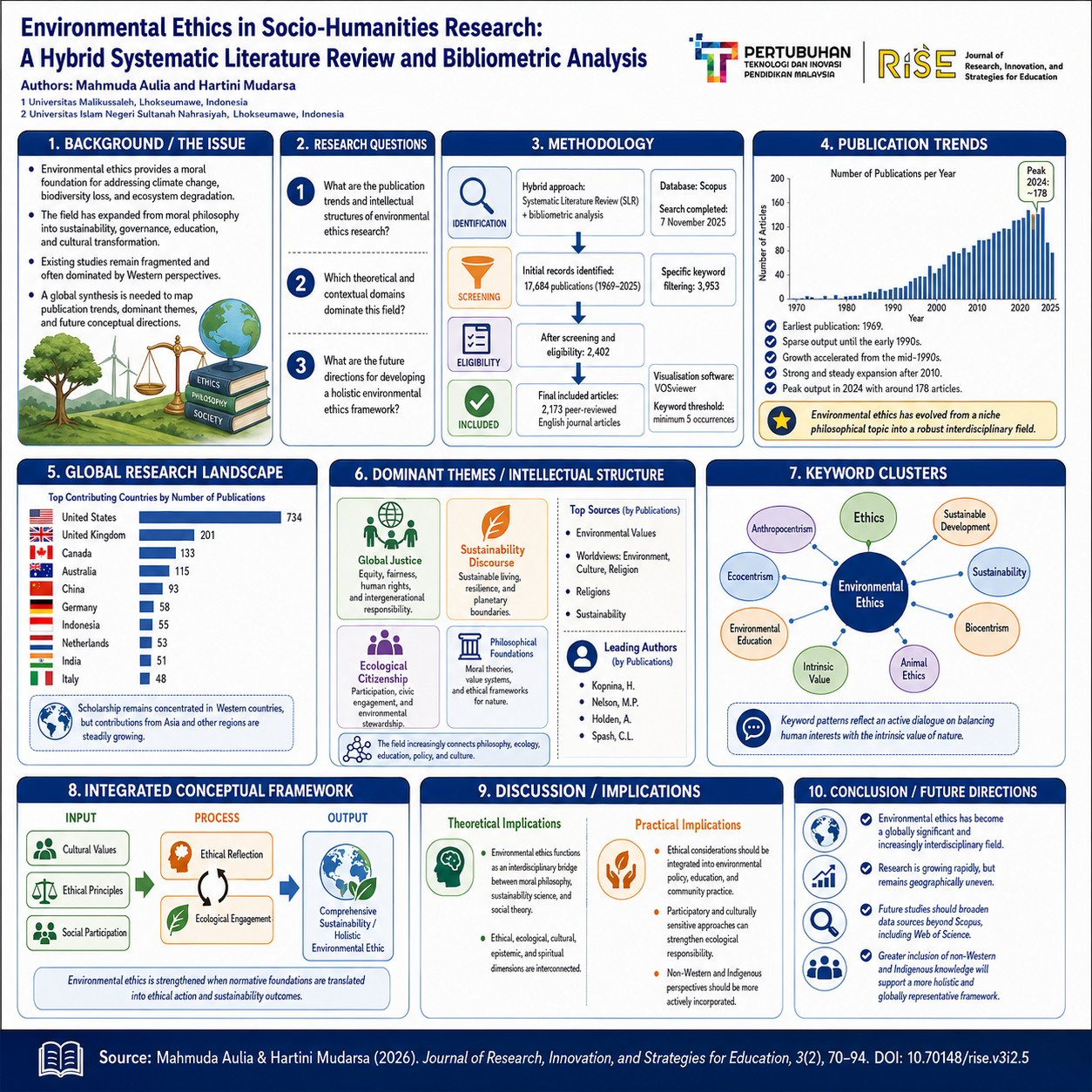
This research combines two approaches, namely Systematic Literature Review (SLR) and bibliometric analysis, to see examine research on environmental ethics throughout the world. Data is taken from basic data Scopus, who initially discovered 17,684 publications from year to year 1969 to 2025. After the screening and eligibility checking process ,2,173 articles were selected for analysis (completed on 7 November 2025). Data visualization is done using VOSviewer The results show that the topic of environmental ethics is increasingly attracting the attention of researchers in various countries, especially in the United States, United Kingdom, and Canada which is the most productive country in this field. Some of the main themes that emerged in these studies include global justice, sustainability discourse, ecological citizenship, and philosophical foundations of environmental ethics. Based on these findings, this study proposes an integrated conceptual framework that connects cultural values, ethical principles, and social participation (as input) with ethical reflection and ecological engagement (as a process) to achieve comprehensive sustainability (as output). Overall, this study provides a comprehensive overview of global patterns, theme clusters, and conceptual directions in environmental ethics studies. Researchers also suggest that future studies expand data sources, for example by adding basic data Web of Science, and involve areas that have been underrepresented so that research results are more inclusive and culturally diverse. The broader implication of this research is the importance of integrating environmental ethics into sustainability policies, education, and social practices in society, in order to improve ethical awareness and ecological responsibility.
References
Ashby, E. (1976). Towards an environmental ethic. Nature, 262(5564), 84–85. Scopus. https://doi.org/10.1038/262084a0
Boustani, N. M. (2025). Integrating Catholic Teachings into Education: Promoting Sustainable Practices Through Laudato Si’ in Lebanon. Religions, 16(3). Scopus. https://doi.org/10.3390/rel16030390
Campos, A. S., & Vaz, S. G. (2021). Justificatory moral pluralism: A novel form oenvironmental pragmatism. Environmental Values, 30(6), 737–758. Scopus. https://doi.org/10.3197/096327121X16141642287601
Davíd-Chavez, D. M., Gavin, M. C., Ortiz, N., Valdez, S., & Carroll, S. R. (2024). A values-centered relational science model: Supporting Indigenous rights and reconciliation in research. Ecology and Society, 29(2). Scopus. https://doi.org/10.5751/ES-14768-290211
Dobson, A. (2003). Citizenship and the Environment. In Citizsh. And the Environ. (p. 238). Oxford University Press; Scopus. https://doi.org/10.1093/0199258449.001.0001
Donthu, N., Kumar, S., Mukherjee, D., Pandey, N., & Lim, W. M. (2021). How to conduct a bibliometric analysis: An overview and guidelines. Journal of Business Research, 133, 285–296. Scopus. https://doi.org/10.1016/j.jbusres.2021.04.070
Ferraro, K. M., & Whitehead, T. (2025). Rewilding relationships: Principles for forging relationships in social-ecological systems. Ambio. Scopus. https://doi.org/10.1007/s13280-025-02238-1
Florit, L. F. (2019). From environmental conflicts to socio-environmental ethics: An approach from the traditional communities’ perspective. Desenvolvimento e Meio Ambiente, 52, 261–283. Scopus. https://doi.org/10.5380/DMA.V52I0.59663
Gardiner, S. M. (2011). A Perfect Moral Storm: The Ethical Tragedy of Climate Change. In A Perfect Moral Storm: The Eth. Tragedy of Climate Change (p. 512). Oxford University Press; Scopus. https://doi.org/10.1093/acprof:oso/9780195379440.001.0001
Giraud, E., Hollin, G., Potts, T., & Forsyth, I. (2018). A feminist menagerie. Feminist Review, 118(1), 61–79. Scopus. https://doi.org/10.1057/s41305-018-0103-1
Gurbanova, A. (2024). The Role of the Education System in the Formation of Environmental Responsibility of Youth. In Mammadov F.S., Mammadov F.S., Aliev R.A., Kacprzyk J., & Pedrycz W. (Eds.), Lect. Notes Networks Syst.: Vol. 1252 LNNS (pp. 493–497). Springer Science and Business Media Deutschland GmbH; Scopus. https://doi.org/10.1007/978-3-031-81564-5_58
Helli, A. (2024). Does the Qur͗ān Offer Foundational Principles for Environmental Ethics? Journal of Islamic Ethics, 6(2). Scopus. https://doi.org/10.1163/24685542-20240003
Humaida, N. (2019). The importance of ecocentrism to the level of environmental awareness for sustainable natural resources. In Widiatmaka null (Ed.), IOP Conf. Ser. Earth Environ. Sci. (Vol. 399, Issue 1). Institute of Physics Publishing; Scopus. https://doi.org/10.1088/1755-1315/399/1/012131
Imran, M. H. (2024). Religions and their philosophies. In Relig. Philos. And Environ. Ethics (pp. 64–132). Bentham Science Publishers; Scopus. https://doi.org/10.2174/9789815274820124010005
Ivleva, M. L., Ivlev, V. Y., & Kurilov, S. N. (2019). The development of the social paradigm of eco-centrism: A philosophical interpretation of the sociological research in university. RUDN Journal of Sociology, 19(4), 692–706. Scopus. https://doi.org/10.22363/2313-2272-2019-19-4-692-706
Khizar, H. M. U., Khurshid, R., & Al-Waqfi, M. (2024). Unraveling the two decades of Knowledge Hiding scholarship: A systematic review, bibliometric analysis, and literature synthesis. Journal of Innovation and Knowledge, 9(4). Scopus. https://doi.org/10.1016/j.jik.2024.100624
Kramer, E., Greenspan, I., & Yoreh, T. (2024). Sacred Soil, Green Ideals. Worldviews: Environment, Culture, Religion, 28(2), 95–124. Scopus. https://doi.org/10.1163/15685357-02802005
Lecaros Urzúa, J. A. (2013). Environmental ethics: Principles and values for a responsible citizenship in global society. Acta Bioethica, 19(2), 177–188. Scopus. https://doi.org/10.4067/s1726-569x2013000200002
Lou, X., Mei, D., & Li, L. M. W. (2025). Development and validation of a scale measuring intrinsic, relational, and instrumental environmental values. Journal of Environmental Psychology, 106. Scopus. https://doi.org/10.1016/j.jenvp.2025.102744
Martin, E., & Beatley, T. (1993). Our Relationship with the Earth: Environmental Ethics in Planning Education. Journal of Planning Education and Research, 12(2), 117–126. Scopus. https://doi.org/10.1177/0739456X9301200207
Rafiq, F. (2025). Environmental servant leadership and green innovation: The mediating role of corporate environmental ethics. Discover Sustainability, 6(1). Scopus. https://doi.org/10.1007/s43621-025-01338-y
Salisu Barau, A., Stringer, L. C., & Adamu, A. U. (2016). Environmental ethics and future oriented transformation to sustainability in Sub-Saharan Africa. Journal of Cleaner Production, 135, 1539–1547. Scopus. https://doi.org/10.1016/j.jclepro.2016.03.053
Singh, S. K., Chen, J., Giudice, M., & El-Kassar, A.-N. (2019). Environmental ethics, environmental performance, and competitive advantage: Role of environmental training. Technological Forecasting and Social Change, 146, 203–211. Scopus. https://doi.org/10.1016/j.techfore.2019.05.032
Stalhammar, S., & Thorén, H. (2019). Three perspectives on relational values of nature. Sustainability Science, 14(5), 1201–1212. Scopus. https://doi.org/10.1007/s11625-019-00718-4
Urzúa, J. A. L., & Gaete, G. L. (2018). Making environmental ethics more practical: A model of principlism. Ramon Llull Journal of Applied Ethics, 9(9), 95–116. Scopus.
van Mansvelt, J. D., Struik, P. C., Bos, A., Daub, W., Sprangers, D., van den Berg, M., Vingerhoets, M., & Zoeteman, K. (2021). Changing ground: Handling tensions between production ethics and environmental ethics of agricultural soils. Sustainability (Switzerland), 13(23). Scopus. https://doi.org/10.3390/su132313291
White Jr., L. (1967). The historical roots of our ecologic crisis. Science, 155(3767), 1203–1207. Scopus. https://doi.org/10.1126/science.155.3767.1203
Yu, X., Sun, Z., Sun, D., & He, R. (2025). Sustainable development assessment of household e-waste reverse supply chains from an environmental ethic perspective. Humanities and Social Sciences Communications, 12(1). Scopus. https://doi.org/10.1057/s41599-025-05012-6
Zheng, D., & Dai, E. (2012). Environmental ethics and regional sustainable development. Journal of Geographical Sciences, 22(1), 86–92. Scopus. https://doi.org/10.1007/s11442-012-0913-6
Downloads
Published
Issue
Section
License
Copyright (c) 2025 Mahmuda Aulia, Hartini Mudarsa (Author)

This work is licensed under a Creative Commons Attribution 4.0 International License.